• Hello ES! We could use some help to get us past the finish line on building the new knowledgebase for the forum.
    Can you donate? Please see our fundraising page. Thank you!

Motor Design: How to pass the 250W power standard?

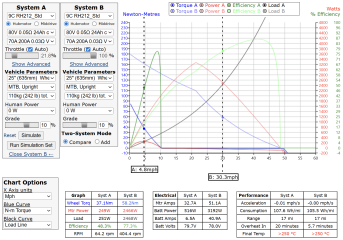
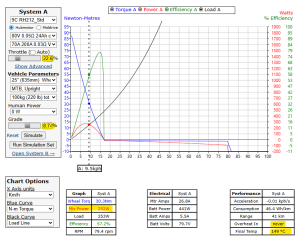
This is simple to simulate. Grin defines 150°C as overheat in the motor simulator. So I searched two operation points for the MAC 12T. One with full throttle, that gives >500W continuous power, one with half throttle, that gives quite exactly the mysterious 250W continuous power.
View attachment 383310
View attachment 383311


Did you try different loads/grades? I tried using the RH212, and with a 10% grade and 21.8% throttle (4.8 mph) it overheats in 20 minutes. At full throttle, it's using 2466W, but climbing at 30.3 mph. It overheats faster, but you could climb a couple of miles at that grade before you need to worry about it.

1768458933496.png
 
Did you try different loads/grades?
Yes, it took some iterations with different throttle and grade settings to find an operating point, that reaches 149°C with 250W motor power. But of course, with the throttle you are setting the voltage. @thepronghorn is right, if he says
The rated power must be at a specified voltage.
I guess, the specification in the test for EN 15194 only applies to battery voltage, not to the voltage, that the motor really gets from the controller by PWM.


1768463744235.png

I like this presentation from Maxon very much. It explains the basics very good:

1768468776482.png
 
Last edited:
A comment framing my understanding of some of the task. I'll repeat some other information I wrote earlier.

In Australia, the laws about ebikes specifically disallow meeting EN 15194 by external configuration. It can't be done by controller settings. The law here also disallows switches or other externally available settings or controls to change between meeting the standard and not meeting the standard.

The motor must pass the certification as a 'black box'.

But. I am aware of many instances in the ICE world where the same basic engine is 'de-tuned' to meet various conflicting requirements - such as robustness, or to meet emissions standards, or fuel economy standards. Re-use of the basic engine does not invalidate this.

I agree that a close reading of the laws is needed to ensure this idea can apply, but my reading to date does not contradict this.

If I start with a motor, and open it up and make changes so that it behaves differently, it does not matter if the original motor met the standard or not. (I think) what matters is that it's a 'permanent change' by replacing or adding parts which require disassembly and equivalent actions to reverse the changes. That I started with existing components won't matter. What matters is that I must take the motor apart (this will not be done by the side of the road) and change some components - such as substituting (or adding) a different circuit board to permanently change the motor's behaviour.
  • Disassembly beyond what might occur in ordinary use must happen.
  • The behaviours may not be introduced or removed without disassembling the motor (no external switches, plugs, configurations).
  • Once made and reassembled, the motor persists in the new behaviour inherently, As it is a different motor, it may benefit from a different supporting controller and configuration, but it's adherence to the certification is not due to the external configuration - rather it's inherent in the now re-manufactured motor.
I think this is true, based on my reading. What about a circuit board that monitors temperature over time, notes power over time, and causes the motor to behave to meet the specification using the original magnets and coils? I'm suggesting that this can be in the possible solutions, just as de-turning an ICE engine.

Think of an approach of re-manufacturing existing motors with whatever changes permit them to pass EN 15194 (which calls out the measurement approach of the EU motor spec, but itself specifies the measurement to meet). Think of a re-manufactured motor, specifically for the purpose of meeting the certification in all it's demands. Think of a kit which accomplishes this.
The only thing I can quickly think of is to change the winding from wye to delta but this might only make sense if you wanted to increase the rpm/volt of the motor or for some reason wanted to run the motor at a lower voltage or perhaps smaller wheel etc.
 
Below picture of my local postmans bike. An Post primarily uses the Radkutsche Musketier electric cargo bike, which features a front hub motor with approximately 70 Nm of torque. This high torque is essential for carrying heavy loads up to 300kg, as required for postal deliveries. 25Km/hr speed restricted. Its rated at 250W. There can be a lot of flexibility built into the European 250w thermal rating system which I think can have its advantages.

250Wpost bike.jpg
 
Bingo! A penny for the smart fellow.

Except (in my inquiry) the external controller can't solve the problem - that is specifically disallowed by the laws in Australia, where much of the rancor about ebikes concerns 'illegal' modifications to them.
Our laws are absolutely idiotic and made by people who dont fundamentally understand the technology they're regulating. We have no problem acknowleding that a motor controller and the motor are one system with one rated power output when it comes to cars, nobody is going to court to argue that a certain driver is liable in a crash because their ECU *could* be tuned to allow for higher power output (even if it's not), but for some reason the same logic doesnt apply to an electric motor controller.

Definitely a ploy by the big OEMs to limit DIYers, or to force controllers to come with DRM locked firmware that cant be changed.
 
Could there be regional differences in how the law is worded?
In germany it says "elektromotorischen Hilfsantrieb mit einer größten Nenndauerleistung von 0,25 kW"
Its the rated continous power of the whole drive system, not just the motor. Even though many people online only talk about the motors rating.

The norm i found that can be used for the drive system (UN-ECE 85 from 2014) states a 30 minute test at the manufacturer specified power (so not the an arbitrary higher number).
Also it allows the manufacturer to set the RPM for the test. The RPM just has to allow >90% of the motors maximum power, determined via a test that again allows the manufacturer to specify an RPM.
So according to this norm, if you specify a low enough RPM for both tests, any drive system can be rated 250W beacuse near 0 RPM you will get near 0 mechanical power, no matter how much power you are pumping into the motor.
(Except if you use sensorless, then maybe it cannot operate at low enough RPM)

So there is this UN ECE 85 for the power of the drive system but also the EN 60034-1 electrical machine Norm (apparently motor only) that lots of people mention, which in addition to setting an RPM allows the manufacturer to set a temperature limit.
There is also EN 15194 document which defines continuous rated power as "output power specified by manufacturer, at which the motor reaches its thermal equilibrium at given ambient conditions".
However the german law at least is not about the motor but the drive system.

The question is which Norm should be used?
 
Last edited:
The question is which Norm should be used?
There are thousands of opinions, but very little knowledge.


For me, the simplest and best definition can be found on the Bosch sites:

1781094161374.png
 
Back
Top