offGridDownUnder
Power poster
This is a technical question, and I'd prefer not to discuss other issues here. I don't want philosophy, I am asking about practical engineering approaches.
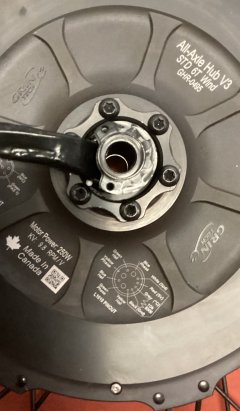
For now, presume a 500W-rated Direct Drive hub motor. What internal modifications would lead to this motor failing a 500W power restriction and passing a 250W power restriction test?
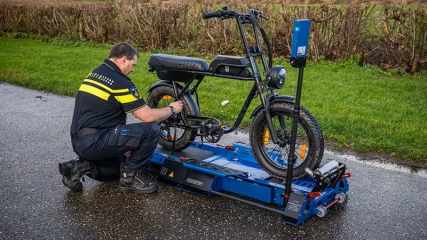
Where I live, in a legal case, the authorities may seize a bike they suspect is unlawful, and subject it to testing to determine the matter. I don't care how likely this is, I want to know technically what could be done to ensure a motor passes the 250W continuous power test. Regardless of the source parts, a motor that is permanently modified to meet the restriction is probably defensible in court - replacing internal components to (truthfully) meet the standard, rather then relying on external configuration (which is explicitly disallowed by local laws).
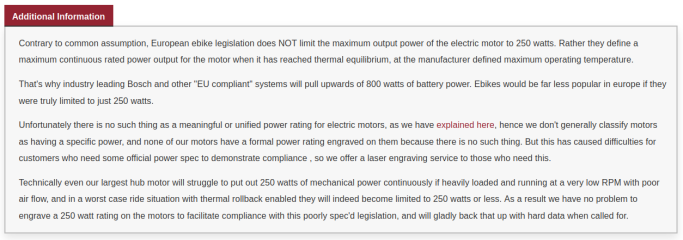
I know that a 250W rated motor may pass 1000W or more for short times and that this is not what the limit means. The limit means that the motor will not provide 1000W for more than a short time (or anything beyond 250W for a short time, but can provide 250W indefinitely).
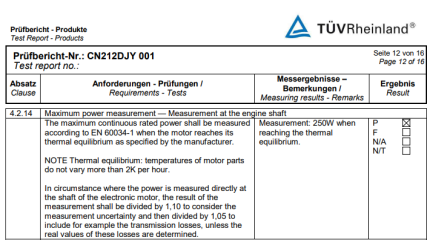
But I'm not knowledgeable about motor power electrics and that's what I want to ask about. I am looking for a copy of the EU15194 spec and other sources for how the measurement is actually done for certification, but I think the general question can be addressed based on the general physics of DD motors, so I want to start learning about options.
Moderator - please move this to the best forum to be visible to people who know about motor physics. Thanks.
For now, presume a 500W-rated Direct Drive hub motor. What internal modifications would lead to this motor failing a 500W power restriction and passing a 250W power restriction test?
Where I live, in a legal case, the authorities may seize a bike they suspect is unlawful, and subject it to testing to determine the matter. I don't care how likely this is, I want to know technically what could be done to ensure a motor passes the 250W continuous power test. Regardless of the source parts, a motor that is permanently modified to meet the restriction is probably defensible in court - replacing internal components to (truthfully) meet the standard, rather then relying on external configuration (which is explicitly disallowed by local laws).
I know that a 250W rated motor may pass 1000W or more for short times and that this is not what the limit means. The limit means that the motor will not provide 1000W for more than a short time (or anything beyond 250W for a short time, but can provide 250W indefinitely).
- Is rewinding the motor the only way?
- Is redesigning the casing to cause overheating the only way?
- Is adding an internal circuit board that monitors power and time adequate?
But I'm not knowledgeable about motor power electrics and that's what I want to ask about. I am looking for a copy of the EU15194 spec and other sources for how the measurement is actually done for certification, but I think the general question can be addressed based on the general physics of DD motors, so I want to start learning about options.
Moderator - please move this to the best forum to be visible to people who know about motor physics. Thanks.