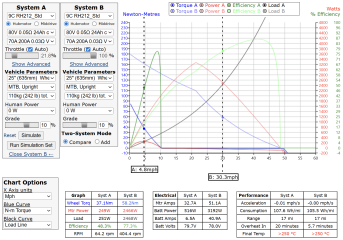
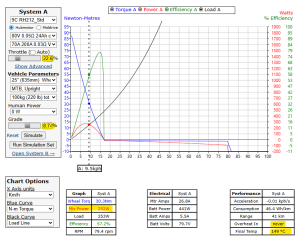
A comment framing my understanding of some of the task. I'll repeat some other information I wrote earlier.
In Australia, the laws about ebikes specifically disallow meeting EN 15194 by external configuration. It can't be done by controller settings. The law here also disallows switches or other externally available settings or controls to change between meeting the standard and not meeting the standard.
The motor must pass the certification as a 'black box'.
But. I am aware of many instances in the ICE world where the same basic engine is 'de-tuned' to meet various conflicting requirements - such as robustness, or to meet emissions standards, or fuel economy standards. Re-use of the basic engine does not invalidate this.
I agree that a close reading of the laws is needed to ensure this idea can apply, but my reading to date does not contradict this.
If I start with a motor, and open it up and make changes so that it behaves differently, it does not matter if the original motor met the standard or not. (I think) what matters is that it's a 'permanent change' by replacing or adding parts which require disassembly and equivalent actions to reverse the changes. That I started with existing components won't matter. What matters is that I must take the motor apart (this will not be done by the side of the road) and change some components - such as substituting (or adding) a different circuit board to permanently change the motor's behaviour.
- Disassembly beyond what might occur in ordinary use must happen.
- The behaviours may not be introduced or removed without disassembling the motor (no external switches, plugs, configurations).
- Once made and reassembled, the motor persists in the new behaviour inherently, As it is a different motor, it may benefit from a different supporting controller and configuration, but it's adherence to the certification is not due to the external configuration - rather it's inherent in the now re-manufactured motor.
I think this is true, based on my reading. What about a circuit board that monitors temperature over time, notes power over time, and causes the motor to behave to meet the specification using the original magnets and coils? I'm suggesting that this can be in the possible solutions, just as de-turning an ICE engine.
Think of an approach of re-manufacturing existing motors with whatever changes permit them to pass EN 15194 (which calls out the measurement approach of the EU motor spec, but itself specifies the measurement to meet). Think of a re-manufactured motor, specifically for the purpose of meeting the certification in all it's demands. Think of a kit which accomplishes this.