

-
Hello ES! We could use some help to get us past the finish line on building the new knowledgebase for the forum.
Can you donate? Please see our fundraising page. Thank you!
You are using an out of date browser. It may not display this or other websites correctly.
You should upgrade or use an alternative browser.
You should upgrade or use an alternative browser.
Motor Design: How to pass the 250W power standard?
- Thread starter offGridDownUnder
- Start date
Apartunis
Regular
Why should they??? The usual power of eBikes is much higher than 250W. The peak power is not limited at all. This 250W rated continous power is just a number on the paper.
It does remind me of French "statutory horsepower" under which for instance the Citroën 2CV was rated at 2HP but started at 9HP actual and finished its run with 29HP.
offGridDownUnder
Power poster
The only testing that counts is the criteria your government uses to test it. Nobody but they can tell you what that is.
What is your engineering background?
- Correct. That is part of what my thread is about.
- I did not ask you about your engineering background. I was not challenging your expertise. I asked you if you had knowledge of motor engineering as that is what this thread is about, and that would be a useful contribution. If you want to write about your personal opinions about tangential matters, please start a different thread.

There may be something to that. Why limit power when you can tax it? If the lawmakers could figure out that that’s a more reliable revenue stream, then the laws will change. 250w is the minimum lol.It does remind me of French "statutory horsepower" under which for instance the Citroën 2CV was rated at 2HP but started at 9HP actual and finished its run with 29HP.
offGridDownUnder
Power poster
Among other matters, I am going to pursue ebike advocacy in what is becoming a hostile environment (Australia). This means I am going to be exposed to attack, by some parties with deep pockets. As well, if some dumb car driver decides to involve me in a collision, their insurance company, which also has very deep pockets because they have a maniacal focus on not paying out on claims can force a test of the motor on my trike, or simply assert so in court and force me to try to pay for the certification test.I'm hoping to never have to test this out in Court.
For all I know, it's easy to modify a higher power rated motor to conform to the 250W rating. I'm looking into that topic.
There is no sensible reason for anyone to tell me i should not do this, or oppose me. Not on an ebike positive forum (??)
Apartunis
Regular
I think the kind of controller programming that I was proposing earlier (high torque motor limited to 250W at the maximum range of speeds) could also be used as a default preset for an outlaw bike in adverse enforcement environments. If the plod can't show that it ever makes more than 250W, they have to let it go even if you have a secret code to unlock more performance. And it provides a ready explanation for why such a big motor and battery on a 250W bike.
offGridDownUnder
Power poster
Bingo! A penny for the smart fellow.We know power output is proportional to torque x rpm. I have wondered how technically difficult it would be to map torque against rpm, and program a controller to deliver the full 250W output down to very low road speed, by modulating amps vs motor speed. By using this technique with a motor that is capable of high output torque, the power restrictions could be observed strictly, while allowing much better initial acceleration and steep climbing than a typical 250W machine.
Except (in my inquiry) the external controller can't solve the problem - that is specifically disallowed by the laws in Australia, where much of the rancor about ebikes concerns 'illegal' modifications to them.
Maybe up front, in your first post, you could just state only folks from New South Wales need reply.This is an inquiry into the technical possibilities of modifying a high power rated bicycle motor so that it passes the EN 15194 250W motor rating. If you need badly to talk about something else, please start your own thread about it, and others who want to talk about the same can join you there.
Why would they be sued? The mark 250W and that can be based on their own rating criteria, like it is for all motor companies. Are they an Australian based company? The crime would be knowingly purchasing a motor marked 250W, when the seller has made it publicly known what their position is on ratings, via the article I linked earlier. Grin has no liability.WHOA!
Grin did not put this label on my All-Axle motor! I did avail myself of the laser marking service, but that's in a different font in a different place, and people who are already suspicious of after-the-fact modification (which is a BIG part of the discussion about ebikes here in Australia), or people who see monetary benefit in being suspicious of after-the-fact modification (Insurance companies, possibly fossil-fuel industries if I make any headway with my advocacy) may use that as a point of attack (no, I don't care how likely this is - I want to solve the actual question, not stream my opinions out in public thoughtlessly).
If Grin themselves puts this on the motor labels, then they can be sued if the motor does not in fact pass the 250W test, although there is still the question of 'which test?' as they are Canada based. That adds the Canadian legal motor rating laws to the investigation.
Last edited:
offGridDownUnder
Power poster
No, it's not.This 250W rated continous power is just a number on the paper.
It is a repeatable value which can be demonstrated by an actual series of steps carried out in a lab and proven in Court. That there may be ways this procedure can be loose does not change this. It is possible not to meet the test in a lab.
offGridDownUnder
Power poster
Why would they be sued?
??
'Why?' - because someone decides to sue them. Anyone can do that, and the Court then will decide on the merits. The only way to find out the outcome is to bring the suit - so of course this is the reason someone might bring the suit.
Can they be held to account in Australia for breach of promise or false advertising or some other aspect? Australia has Consumer Protection laws which apply regardless of manufacturer claims, such as warranty for fitness and fraud for incorrect claims. Grin ships directly to Australia - that may be sufficient. It's worth investigating - it may resolve the question I am investigating in this thread. For the Australian market.
I do not know if that is sufficient to support an outcome, although anyone aggrieved can bring the suit here. But I also do not know that the suit - and other statutory Consumer Protections in Australian law - would fail. That this protection might be available in Australia due to Grin's claim is worth considering.
No, it's not.
It is a repeatable value which can be demonstrated by an actual series of steps carried out in a lab and proven in Court. That there may be ways this procedure can be loose does not change this. It is possible not to meet the test in a lab.
Its worth noting that certification costs are very expensive according to below. (e.g. $12k-25k just for EN15194 alone)
Why Cargo Bike So Expensive? Certification Costs Explained
I guess the government should sue Grin to make up for all the money they're investing/losing on all of this after the fact testing/monitoring. Sound like a terrible place for ebikers. I get why you're miserable.I do not know if that is sufficient to support an outcome, although anyone aggrieved can bring the suit here. But I also do not know that the suit - and other statutory Consumer Protections in Australian law - would fail. That this protection might be available in Australia due to Grin's claim is worth considering.
This is pretty interesting reading. So who is on the hook for the testing costs to meet the certifications? The importer, the exporter? Does each certification need to be labeled on each component? I guess it doesn't matter much, since it gets blended into the cost the consumer pays in the end.Its worth noting that certification costs are very expensive according to below. (e.g. $12k-25k just for EN15194 alone)
Why Cargo Bike So Expensive? Certification Costs Explained
Epithemeus
Established
Given the specifications shown in this thread with no mention of the load, rpm, how long it has to take to reach "thermal equilibrium", the temperature at said thermal equilibrium, what is the air flow etc. This test is not repeatable at all. Take any motor, don't let it spin, feed in 50 watts, it'll eventually reach a steady state temp and you can call it a 50 watt motor by that criteria. The absolute most important thing for engineering purposes is to find the exact specifications of the test. Without them you can't do anything. If these are not properly defined then that is an opening for a legal attack for any motor based on ambiguity of the law.It is a repeatable value which can be demonstrated by an actual series of steps carried out in a lab and proven in Court
Assuming they do have these quantities actually defined for the test though, the easiest way to modify a higher power motor to comply would be to decrease its ability to shed heat such that it reaches a given temperature sooner. Some sort of thermally insulating coating on the outside or inside of the motor could work. Wrapping foam around the outside of a hub motor could work. For mid drives same, but you can also potentially sever connections to heatsinks or remove fins. You essentially want to look at all the thermal improvement threads here and think "How can I do the opposite of this?"
Somehow increasing the air gap between the stator and rotor would both insulate and reduce efficiency thus leading to higher thermal load and decreased power capability. This would also change other motor params though.
You could also rewind the motor with higher resistance wire, lower quality copper purity or some other material entirely. This would also change more motor params though.
offGridDownUnder
Power poster
If by 'this test', you mean 'this thread', then yes, this thread does not define a repeatable test.Given the specifications shown in this thread with no mention of the load, rpm, how long it has to take to reach "thermal equilibrium", the temperature at said thermal equilibrium, what is the air flow etc. This test is not repeatable at all.
I wrote that the EN 15194 specification is repeatable.
On your suggestion of forcing overheat of the motor, I agree this could work. I don't know that this is the only way, and I would prefer other ideas.
offGridDownUnder
Power poster
It will matter when it is challenged. This might be by government authority, it might be from a party that says they are injured because of my reliance on the statement.I guess it doesn't matter much
Assuming they stay in business after being fined and sued, the cost of those legal settlements will just get baked into the new price, so I guess it doesn't matter much.It will matter when it is challenged. This might be by government authority, it might be from a party that says they are injured because of my reliance on the statement.
offGridDownUnder
Power poster
Well, no. This is a thread about passing the EN 15194 250W rating, which is adopted in New South Wales, and also in the rest of Australia, and in much of Europe, and perhaps other jurisdictions I don't know about. All of them may benefit from some of this.Maybe up front, in your first post, you could just state only folks from New South Wales need reply.
I am focused on NSW, as I'm here, although I might move within Australia.

stancecoke
Minor legend
The easiest way is to overheat the magnets once, to make them loose performance permanently. Then you need more current for the same torque and the motor will heat faster. But as long as you don't know the exact test procedure, this whole thread is completely senseless.For all I know, it's easy to modify a higher power rated motor to conform to the 250W rating. I'm looking into that topic.
Or you simply say you are the manufacturer and define the thermal equilibrium and choose a very low speed, where the motor produces much heat and little mechanical power. I guess, this is the way the OEM go also....

As far as I am aware "ALL" hub motors sold by Grin meet EN 15194 250W rating
The "option" to have any of their motors Laser Etched 250w Max is available in the "Accessory" section of all the motors they sell
at an additional cost of USD $15
" 1 x Laser Mark 250W on Motor + USD$15.00
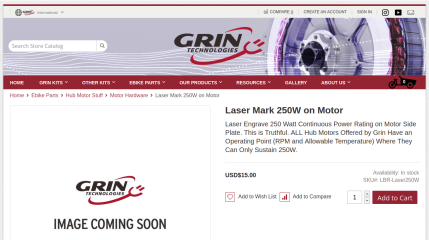
Laser Engrave 250 Watt Continuous Power Rating on Motor Side Plate. This is Truthful. ALL Hub Motors Offered by Grin Have an Operating Point (RPM and Allowable Temperature) Where They Can Only Sustain 250W. "

 ebikes.ca
The "option" to have any of their motors Laser Etched 250w Max is available in the "Accessory" section of all the motors they sell
at an additional cost of USD $15
" 1 x Laser Mark 250W on Motor + USD$15.00
Laser Engrave 250 Watt Continuous Power Rating on Motor Side Plate. This is Truthful. ALL Hub Motors Offered by Grin Have an Operating Point (RPM and Allowable Temperature) Where They Can Only Sustain 250W. "
Laser Mark 250W on Motor
Laser Engrave 250 Watt Continuous Power Rating on Motor Side Plate. This is Truthful. ALL Hub Motors Offered by Grin Have an Operating Point (RPM and Allowable Temperature) Where They Can Only Sustain 250W.
ebikes.ca
It takes a LOT longer than most people would realize for a hub motor to reach
steady state temperature equilibrium, upwards of 1-2 hours,
while usually the longest steep hill climbs that you actually encounter on the road are over in less than 5-10 minutes. The end result is that motors will have a much lower power rating than what people routinely subject them to, and this would be a misleadingly low number. For instance, the 45mm wide stator MXUS motors are often sold as 5000 watt hub motors. At 250 rpm the core will eventually reach 100oC with just 800 watts of output power.
Grins/Justin's "Power Rating" theory
Futility of Motor Power Ratings
"There's no such thing as a rated watt!" Read here for why we don't advertise a simple power rating for the motors we sell. Also, have a look at our Youtube video where Justin talks about the power to propel bicycles in <a href="https://www.youtube.com/watch?v=ALde6zhLPs0">"School of Watts"</a>.
 ebikes.ca
stancecoke
Minor legend
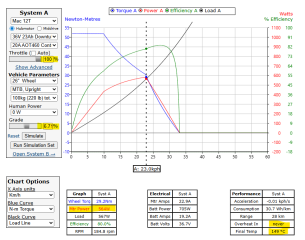
This is simple to simulate. Grin defines 150°C as overheat in the motor simulator. So I searched two operation points for the MAC 12T. One with full throttle, that gives >500W continuous power, one with half throttle, that gives quite exactly the mysterious 250W continuous power.ALL Hub Motors Offered by Grin Have an Operating Point (RPM and Allowable Temperature) Where They Can Only Sustain 250W.

Last edited:
This is pretty interesting reading. So who is on the hook for the testing costs to meet the certifications? The importer, the exporter? Does each certification need to be labeled on each component? I guess it doesn't matter much, since it gets blended into the cost the consumer pays in the end.
The author I think is suggesting that for someone to produce and sell a bike say in the US, they may need to budget an upfront cost of $60k–$150k for certification. More money again if they want to sell in Europe. No mention of Australia.
I presume this adds an extra cost and risk as they need to sell a certain quantity to cover the costs. You can possibly see here why legitimate e-bike producers can go bankrupt and why uncertified bikes can be so much cheaper..
Importers can I think import the bikes already approved/certified for example by local labs in the far east which I assume are only a fraction of the US cost of US or European labs.
AFAIK, the European EN15195 test is done on the complete finished bike and also includes the charger and instructions etc that come with the bike. Other individual tests (such as motor power, battery test and radio interference etc) are separate tests I think. Sample document below. The test lab is in Shenzhen.
Last edited:
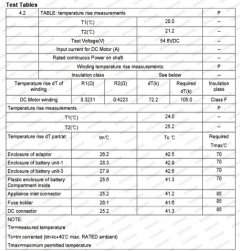
Some more clues about the EN60034 test I came across from a particular ebike test report. From what I can figure out, the motor winding is considered as Class F (155C max ?). As the ambient temperature max value is 40C, this would normally allow for a max temp rise of 155-40 =115 for air cooled windings. The cert shows this max value as dt = 105k. (the term 'Required TmaxC' is used which I think is misleading) The actual dt value for this actual test was 72.2 and the ambient temperature was 20 or 21.2, so it appears to me that the equilibrium temperature was about 94C for the test. The winding temperature increase was calculated by measuring the increase in the winding resistance .
Last edited:
offGridDownUnder
Power poster
A comment framing my understanding of some of the task. I'll repeat some other information I wrote earlier.
In Australia, the laws about ebikes specifically disallow meeting EN 15194 by external configuration. It can't be done by controller settings. The law here also disallows switches or other externally available settings or controls to change between meeting the standard and not meeting the standard.
The motor must pass the certification as a 'black box'.
But. I am aware of many instances in the ICE world where the same basic engine is 'de-tuned' to meet various conflicting requirements - such as robustness, or to meet emissions standards, or fuel economy standards. Re-use of the basic engine does not invalidate this.
I agree that a close reading of the laws is needed to ensure this idea can apply, but my reading to date does not contradict this.
If I start with a motor, and open it up and make changes so that it behaves differently, it does not matter if the original motor met the standard or not. (I think) what matters is that it's a 'permanent change' by replacing or adding parts which require disassembly and equivalent actions to reverse the changes. That I started with existing components won't matter. What matters is that I must take the motor apart (this will not be done by the side of the road) and change some components - such as substituting (or adding) a different circuit board to permanently change the motor's behaviour.
Think of an approach of re-manufacturing existing motors with whatever changes permit them to pass EN 15194 (which calls out the measurement approach of the EU motor spec, but itself specifies the measurement to meet). Think of a re-manufactured motor, specifically for the purpose of meeting the certification in all it's demands. Think of a kit which accomplishes this.
In Australia, the laws about ebikes specifically disallow meeting EN 15194 by external configuration. It can't be done by controller settings. The law here also disallows switches or other externally available settings or controls to change between meeting the standard and not meeting the standard.
The motor must pass the certification as a 'black box'.
But. I am aware of many instances in the ICE world where the same basic engine is 'de-tuned' to meet various conflicting requirements - such as robustness, or to meet emissions standards, or fuel economy standards. Re-use of the basic engine does not invalidate this.
I agree that a close reading of the laws is needed to ensure this idea can apply, but my reading to date does not contradict this.
If I start with a motor, and open it up and make changes so that it behaves differently, it does not matter if the original motor met the standard or not. (I think) what matters is that it's a 'permanent change' by replacing or adding parts which require disassembly and equivalent actions to reverse the changes. That I started with existing components won't matter. What matters is that I must take the motor apart (this will not be done by the side of the road) and change some components - such as substituting (or adding) a different circuit board to permanently change the motor's behaviour.
- Disassembly beyond what might occur in ordinary use must happen.
- The behaviours may not be introduced or removed without disassembling the motor (no external switches, plugs, configurations).
- Once made and reassembled, the motor persists in the new behaviour inherently, As it is a different motor, it may benefit from a different supporting controller and configuration, but it's adherence to the certification is not due to the external configuration - rather it's inherent in the now re-manufactured motor.
Think of an approach of re-manufacturing existing motors with whatever changes permit them to pass EN 15194 (which calls out the measurement approach of the EU motor spec, but itself specifies the measurement to meet). Think of a re-manufactured motor, specifically for the purpose of meeting the certification in all it's demands. Think of a kit which accomplishes this.
thepronghorn
Regular
The rated power must be at a specified voltage. The easiest way to turn a 500W motor into a 250W motor would be to halve its voltage rating. Assuming it can still make the same torque it made at its original voltage, its new speed will be halved which will give you half the power output. Obviously this won't work for all motors, but it should be pretty accurate for bicycle hub motors.
Similar threads
- Replies
- 0
- Views
- 649
- Replies
- 1
- Views
- 763
- Replies
- 8
- Views
- 2,816


