• Hello ES! We could use some help to get us past the finish line on building the new knowledgebase for the forum.
    Can you donate? Please see our fundraising page. Thank you!

Pedal generator from a friction drive?

yabert

Regular
Joined
Apr 23, 2016
Messages
252
I want to build a pedal generator (100-500W) to charge a 16S LFP battery.
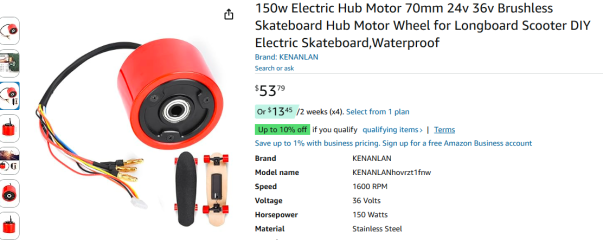
I thought about using a Skateboard Hub Motor Wheel in direct contact with a bike wheel (friction drive) to have proper rpm.
Skate hub motor are really affordable and should offer proper friction in contact with a bike tire.
End voltage can be too low, so I plan to use a boost MPPT to charge at 50+V.
If all this kind of work, the last component I need is a controller to set the regen power.
I need advices to select proper BLDC controller for this pedal generator.
Thanks
1764726886527.png
 
I want to build a pedal generator (100-500W) to charge a 16S LFP battery.
I thought about using a Skateboard Hub Motor Wheel in direct contact with a bike wheel (friction drive) to have proper rpm.
Skate hub motor are really affordable and should offer proper friction in contact with a bike tire.
End voltage can be too low, so I plan to use a boost MPPT to charge at 50+V.
If all this kind of work, the last component I need is a controller to set the regen power.
I need advices to select proper BLDC controller for this pedal generator.
Thanks

I'd use a cheap VESC controller, rated for 48v nominal or higher(60v), use a potentiometer to set regen power into the battery, no need for an intermediary boost MPPT.

The downsides to friction drive like you are suggesting, are significant losses, and high wear on tires.

You can find 8-10mm shaft, RC/e-skate out runner motors for cheap.

Is this going on an existing bicycle, or bicycle stand?

If you are building a dedicated pedal power stand, you have an easy availability of #25, or #35 chain/sprockets.
 
If you are building a dedicated pedal power stand
Yes, I plan a dedicated pedal power stand.
Do you mean it's way more efficient to use a chain as ratio instead of friction drive (small hub motor wheel on a bike tire)?
 
I'd use a cheap VESC controller, rated for 48v nominal or higher(60v), use a potentiometer to set regen power into the battery, no need for an intermediary boost MPPT.
With a bit more search I realize that imply typical 24-36V skateboard motor to spin way to fast to give the desired 54-58V. No?

It look like those tiny motor are around 150-200kV who imply over 8000 rpm to give 54V, right?
 
Yes, I plan a dedicated pedal power stand.
Do you mean it's way more efficient to use a chain as ratio instead of friction drive (small hub motor wheel on a bike tire)?
Yes, definitely.

It look like those tiny motor are around 150-200kV who imply over 8000 rpm to give 54V, right?
No, the controller will boost the voltage high enough to push whatever current you command/that you legs can push(within limits, of course)

A FOC controller is basically a PWM modulated DC->AC buck converter/inverter.

When doing regen, it effectively acts as a AC->DC boost converter, using the motor coils as the inductors.

You may have to play a bit with finding a good gear ratio/motor kV.

I can tell you that variable regen works very well on my cargo bike, Cyclone3kW left hand drive, 26" wheels, Flipsky 75100 pro controller, 48v nom(13s LiIon) geared for ~24mph at WOT.

I can skid the tire on gravel roads down to about 8mph, and have good braking all the way down to stall speed, I almost don't use the mechanical brakes any more.
 
Last edited:
Is it make sense to go with a bike hub motor directly instead of a small skateboard out runner motor?
From my understanding, skateboard motor need to spin 1000-2000 rpm to reach decent power, so that imply lot of gearing from 100 rpm legs.
 
A bike hub motor would be easy to set up and be reasonably efficient. I have seen a few people do it. You can use a standard bike chain. Unless you have legs like Lance Armstrong on steroids, a small 250w motor will be able to handle all you can put out.
A direct drive will have lower losses than a geared hub. You may need to swap the chain ring around to the other side if the hub has a freewheel sprocket.
 
Thanks for your input fechter.

I just realize something I've seen in a video few days ago: If I start with a PM DC motor, I don't need motor controller and simply need a DC-DC.... aka MPPT.
I have a Victron 100/20 laying around. I will look at that PM motor.
 
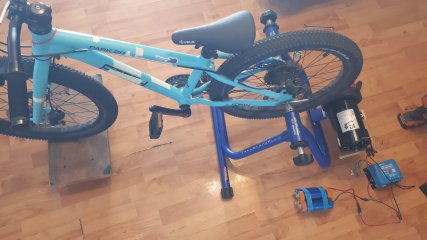
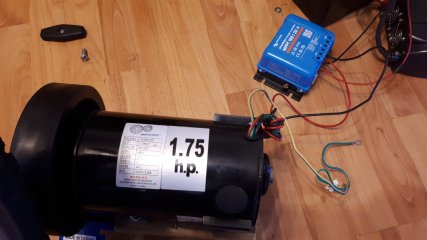
Some tests done with the MPPT 100/20 and a PM motor from a treadmill (find for 20$).
Motor spin way to slow. I'm only able to charge a 12V battery as the MPPT input voltage need to be 5V over battery voltage to start charging.
With a 20'' wheel (kid bike) it reach 50-100W, but it's hard to have enough voltage to simply allow the MPPT to start the charge.
It's barely enough with 26'' wheel. It kind of work, but I'm limited to a bit over 250W caused of the 20A limit (12.8V x 20A).
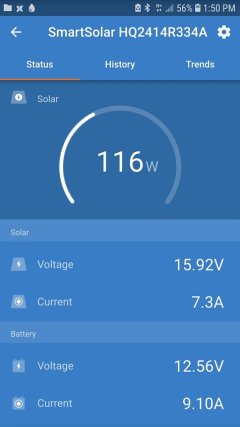
It's nice to have the Victron app reporting input/output voltage, amps and power, but a motor controller should work way better than the MPPT solution.

Anyway the goal is to charge 48V, so I have to add gearing allowing rpm to be 4-5 times higher or find another motor + controller set up.

20251206_105440.jpg
20251206_134923.jpg
Screenshot_20251206-135019.jpg
 
Honestly, you should be impressed with your results so far. This is not a bad output at all, considering you're just throwing parts together. Also, consider that an average person's power output while pedaling is somewhere in the range of 100-200w continuous, 200-250w burst. How long were you pedaling, how hard? What's your goal: a place to put in an hour of strenuous exercise that also charges your 16s system? Or a chill sitting spot where you can leisurely pedal while watching TV for an hour? Keep in mind that the human body can only output so much power, you can't charge a battery with 400w if your body can only output 200w, you know?

Also. You have efficiency losses from the chain drive between the cranks and the wheel. Efficiency losses from the friction drive between the wheel and the treadmill motor. And finally, a little bit of efficiency loss from the charge controller to the battery (victron is a good brand, but they'll top out at about 90-95% efficiency). All that, and you're still able to get 116w into the battery? That's pretty darn great.
 
Also, consider that an average person's power output while pedaling is somewhere in the range of 100-200w continuous, 200-250w burst.
Yeah! I know a thing or two about how much power I can output because we have the chance to have a cargo bike with a Bosch mid drive. This one with torque sensing and rpm can show us output Watts.
I can average 100-150W for minutes and up to 800W for 2-3 seconds ;)
Clearly, a 150W on our cargo bike seem way more easier to do compare to that 150W on this pedal generator set-up.

Results are not bad for sure considering treadmill motor/no motor controller.
Our goal is to charge 16S battery without the need of DC-DC.
 
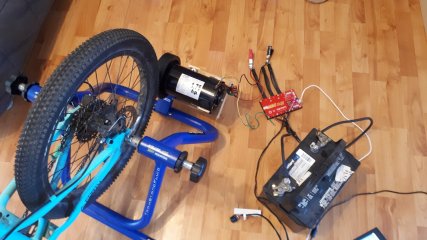
I tried with a VESC 75/300 controller I had for another project.
It still kind of work as I'm able to output around 250W by throttled the motor in the opposite direction of the bike wheel, but the feeling is bad.
It's not real regen as the motor continuously try do spin in the oppisite direction based on max current available.
That give it's impossible to maintain proper rpm as crank position determine how much torque we can put to the motor.

Instead I would like to have peak motor torque (based on Amps setting) when crank is in ideal position and lower motor torque when crank is perpendicular to ground... in other world, real regen.

I'm sure I can set the VESC to obtain this, but I don't know how.

Also, VESC display only show motor Amps and not battery Watts. It's annoying to have to calculate VxA to know W while VESC can do this.
Advice? Input?

20251208_124338.jpg
 
Somewhere I saw somebody that built something similar. They removed the tire and tube and found a long timing belt that just sits on the rim. The generator had a pulley to match the belt. This is pretty low loss and has a higher gear ratio.
 
a long timing belt
Sure this will resolve my RPM problem and probably remove a bit inefficiency (friction drive) from the equation.
But it will remove a nice feature: any bike of the family can be install on this generator :confused:
 
So, I connected the Victron Shunt to the generator battery side and I'm now able to see power, V and Amps on the app.

That bring me to understand that I don't understand how to imply regen on the VESC controller 😲 :unsure:
Is there something to set somewhere in VESC tool to have proper regen adjustment via potentiometer?
 
...the MPPT input voltage need to be 5V over battery voltage to start charging...

Well then your MPPT is NOT a MPPT!?
The whole idea behind them is to take any old/low voltage and turn it into pulses of power at the correct voltage for charging the battery.
That's what they do for Solar in low sun.

ie: You should be free to pedal at any rate/cadence of your choosing and still charge the battery.
More pulses when pedaling hard and less when just dawdling along.


For the roller on tire thing:
3D Printing a mirror image of your tire tread, out of something durable, and gluing it onto the skateboard wheel should help a lot, IF you then greatly decrease the pressure with which its pressed to the tire.
 
Well then your MPPT is NOT a MPPT!?
The whole idea behind them is to take any old/low voltage and turn it into pulses of power at the correct voltage for charging the battery.
First thing I want to write: Sure, everyone know that Victron MPPT Smart 100/20 is not an MPPT 😆

That's what they do for Solar in low sun.
The difference between solar panel and the motor generator is:
Any amount of light on a panel will generate a lot of volts with a variable amount of amps depending of the light it received.
PM motor need to spin to generate volts. Low RPM=low V, higher RPM=higher V.
 
I'm sure I can set the VESC to obtain this, but I don't know how.
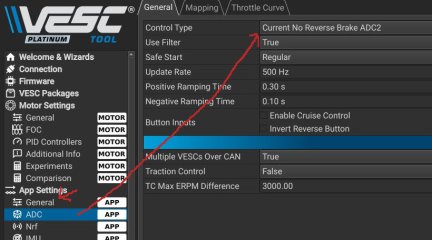
Hook up a potentiometer or hall throttle to ADC2 input on the controller, and set "Current No Reverse Brake ADC2" in the APP settings in Vesc-tool,
you will get a very nice variable proportional regen control;

app-adc.jpg
 
Motor spin way to slow. I'm only able to charge a 12V battery as the MPPT input voltage need to be 5V over battery voltage to start charging.
VESC controllers can run DC brushed motors using 2 of the 3 phase motor wires, have a look at my VESC boost charging guide to understand how you can use any AC/DC voltage source lower than the battery pack you are tying to charge;
 
Hook up a potentiometer or hall throttle to ADC2 input on the controller, and set "Current No Reverse Brake ADC2"
A huge tanks for your input A-Damw.
Especially as I discover your thread about Making bms's VESC compatible :D 😍

Sadly, this ADC2 pot with current no reverse don't give me interesting variable regen. In fact it don't give me any regen at all.
The only way I can have regen is to set throttle control type to current and start pedaling fast with throttle at 0 and that give me up to 200W. The regen power seem proportional to RPM.
 
First thing I want to write: Sure, everyone know that Victron MPPT Smart 100/20 is not an MPPT 😆


The difference between solar panel and the motor generator is:
Any amount of light on a panel will generate a lot of volts with a variable amount of amps depending of the light it received.
PM motor need to spin to generate volts. Low RPM=low V, higher RPM=higher V.
:)
NB the "?"

I'm here to learn...
Seems I was wrong in thinking that a MPPT took any old lower voltage and turned it into pulses at the optimal charging voltage of the battery, using 'charge caps in parallel - discharge in series' tech..?
So what does that? Some sort of special Boost converter - MPPT combo?
Called?? 'The Unobtainium Circuit'?? 🤷‍♂️ :)
 
Back
Top