
bgt
Established
Grumpy or not, thanx for the infoastmacca said:antihistamines and paracetamol are wunderful things wot!??

Grumpy or not, thanx for the infoastmacca said:

Road speed is irrelevant on the tested motor, so is it different to Kepler's motor or does Kepler's ignore speed as well?Kepler said:PAS cuts power as a function of road speed but dials down assist (limits current) as a function of crank speed. With the standard programming, the faster you pedal, the less assist you get. A feature I personally hate and have removed via programming. Lets hope my drive doesn't blow up now:lol:
Great to see the thinking behind the settings on Em3EV supplied motors but I think it is wrong in parts which leads me the the view the settings are sub optimal for most people.cell_man said:Hi Guys. Ok, this is what I have recently been telling people:
and this corresponds to other posts, particularly where they mention controller failure or hot motors. Without phase current limiting there is no way to guarantee a motor will not overheat. You rely on the operator keeping the motor at a reasonably high rpm or minimising voltage applied to the motor at low motor speeds. The best a seller can do to avoid overheating is to keep the Limitspd% low so that little current is applied at low cadences but for an operator who avoids low cadence for more than a few seconds this is bad because the motor will provide no power at normal cycling cadences. An operator that keeps pedaling cadence in normal ranges, above about 60 rpm, with the BBS01 will never overheat the motor but an operator that lets motor speed drop below this risks overheating the motor with a wide range of controller settings. This would go away with phase current limiting but the BS0X doesn't have that feature. The seller suffers potential warranty claims if the Limitspd% is set high but the operator suffers poor performance if the Limitspd% is set low. The current to the motor is also affected by "Keep Current(%)" and Current Decay (1-8)". Even with the settings applied by Paul I suspect you can overheat the motor by going up a steep hill at low enough cadence. It is what I suspect happened here:cell_man said:Did i mention the controller seems to have little or no phase current limiting, well it hasn't and the fets are cheap low level things that are easily blown. At least now, they have fitted 9 low quality fets to their 25A controller instead of 6 low quality fets, like the previous version 25A controller.
particularly as the controller failed twice.hie2kolob said:Just recently my second controller went belly up while riding along the Wasatch Mountain range... I used only the first two preset PAS levels(out of the nine PAS level setting) PAS1 and PAS 2 (current 52% and 56% respectively) with no throttle in the ride... The motor enclosure was noticeably hot.
I disagree. Assist level equates to power. Steady state power is controlled by the combination of Limit current(%), Keep Current(%) and Current Decay (1-8). Power is also a function of cadence with the relationship depending on the value of Keep Current(%) and is modified further when the cadence is varying. Limitspd% will only limit the maximum cadence at which the motor will supply the specified power. It will reduce the specified power to keep the cadence at the Limitspd% level. This is what you see in the graphs above.cell_man said:... Forget about assist level, IMO, that is not how it should be viewed. The PAS level should be used to set the pedal cadence.
I don't agree. I use the gears on the bike to keep nearly the same cadence on all but the steepest hills which makes any assist levels set with too low a Limitspd% useless and I increase the assist level when I can't keep up with the guy in front and reduce assist when I can.cell_man said:IMO, the BBS02 works best when the speed and current progressively increase from assist 1 through to 9 (as is done in the standard settings) and you use the PAS level to set your pedaling cadence and forget about it as assist or power level. Do not view it as an assist, it's not. If setting 5 is the right 1 for you, use setting 5, if you want to do more work, pedal faster and you will take the load away from the motor.
Yes that is true but the operator keeping the cadence above 60 rpm on the BBS01 will also avoid overheating due to over current without requiring controller settings that impede performance.cell_man said:The SW changes can only make the best use of the hardware, when combined with using the kit in an appropriate way. You can't change the hardware limitations of the controller by changing a couple of settings, but you can use the software to tweak things to disguise it's shorfalls and hopefully avoid it operating in ways that are likely to blow a fet due to overcurrent.
Yes, I can see that.cell_man said:The BBS02 controller are very easily damaged with a single bad setting, so for all these guys changing settings, they should be aware they are easily damaged if incorrectly configured and it’s not fair to expect a warranty replacement on controllers, after changes have been made, no matter if those settings seem quite reasonable or not.
Has anyone found that the speed sensor is used by the controller to vary power output on their motor?
I believe this setting is a carry over from hub motor settings as it makes perfect sense when you have no gears.
Road speed is irrelevant on the tested motor, so is it different to Kepler's motor or does Kepler's ignore speed as well?
An operator that keeps pedaling cadence in normal ranges, above about 60 rpm, with the BBS01 will never overheat the motor
no phase current protection
Just something that might be interesting to try, but you could move the PAS pickup and magnets or whatever
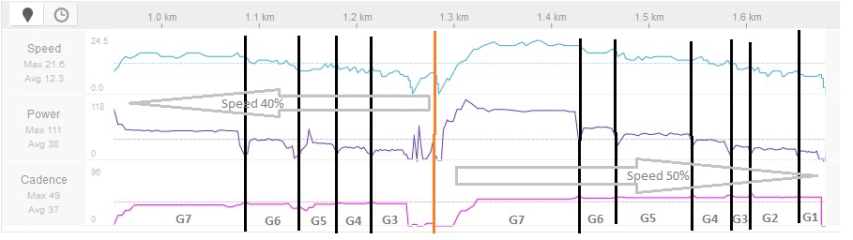
From the test data above you can see that in this case the controlled parameter is the cadence not the speed. In this test case the limiting speed of 40 km/h was set in the controller rather than from the display and Limitspd% was tested at 40% and 50%. The controlled parameter should be speed rather than cadence, is it for anyone else?astmacca said:Has anyone found that the speed sensor is used by the controller to vary power output on their motor?
The limiting speed (in km/hr) set from the display chops motor power when reached. It doesn't "vary" the power, just cuts it.
Yes but the test data shows it is not which is why I've asked here if it does for anyone else.astmacca said:Given the units, that information HAS to be coming from the speed sensor at the wheel rather than the motor controller since actual road speed is independent of cadence because of the gearing.
Yes.astmacca said:However, in a hub motor, for a given wheel size (which is a variable you can enter in this program), a sensor that measured the motor speed WOULD give you road speed wouldn't it??
Pjgold's explanation for the "Keep current(%)" parameter is not consistent with my test data. However, pjgold also says "Current set to 100% the assistance level does not change at all from what you select." which is close to, but not exactly what I see. I speculate that it is a PID controller http://en.wikipedia.org/wiki/PID_controller and that Keep current(%) is the proportional gain parameter. With a PID control algorithm, the higher you set the proportional gain the closer the controlled parameter, in this case current, tracks the set point value. If the proportional gain is set too high the controlled parameter becomes unstable and oscillates which I haven't seen in my testing. Therefore, if you are aiming to keep power constant as specified by the level setting 1-9 regardless of cadence, which is what I want, then setting Keep current(%) to 100 works best. Pjgold and Kepler both recommend a "Keep current(%)" setting of 100% and Paul from Em3ev recommends against 100%. I suspect that once "Keep current(%)" is at 100 then "Current Decay (1-8)" has no effect but I'm not sure of this or exactly what "Current Decay (1-8)" does. I suspect "Current Decay (1-8)" is the integral parameter in the PID algorithm and the proportional gain is high enough at 100% that adding an integral component does not produce an obvious effect but this is pretty speculative. "Current Decay (1-8)" definitely modifies the effect of "Keep current(%)" at values other than 100. Following the suggestion that it is a PID controller we are adjusting to its conclusion, I suspect "Slow-Start Mode(1-8) is the derivative parameter in the PID algorithm but this is untested.astmacca said:On page 22 pjgold opined that the Keep Current setting may be a hangover from hub motor operations (or at least thats what i think he means).
I believe this setting is a carry over from hub motor settings as it makes perfect sense when you have no gears.
That would be the way I would do it.astmacca said:Manufacturer may have just recycled a "standard" program they use to set up and flash their firmware on a number of products??
At high speed in low gear you might be exceeding the maximum rpm of the motor. Better to test at low speeds, perhaps 20km/h. Try your highest gear and lowest gear on flat ground and see if you always get the same speed. You need to pedal but try not to add any human power.astmacca said:Well, my first session of testing round and round the park today had me convinced the motor was controlled by road-speed. Was in a mid range gear where the speed limit % on the PAS setting happened to me very close to what i thought it should in km/hr as a % of the display set speed limit. Thought to be consistent i should do all the testing in the same gear so ration wasn't a variable.
Not until i purposely tested in an "extreme" config (set 50km/hr on the display and was in lowest possible gear) that it became glaringly obvious i was wrong and that the road speeds / PAS level were nothing like what they should have been in km/hr as a % of the display set speed limit and that the motor was not even trying to get there, that the penny dropped.
The controlled parameter is cadence. The gearing then defines the speed. See that the speed changes as the gear is changed but the cadence remains the same.astmacca said:Ken, you say you had the power set to 100% and speed to 40km/hr but on your plot it only gets to a max speed of 21.6km/hr?? How come? Is that all the BBS01 will do on your trainer set up or is there something else going on there??
kjetilhk said:An operator that keeps pedaling cadence in normal ranges, above about 60 rpm, with the BBS01 will never overheat the motor
Even if assist is set to 100% of "current limit"(15), which allows a 36V250W engine to provide 540w? In a long steep hill where I can not get above the road speed limit? And "Keep Current 100%"...
If not: how hard can I push a 250w engine in long steep hills, when I always pedal above 60 rpm? And "Keep Current 100%"
Yes that is right. You need a reasonably high cadence or phase current limiting to avoid overheating but most electric bikes do not have phase current limiting. What saves most people from disaster is that it feels unnatural to pedal at low cadences so they change to a lower gear. There is a more in depth discussion of this at http://endless-sphere.com/forums/viewtopic.php?f=2&t=55283&start=25#p913803.bgt said:Ken, what you are really saying here is, having a low cadence with a high gear can be crucial to the live of the motor. Especially in my country where you can have strong headwinds keeping your speed down.
This sounds like a bad motor controller design(=no phase current protection)...................................people who don't know about this design error and how to deal with it can easily destroy their motor............... :x
You should look elsewhere for a good explanation of phase current limiting. A simple explanation is that limiting current on the battery side of the controller does not in general limit current on the motor side of the controller. Current on the motor side is determined by (applied voltage less back EMF) divided by electrical resistance. Electrical resistance is constant and back EMF increases with motor speed. If the motor speed is too low back EMF is low and current can get too high. A motor has a maximum torque it can produce and current beyond that required to generate maximum torque generates only heat and does nothing useful.astmacca said:no phase current protection
Can someone explain to electrical terminology challenged me, what "phase current protection" is and its significance in this context??
It makes sense to me that if you are working a motor hard (uphill, headwinds) and it is forced to operate below its optimum revs (which all motors have i think?) then its going to struggle suck power and heat up. The positive about a mid drive over a hub as far as i can see is that you have gears to get it closer to that optimum and should use them where as with a hub you just wear that limitation.
Yes.dirkdiggler said:I still haven't fixed my speedometer, so I don't think the Bafang relies at all on the speed sensor. I believe it is a function of cadence.
Ah, that is useful advice. It never occurred to me speed might mean different things in different places.pjgold said:There are serval places in the software that you can set a speed limit and they behave differently.
I only tested Setting speed % on the basic tab and assumed the others behaved the same. That makes sense thanks.pjgold said:Setting a limit at the display unit cuts power at road speed set.
Setting speed % on the basic tab is motor rpm speed
Setting speed on the PAS tab is a road speed
And setting speed on throttle tab is road speed
I assume which ever cuts in first overrides the others
pjgold wrote:
Setting a limit at the display unit cuts power at road speed set.
Setting speed % on the basic tab is motor rpm speed
Setting speed on the PAS tab is a road speed
And setting speed on throttle tab is road speed
I assume which ever cuts in first overrides the others

Thanx, good to know. I had changed them back again to default on my 250W BBS-01. I am also convinced it has a bit of phase protection wisdom build into the micro controller. I have run a lot on full throttle control lately and the motor becomes a bit warmer when I do a "throttle only" ride, so no pedalling=no cadence. Difficult subject if you have no insight in controller setup? I wonder if the ready made bikes with a Bosch/Yamaha/MPF midmotor(which are sold by an enormous amount here) do have phase protection because they do torque assist i.o. PAS which means a heavy load at first start and I see people choosing a high gear so they get more assist. This is in sheer contrast with the Bafang controller stories.Kepler said:I see no advantage in limiting the speed and consider any limitations here counter productive.
keep the the current limit down and the cadence up.
It seems to me like the controller when working in PAS mode, just does not seem to be able to function well at a speed significantly below the motor no-load speed. This motor no-load speed is adjusted by changing the PAS speed setting associated with that particular "Assist" level.
This has served me well over 5000km of hard weekday commuting and weekend single track fun.
Fun km though. To be honest, even if I did suffer a controller failure at this point I would quite happily replace the controller and program it with exactly the same settings again.
PS does any here has the specs of the powerfets used in the controller?
pjgold said:There may be a bit of efficiency to be gained by setting the cadence speed limit to match your preferred cadence so the controller eases of the power at the right point rather than continuing to try and drive up to 120 rpm.
keep the the current limit down and the cadence up

Rusty123 said:If you are interested in maximizing battery range, while still getting benefit from electric assist, I think setting the speed cutout at (or slightly below) your natural cadence makes sense. That gives you assist when accelerating, or climbing hills, but cuts power when you're cruising along on your own power.
How does one determine the relation between the cutout (%?) and cadence? Say if one's natural cadence is 80 or 90 what would the cutout value be?
You describe mine as supplied by Em3Ev before I started fiddling and I didn't like it. When you are on your own you don't notice it much but if you are riding with others and starting to fall off the back as the grade increases you need to change gears up where you would normally change down to go faster on an increasing grade. That reduces your pedaling efficiency. I tried the first time today with constant (i.e cadence independent) power levels and it is better but far from perfect. Previously I wasn't getting assist on descents as the cadence invariably increased beyond the assist range but now it gives help on descents which I don't need and is wasteful. I can dial back the assist level but I've put them close together, the steeper it is the more levels I've gone up and it is a pain to go down 8 levels on a descent then back up again a bit later. Maybe I'll get used to it or change the spacing.Rusty123 said:If you are interested in maximizing battery range, while still getting benefit from electric assist, I think setting the speed cutout at (or slightly below) your natural cadence makes sense. That gives you assist when accelerating, or climbing hills, but cuts power when you're cruising along on your own power.
Yes, I'd agree with that.Kepler said:... in my opinion nothing has really changed in relation to how to configure this controller... The standard control strategy makes no sense to me. It tends to force you into into a harder gear and to spin the cranks slower if you want to maintain your assist. What is the point in that?
Speculation is becauseKepler said:Speculation is now that the drive doesn't have effective phase current limiting. My experience is that with poor phase current control or no phase current control you end up with savage power ramp control.
and I didn't check it but can you can tell from the power ramping whether it has phase current limiting? I thought you could do power ramping without phase current limiting.cell_man said:Did i mention the controller seems to have little or no phase current limiting, well it hasn't and the fets are cheap low level things that are easily blown. .
As stated a few posts back http://endless-sphere.com/forums/viewtopic.php?f=28&t=58780&p=958593#p958358 from the accompanying graph I get 0.85 rpm per speed setting% for a BBS01 but even in that graph there is a slight load dependence. I would guess the BBS02 is 1.3 based on the maximum cadence being 130 rpm. The load dependence would be much higher at Keep Current(%) values less than 100 and Current Decay (1-8) changes things too at values of Keep Current(%) less than 100. I didn't test the dependence on Keep Current(%) during cadence control but I think it follows from the observation that current becomes a function of cadence at Keep Current(%) values less than 100.Aushiker said:How does one determine the relation between the cutout (%?) and cadence? Say if one's natural cadence is 80 or 90 what would the cutout value be?
Thanks
Andrew
No it doesn't. Well, very little at the values I tested. Again see the graph at http://endless-sphere.com/forums/viewtopic.php?f=28&t=58780&p=958593#p958358 Notice that cadence is almost constant regardless of gear which goes through a range of 12 to 34 teeth and working against a load intended to be equivalent to the load at that speed on a flat road.astmacca said:Depends what gear you are in.
No it doesn't. Well, very little at the values I tested.

