• Hello ES! We could use some help to get us past the finish line on building the new knowledgebase for the forum.
    Can you donate? Please see our fundraising page. Thank you!

Pure nickel vs nickel plated & copper sheet?

markglos

Established
Joined
May 23, 2023
Messages
50
Location
Gloucestershire
I'm about to build a 20s7p battery using tenpower 40tg, will have the controller set up to use 20a from each cell with boost set set to use 25a for up to 60s so need whichever option I choose to be ok with that. .
Unfortunately my spot welder isn't able to do the usual nickel plated/copper sandwich method as strongly as I'd be comfortable with.

So now I've got 2 options and was hoping to get some smarter thoughts than my own on what would be best.

Luckily my battery is a handy shape with each series cells going straight from one to the other.

1) 2 layers of 0.2 pure nickel strips going straight from cell to cell.
2) 0.15 copper sheet covering the entire set of cells using 0.15 nickel plated spot welded to the edge of the copper and then the nickel plated spot welded to the cells.

Obviously the conductivity of the nickel plated is the concern but the current would only go through 3-4mm of nickel plated before its going through copper.
 
I had a unusually helpful idea of trying a bigger 12v lead battery as the small one I'd been using was only capable of 390a's.
Still unable to do a copper nickel sandwich but I've got option 3..
3) 0.2 pure nickel spot welded along the edge of some 0.15 copper sheet to bridge the battery to the copper. I'm a lot happier with the idea of doing this with 0.2 pure vs 0.15 plated.

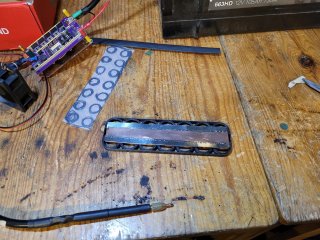
Here's a photo of one of the sheets I've just made, hopefully this ideas a winner??
20250827_195052.jpg
 
Skip the pure nickel in copper nickel sandwich.
Use nickel plated steel, or better yet Stainless steel.

I just welded 0.2mm pure copper under 0.1 SS (304 grade) using The copper brazing paste, and gear 270, of 999, on my AwithZ P20B 14.6kw welder.
0.1ms preheat, double pulse, 2ms pulse interval.

I have some 0.5mm stainless steel(400series) I was experimenting with.
I was able.to weld 0.3mm copper under this 0.5mm stainless at gear 990, triple pulse, and the tear off strength with just a pair of welds, two dots, was extreme.

Im done with pure nickel, or nickel.plated steel.

Copper/stainless sandwich is far superior in my opinion.

The electrodes to not stick, and there are few if any sparks with the 304 stainless, or 400 series for that Matter.
 
Last edited:
Skip the pure nickel in copper nickel sandwich.
Use nickel plated steel, or better yet Stainless steel.

I just welded 0.2mm pure copper under 0.1 SS (304 grade) using The copper brazing paste, and gear 270, of 999, on my AwithZ P90B 14.6kw welder.
0.1ms preheat, double pulse, 2ms pulse interval.

I have some 0.5mm stainless steel(400series) I was experimenting with.
I was able.to weld 0.3mm copper under this 0.5mm stainless at gear 990, triple pulse, and the tear off strength with just a pair of welds, two dots, was extreme.

Im done with pure nickel, or nickel.plated steel.

Copper/stainless sandwich is far superior in my opinion.

The electrodes to not stick, and there are few if any sparks with the 304 stainless, or 400 series for that Matter.
Oh yeah, stainless steel is a wonder material for spot welding.

I can do clean weld on USED cells using 0.2mm Cu + 0.1mm stainless steel.
 
Oh yeah, stainless steel is a wonder material for spot welding.

I can do clean weld on USED cells using 0.2mm Cu + 0.1mm stainless steel.
I did two layers of 0.15 copper under 0.1mm Stainless tonight, at gear 590 of 999.

I then tried two layers of 0.2 copper under 0.1mm stainless, using gear 900, and triple pulse, with flux, and it pulled off too easily. I didnt try pushing towards gear 999. 0.4mm copper is well excessive for my demands at this point.

I was able.to weld stacked 0.10mm and 0.15mm copper, with flux, no sandwich, Solid welds, but the copper tears away from the welds too easily, in my opinion, without Stainless steel cap locking it down.

My P groups need to flex.independent of each other so I want the strength if Stainless and the conductivity of copper.
 
Skip the pure nickel in copper nickel sandwich.
Use nickel plated steel, or better yet Stainless steel.

I just welded 0.2mm pure copper under 0.1 SS (304 grade) using The copper brazing paste, and gear 270, of 999, on my AwithZ P20B 14.6kw welder.
0.1ms preheat, double pulse, 2ms pulse interval.

I have some 0.5mm stainless steel(400series) I was experimenting with.
I was able.to weld 0.3mm copper under this 0.5mm stainless at gear 990, triple pulse, and the tear off strength with just a pair of welds, two dots, was extreme.

Im done with pure nickel, or nickel.plated steel.

Copper/stainless sandwich is far superior in my opinion.

The electrodes to not stick, and there are few if any sparks with the 304 stainless, or 400 series for that Matter.

I'd not heard of using stainless steel strips before, I just looked up its conductivity and can see why it'd be more useful for copper/ss sandwich.

Unfortunately I'm only using a k99 modded to separate the logic circuit to stop the welding voltage drop from frying it plus 6awg custom cables and pens.

I started welding the battery using what I wrote for option 3 last night as the bigger battery gives it enough current to weld the pure nickel to the copper, but unfortunately not enough to do a copper nickel sandwich even with the nickel plated.

Too late for this one but I'm gonna order some stainless steel strip to see that'll enable it to do the sandwich method successfully in the future. Although the main goal is for a Glitter 811 so I have the power to weld copper with ease, did think about buying a glitter 801h now but I think it'd be false economy when I could wait a little longer and buy the bigger version.

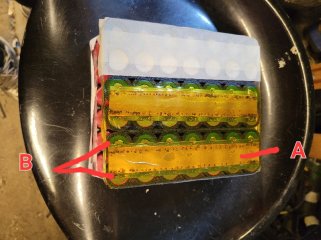
20250828_120235.jpg

A is 0.15mm copper
&
B is 0.2x8mm pure nickel

So the current runs for 3-5mm from the battery over the pure nickel and then for 20mm over the copper plate back to 3-5mm over pure nickel into the next series cell.

I've probably gone over kill with the amount of welds securing the nickel to the copper but figured the more the better.

I'm feeling fairly confident this won't give excessive voltage sag at 20a with upto 60 seconds at 25a's. The question is would you guys more experienced than me feel confident about that too?
 
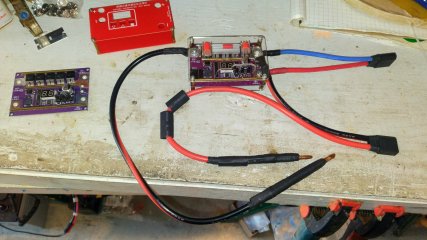
My welder previous to the AwithZ p20b was a 21$ purple circuit board with 5 mosfets. I also used second 12v battery to power the driver with XT90s antisoark connector, and a separate Zee 3s 5.2 AH '80c' Lithium Polymer battery as te Weld battery. I made fatter weld pens from 8awg and added more.solder to mosfet feet. I built three esk8 batteries with this set up, using 0.1mm copper, 0.1mm nickel plated steel sandwich.
20250626_135310.jpg


As the lithium polymer battery aged higher and higher pulse durations were required, and id have to warm up the battery, and recharge it back above 12.4v, or weld consistency was horrible.

The red welder blew up when I hooked it to a large 12v AGM battery, also with separate mosfet driver battery.

The AwithZ P20b welder I have now can weld 0.1mm copper, 0.1mm nickel.plated steel.using gear 90, of 999, or basically 9% of its available power.

Last night it came close to welding 0.4mm copper under 0.1mm stainless on gear 900, using the welding flux/copper brazing paste, and a triple pulse. I didn't try again at a higher gear.
 
I have some 0.5mm stainless steel(400series) I was experimenting with.
I was able.to weld 0.3mm copper under this 0.5mm stainless at gear 990, triple pulse, and the tear off strength with just a pair of welds, two dots, was extreme.
Can you please explain the benefit of this extra thick stainless steel? My first attempt was with 0.1mm stainless steel or 0.05mm stainless steel in sandwich with 0.3mm copper. I would expect the thinner the better but maybe not so?
 
Can you please explain the benefit of this extra thick stainless steel? My first attempt was with 0.1mm stainless steel or 0.05mm stainless steel in sandwich with 0.3mm copper. I would expect the thinner the better but maybe not so?
I experimented with 0.5mm stainless steel, as I had some on hand, and was still awaiting delivery of 0.1mm stainless. The AwithZ P20B welder was still new to me, and I wanted to play with it and test its abilities.

To my surprise, I was still able to weld copper under 0.5mm stainless. I think it is a 400 Series stainless as it is slightly magnetic.

The tear off strength, with just one pair of welds was extreme. The amount of force required to pull, and roll the sandwich from the cell was on the order of being ridiculous and cell deforming.

I was using Nelvick's( ZEUS-FL) welding flux under the copper, and when removing the 0.5mm stainless and copper, the copper left attached to the cell was both flat and wide. Very wide contact patch.

Nelvick's flux tins the copper adjacent to the welds, and my hypothesis was, and is, that the thick stainless, pressing the copper flat, and got so hot that the copper was not Only welded to the cell below the electrodes, but also soldered to it a certain distance from the welds.


I think the thick 0.5mm stainless not only presses the copper flat, but heats the copper below more evenly so that the Flux tins/ and solders the copper to the cell adjacent to the welds far wider than 0.1mm SS can and does..

I have not tried any thickness of stainless between 0.1 and 0.5mm, but if my hypothesis holds water, perhaps the goldilocks zone of stainless sandwich lies in the 0.25mm thick zone.

Welding the 0.5mm stainless over copper certainly takes more power than 0.1mm stainless, but not by a magnitude of 4.
Cutting 0.5mm of stainless with tin snips beats them up pretty well.

I do have 0.07mm stainless and it was advertised as 304 grade. I was not able to notice any difference between it and 0.1mm, when welding.

More recently, I screwed up a welded tab orientation, 0.2mm copper under 0.1 stainless using flux.

I pried off the stainless cleanly and then welded more 0.2mm copper to the 0.2 copper still on the cell. Somehow I made the same mistake again with orientation, and after throwqing tools and cursing for the appropriate amount of time, I then pried off all three layers. That first layer of copper was welded/ soldered to the cell nearly as wide and as flat as the 0.5mm stainless experiments.

Being able to remove the stainless cleanly and weld more copper atop the copper still on the cell poses some interesting possibilities in terms of increasing ampacity.

It appeared it also increases the amount of copper in direct contact with the cell too.

There is a lot more experimentation to be done, and tested.
I've been slacking on making some testable samples.

If the copper is welded AND Soldered to the cell when using Nelvicks flux, a quality tool and a capable person running that tool should be able to measure the difference in resistance.
 
Can you please explain the benefit of this extra thick stainless steel? My first attempt was with 0.1mm stainless steel or 0.05mm stainless steel in sandwich with 0.3mm copper. I would expect the thinner the better but maybe not so?
As you go thicker and thicker in material, getting the sandwich material to actually transfer the heat and not get obliterated gets harder and harder.

It's why my usual rule of 50% minimum thickness exists: anything thinner risks of being obliterated.

Once I get my new welder to be able to do >0.2mm, I'll probably get 0.15-0.2mm SS, and proportionally go up.

Remember that even 0.5mm stainless steel only has 10% the conductivity of copper and only the equivalent bulk conductivity of 0.125mm aluminium.
 
Last edited:
If I understand what you both say, then the SS is meant to get hot and spread the heat for the Cu to weld better and on larger area. Downside is this only works if the tool is capable to provide enough power to begin with.

This would explain why I burnt through the 0.05mm SS when welding 0.3mm Cu (with the flux) and the SS could be removed afterwards, fortunately leaving a good enough weld joint between Cu and cell. That was with kweld at 120J.
Applying same procedure with 0.1mm SS left the SS intact and stick to the Cu, but not neatly welded - could be pried off too easily.

So I will try with 0.15mm or 0.2mm SS over 0.3mm Cu (and flux) and check whether my kweld is up to that task. I have to build 2 more packs 3S1P from the EVE-50PL_125A preproduction cells
 
I know a lot of people will be happy to hear the Kweld can weld 0.3mm copper under 0.05mm stainless with flux at 120joules. Are using a supercapacitor or a battery to feed it?

I'd not be concerned very much that 0.05mm stainless had holes blown through it if the 0.3mm copper is solidly welded to the cell, and tears holes through the copper when rolled off of the cell.

0.3mm copper is strong enough on its own and any extra ampacity of the 0.05mm stainless is inconsequential.

I have had thick copper seem to weld strongly, but fail to tear when removed. It just popped off abruptly and left only faint traces of copper on the cell.
So I increased welder power uNtil BOTH weld points tore the copper equally and left equal size of copper on the cell.
From faint copper traces to solid equally torn copper was about 15% difference in power level on my AwitbZp20b using 0.3mm copper, under 0.2mm nickel plated steel busbar from the Makita 10 cell 21700 kit.
That also assumes 'gear' is linear to power delivered, but I've no way to confirm that.

Do note that you cannot solder balance leads to stainless steel.
It seems to be solder phobic.
 
It's why my usual rule of 50% minimum width exists: anything thinner risks of being obliterated.
Did you mean minimum thickness?
Once I get my new welder to be able to do >0.2mm, I'll probably get 0.15-0.2mm SS, and proportionally go up.
Which welder do you have?

I just bought my first real welder- AwithZ UF20B from Nelvick DIY500AMP. Been doing test welds 0.15 mm Cu sandwich of Ni and stainless steel, flux and no flux. That's a lot of combinations with the many welder settings and materials which makes it difficult to keep track of.
 
I know a lot of people will be happy to hear the Kweld can weld 0.3mm copper under 0.05mm stainless with flux at 120joules. Are using a supercapacitor or a battery to feed it?
I use 3S 6000mAh HV lipo, charged to 4.25V/cell for 10 to 20 weld shots, until it triggers the 3.7V under load cell checker, then recharge.
The kweld has received new housing with extra cooling kweld desk case with fan by rio | Download free STL model | Printables.com plus 2 fans for the lipo and wiring.

To achieve possible large area of contact, I always 3Dprint a die for the Cu strips like this 21700 LiIon holder for Promovec Carrier case by rio | Download free STL model | Printables.com
 
Did you mean minimum thickness?

Which welder do you have?

I just bought my first real welder- AwithZ UF20B from Nelvick DIY500AMP. Been doing test welds 0.15 mm Cu sandwich of Ni and stainless steel, flux and no flux. That's a lot of combinations with the many welder settings and materials which makes it difficult to keep track of.
That is correct, I meant thickness. Thank you for correcting me.

The welder I currently have is the Kekk K7 Pro. It's a pretty decent part-DIY spot welder, does 0.15mm Cu + 0.1mm steel easily, can do 0.2mm Cu if I use 0.1mm SS.

I plan to upgrade if I find the funds somewhere because I want to be able to weld thicker copper and possibly aluminium for large format cells like CALB 36Ah and 38Ah 4695s.
 
That is correct, I meant thickness. Thank you for correcting me.
My intent was not to correct you. Just looking for clarification since I am new to it.

So, in a Cu / SS sandwich, if Cu thickness increase, does it require a proportional increase in SS thickness?
 
I experimented with 0.2mm nickel plated copper today on my AwithZ p20b

No flux, no sandwich and it Required gear 800 before the strip would tear leaving little pinpricks on the cell.

The same settings on 0.2mm copper yielded same exact results.

Using flux and gear 800 no sandwich was more than enough power on either nickel plated or pure 0.2mm copper.

I think the copper tears off too easily comoared to when it has stainless on top.

For reference, I get very good very strong welds of 0.2mm copper under 0.1mm stainless using flux and gear 385 (of 999)

So flux and stainless Sandwich reduce the power required by at least half when welding 0.2 copper.
 
My intent was not to correct you. Just looking for clarification since I am new to it.

So, in a Cu / SS sandwich, if Cu thickness increase, does it require a proportional increase in SS thickness?
Since no one answered my question, I had to buy some 0.2mm 304 stainless from ali to see for myself. On my AwithZ UF20B on the same settings (gear 95) with 0.2mm copper, 0.2mm SS produced much weaker welds than 0.1mm SS.

Checked the resistance of the SS strips of the same length using my HRM-10 internal resistance tester, 0.1mm SS has twice the resistance of the 0.2mm SS. Higher resistance of the 0.1mm SS generates higher temperature at the weld points, producing better welds for me.
 
Since no one answered my question, I had to buy some 0.2mm 304 stainless from ali to see for myself. On my AwithZ UF20B on the same settings (gear 95) with 0.2mm copper, 0.2mm SS produced much weaker welds than 0.1mm SS.

Checked the resistance of the SS strips of the same length using my HRM-10 internal resistance tester, 0.1mm SS has twice the resistance of the 0.2mm SS. Higher resistance of the 0.1mm SS generates higher temperature at the weld points, producing better welds for me.
I couldnt definitevly answer your question.
I noticed no difference between 0.07 and 0.1mm 304 stainless.

0.5mm 400 something grade stainless required way more power, but when used with flux seemed to both weld and solder the copper very Flat and wide to the cell and had incredible tear off strength.

I have just welded 0.2mm copper using some 0.1mm stainless with the slot to weld across, and could tell no difference between slotted welds and non slotted, strength wise.

I think once one gets above 0.2mm copper then the added power needed to weld the cu/ss sandwich successfully risks punching holes through the stainless, so then perhaps thicker stainless is then needed.

Your UB20 appears to not be powerful enough to do 0.2mm copper under 0.2mm stainless at 95% of its available power.

One thing that is always a variable between usere is the amount of pressure one uses, and the shape of the welding tips.

I've started using an arkansas sharpening stone to clean and shape my tips. The little red diamond coated file my p20b came with, is too aggressive in my opinion.

The small grooves it leaves behind can change the total surface area in contact with sandwich, and thus change resistance and weld consistency.
 
Last edited:
I have just welded 0.2mm copper using some 0.1mm stainless with the sslo to weld across, and could tell no difference between slotted welds and non slotted, strength wise.
What is sslo?
Your UF20B appears to not be powerful enough to do 0.2mm copper under 0.2mm stainless at 95% of its available power.
I agree. It also cannot produce a strong weld with 0.3mm CU/ 0.1mm 304 SS with flux. Tear strength very low, leaves just a pin prick of copper on the cell.

I've started using an arkansas sharpening stone to clean and shape my tips. The little red diamond coated file my p20b came with, is too aggressive in my opinion.
What grit is the P20B diamond file? UF20B came w/o a file. I use the red one (600 grit) in this kit. Not aggressive and keeps the round tip smooth and round.
 
What is sslo?

What grit is the P20B diamond file?
Sorry, typing on phone which often annoyingly forces me to type in portrait mode, and forgot to proofread.
Sslo was supposed to be 'slot'. will edit.

I'll guess the red handled file provided with the p20b is 120 grit.

0.3mm copper takes a lot.of power, even with flux and stainless. My p20b can do it at high gear levels, but it will get hot so I got to slow down

I want to get a roll of 0.25mm copper.

If expending additional time and effort are not a concern, and you want thicker than 0.2mm copper, weld it with the stainless, then use a sharp chisel amd remove the stainless from the copper, then weld more copper SS sandwich to the copper. below.

I used the same settings as 0.2mm copper 0.1mm stainless to the cell, and tried to avoid welding on the previous welds.
 
If expending additional time and effort are not a concern, and you want thicker than 0.2mm copper, weld it with the stainless, then use a sharp chisel amd remove the stainless from the copper, then weld more copper SS sandwich to the copper. below.
I'll have to try that, thanks!

For gear setting that make good welds on 18650 cells with 0.15mm cu/ 0.10mm 304 SS, will the gear setting have to go up for 21700 cells? If so by how much, percentage wise.
 
I've been using same settings on 18650 and 21700's.

I always buy an extra cell and do tear off tests on it before committing to settings.


Welding to cells that were previously welded to, and then cleaned of the old welds takes a bit less power than new cells whose nickel plating is still intact.
 
If expending additional time and effort are not a concern, and you want thicker than 0.2mm copper, weld it with the stainless, then use a sharp chisel amd remove the stainless from the copper, then weld more copper SS sandwich to the copper. below.
Getting the welded stainless off the copper cleanly was not possible for me. If I need thicker than 0.2mm copper, I will buy another welder that can do the job.

The first pack I'll be building will probably be 13S2P 21700 cells with cell spacers. Would 40 mm square copper sheet be the correct size interconnect for 2P?

edit: 30mm width rolls of Cu are the next size down. 35mm seems ideal but not available in my searches.
 
Last edited:
Back
Top