• Hello ES! We could use some help to get us past the finish line on building the new knowledgebase for the forum.
    Can you donate? Please see our fundraising page. Thank you!

Weld Nickel-Plated Copper w/ Dual Capacitor Welder?

I've no experience welding nickel plated copper, or with the welder you describe.

I imagine the thickness of the nickel plating has a significant effect on the power required to weld it solidly, and the ultimate resistance of the strips. If the thickness of the plating is unknown, or it varies on the same plated strips, then comparing it to other Nickel plated copper, or perhaps even a different section of strip from same source, could lead to inaccurate, inconsistent and undesirable results.

I want copper in direct contact with my cells, So I am personally sticking with Stainless Steel on top of copper, as stainless seems to be a magic welding aid, and it adds so much physical strength to the welded sandwich.

I don't feel 0.2mm copper by itself has the strength to handle the vibration and flexing stresses in my application, Esk8.

I am not allowing high humidity or moisture in direct contact with my copper, so I am not worried about corrosion.
If it gets wet, I have bigger problems.

I am also not in battery production 'time is money mode', so cutting out stainless and prewelding it at low power levels to the copper then welding the sandwich to cells at much higher power levels, is not yet driving me insane to the point where I want to eliminate the sandwich method.

For reference, I am welding 0.2mm copper under 0.1mm SS using Nelvick's flux, at 32 to 38.5% of the available power of my welder which claims to be capable of 14.6KW. I am using 0.15ms preheating and two welding pulses and gear 320 to 385 (of 999), So about 5.621kw on gear 385, if the gear is linear to welding power and if Gear 999=14.6kw.


If I do not use Nelvick's Flux, I need to use gear 550 to 580 to weld 0.2mm pure copper under 0.1mm stainless steel, so 55 to 58% of the welder's power.


If you look at the nickel plated copper rolls closely, the sides are still copper colored, so it is not like the copper is completely sheathed in corrosion resistant pure nickel.
I am suspicious of it, and would prefer to test 0.25mm, but not so interested that I will be purchasing 0.25mm Nickel plated copper just to assuage my curiosity.
 
Nickel-plated copper strip is available in 0.15 and 0.20 x 10mm at competitive cost, which would provide corrosion & wear resistance at low electrical resistance.
If such strip can be welded directly w/ a dual 3000F 3Wh capacitors welder, removing the nickel/steel sandwich material would simply assembly.

Tag @sternwake, @BlueSwordM, @ZEUS-FL to request input 🤞
Nickel plating is often not thick enough to actually help unless you start doing large thickness plating, where copper-clad nickel starts being much more useful.

Still, thank you for this, as this isn't a bad price for nickel plated copper strip.
 
I've no experience welding nickel plated copper, or with the welder you describe.

I imagine the thickness of the nickel plating has a significant effect on the power required to weld it solidly, and the ultimate resistance of the strips. If the thickness of the plating is unknown, or it varies on the same plated strips, then comparing it to other Nickel plated copper, or perhaps even a different section of strip from same source, could lead to inaccurate, inconsistent and undesirable results.

I want copper in direct contact with my cells, So I am personally sticking with Stainless Steel on top of copper, as stainless seems to be a magic welding aid, and it adds so much physical strength to the welded sandwich.

I don't feel 0.2mm copper by itself has the strength to handle the vibration and flexing stresses in my application, Esk8.

I am not allowing high humidity or moisture in direct contact with my copper, so I am not worried about corrosion.
If it gets wet, I have bigger problems.

I am also not in battery production 'time is money mode', so cutting out stainless and prewelding it at low power levels to the copper then welding the sandwich to cells at much higher power levels, is not yet driving me insane to the point where I want to eliminate the sandwich method.

For reference, I am welding 0.2mm copper under 0.1mm SS using Nelvick's flux, at 32 to 38.5% of the available power of my welder which claims to be capable of 14.6KW. I am using 0.15ms preheating and two welding pulses and gear 320 to 385 (of 999), So about 5.621kw on gear 385, if the gear is linear to welding power and if Gear 999=14.6kw.
Oh yeah, stainless steel is an actual nuke when it comes to these things.
 
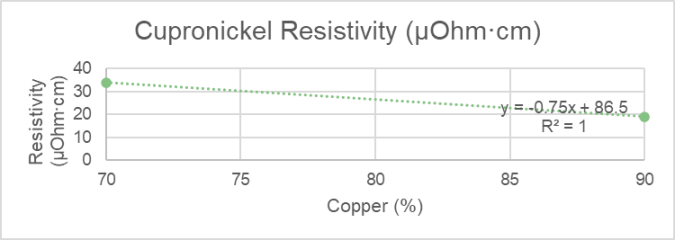
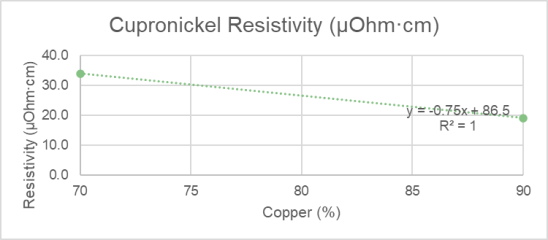
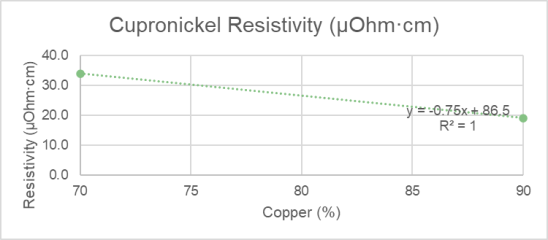
Any alloy of copper significantly reduces the electrical conductivity.
Far more than one would expect. It is not linear.
 
Indeed:
1766370181042.png
1766370028186.png
1766370049263.png

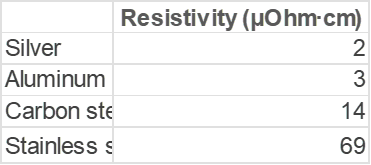
For comparison:
1766370223588.png

However, all cupronickel alloys -- including pure nickel:
1766370365445.png
1766370374734.png
 

Attachments

  • 1766369862517.png
    1766369862517.png
    16.9 KB · Views: 1
  • 1766369875456.png
    1766369875456.png
    21.9 KB · Views: 1
  • 1766369897116.png
    1766369897116.png
    21.9 KB · Views: 1
  • 1766369925729.png
    1766369925729.png
    9.2 KB · Views: 1
  • 1766369961222.png
    1766369961222.png
    6.9 KB · Views: 1
  • 1766370024766.png
    1766370024766.png
    6.8 KB · Views: 1
  • 1766370119120.png
    1766370119120.png
    12.2 KB · Views: 1
  • 1766370265878.png
    1766370265878.png
    5.8 KB · Views: 1
Back
Top