• Hello ES! We could use some help to get us past the finish line on building the new knowledgebase for the forum.
    Can you donate? Please see our fundraising page. Thank you!

What Actually Happens Before a TOSEVEN DM Motor Ships

to7motor@SZ

🔋 Established
Joined
Feb 20, 2024
Messages
60
Location
Suzhou
Hi everyone,

Over the past two years, we've gained valuable insights from conversations across Reddit and Endless Sphere. While many riders have shared positive experiences, others have raised thoughtful questions or concerns about long-term reliability. We take all of that feedback seriously, and we believe the best response isn't just words, but actual, real proof. That's why we want to show you exactly how every DM motor is rigorously tested before it ever leaves our factory.

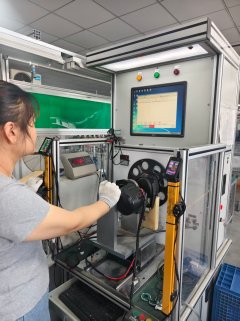
Instead of just saying "every unit is tested," here is a look at what actually happens on our bench for every single DM motor before it ships.


We test every DM motor individually.

We don’t rely on batch sampling. Each production motor is hooked up to a test bench before it’s packed.
The goal is straightforward: make sure the motor, controller, sensors, and communication system all work together properly before anyone installs it.


1. Electrical Safety Check

Before we apply power, we run basic electrical checks:
  • Connector integrity
  • Wiring continuity
  • Power circuit condition
  • Internal communication between controller and sensors
If anything reads off, the motor doesn’t move forward.


2. Controller Functional Test

Then we power up the controller and verify:
  • Startup behavior
  • Hall sensor feedback
  • Rotor position detection
  • Phase switching
  • Internal communication
At this stage, we’re making sure the electronics behave as expected before any load is applied.


3. Torque Sensor Calibration

The torque sensor has a big impact on how the bike actually feels to ride.

Because the torque sensor determines how natural the bike feels to ride, it's one of the last systems we calibrate before final inspection. We check:
  • Zero torque value is correct
  • Sensor output is stable
  • Signal changes smoothly under load
  • No abnormal drift or fluctuation
We spend extra time here because it directly affects ride quality.


4. Dynamic Motor Run Test

During production testing, the motor is operated through multiple speed and load conditions to verify consistent behavior before shipment.

We monitor:
  • Rotation
  • Speed response
  • Current draw
  • Phase balance
  • Controller behavior
This tells us whether the whole system performs normally throughout its range.


5. Acoustic & Mechanical Vibration Check

Small changes in bearing preload or gear meshing often appear as sound before they appear as measurable performance problems. That's why every motor is listened to as well as measured during testing.


6. Communication Verification

E-bike systems rely on smooth communication between components.

Before shipping, we test the motor with supported displays to confirm:
  • Startup works normally
  • Parameters transmit correctly
  • Errors report as expected
  • Assist operation responds properly
7. Final Inspection

Right before packaging, each motor gets a visual once-over:
  • Housing condition
  • Fasteners
  • Labels
  • Connector protection
  • Waterproof seals
  • Packaging completeness
Only after all these checks does the motor get cleared for shipment.


Why Factory Testing Is Just the First Step

Bench testing guarantees that every motor leaves our facility in peak condition. But controlled bench conditions aren't the trails, rain, or heavy daily commutes our riders put these motors through.

Real-world riding introduces variables that no test bench can fully replicate. That's why post-launch feedback from builders, dealers, and riders is a direct input into our production line. Some of the improvements we've introduced over the past two years came directly from field feedback rather than laboratory testing.

We’re Still Working to Get Better

Like every engineering company, we're continuously learning and improving. As riders, dealers, and builders share their experiences, we keep refining our products, our processes, and our tests.

Sometimes improvements come in hardware. Sometimes in firmware.

If you've found something we can improve, we'd like to hear it. Some of the changes we've made over the past two years came directly from rider feedback.


If you’re riding a TOSEVEN DM motor, we really want to know what you think. Good or bad, feedback helps us build better products.

And if you’re curious about any part of our testing process, just leave us your comments,we’re happy to get into the details.
 

Attachments

  • 104a2b6f2e21b57bbccdb7d91f4d8a50.jpg
    104a2b6f2e21b57bbccdb7d91f4d8a50.jpg
    197.7 KB · Views: 12
  • e0c568327718dd39f9aabe7ba644c812.jpg
    e0c568327718dd39f9aabe7ba644c812.jpg
    352 KB · Views: 11
Your out-the-door tests look good to me,
Capture_2026-08-09_68196.png
I'm just approaching 13 months and only 1000 miles on my DM02 with V06027 firmware. Runs nice on 36V,
 
Isn't all this final testing a step backwards from the WE Deming system of Statistical Process Control that the Japanese used so effectively?
 
How does Toseven differ or compare to Tongsheng? Besides a much pickier warranty on peripherals.
Dear Customer,

That’s a fair question.

Honestly, we don't see TOSEVEN as a direct replacement for any established platform. There are already some very mature DIY mid-drive platforms out there, with years of field experience, large installed bases, strong spare-parts ecosystems, and active communities. Those are real advantages, and we respect them.

The DM platform came from a slightly different starting point. It was developed as a new platform with a different set of engineering priorities. The goal was to build a torque-sensing system that could handle more power, run FOC, give riders more tuning options, and adapt to a wider range of bikes.

The DM01 in particular is aimed at people who want more torque and a higher-power platform, while still wanting a natural, torque-based pedal feel, not an on/off switch.

We kept a lot of adjustability because we know riders like to dial things in. But we’ve also learned the hard way that configurability doesn’t mean much if the defaults are off and the docs are thin. That’s something we’re actively improving.

Where established platforms still have an advantage is in maturity, years of forum threads, OSF, spare parts availability, and real-world problem-solving. We respect that, and we’re realistic about where we stand today.

Where we’re trying to differentiate is in building a newer foundation, with better factory QC, ongoing hardware and firmware iteration, and gradually better support and documentation.

Not there yet, but getting better.

And your point about warranty and parts availability is valid. We know warranty handling and parts availability are areas where we still need to improve.

We’re not trying to convince everyone to choose TOSEVEN. We’d rather people understand what each system does well and pick what actually fits their build and riding style.

If you’re coming from a TSDZ2 or TSDZ8 and have specific things you liked, hated, or wished were different, we’re all ears. That kind of real-world feedback is exactly what we’re using to evolve the DM series.

Toseven Support Team
 
Your out-the-door tests look good to me,
View attachment 391463
I'm just approaching 13 months and only 1000 miles on my DM02 with V06027 firmware. Runs nice on 36V,
Dear Customer,

Thanks for the update; 13 months and 1k miles is good data, we really appreciate it.

Great to hear the DM02 is still running nicely on 36V. And thanks for noting the firmware version; that helps us track how different batches hold up in the wild.

Please keep us posted as you rack up more miles; we're curious to see where it goes.

Toseven Support Team
 
Isn't all this final testing a step backwards from the WE Deming system of Statistical Process Control that the Japanese used so effectively?
Dear Customer,

That's a fair point, and you're right. Final inspection shouldn't be the main way we build quality.

Our last post focused on end-of-line testing because someone asked: "Do you test every motor?" But that's just one step, not the whole story.

End-of-line is really a final sanity check to make sure the assembled unit works. It catches stuff, but it doesn't prevent stuff. That's why in-process control is more important.

If our earlier post made it sound like "we test every motor so quality is fine," that's not what we meant.

We're trying to build a process that makes good motors consistently, not just sort out the bad ones at the end. Final test is a backup, not the main event.

We really appreciate you calling this out; we'll pass it along to the factory team.

Toseven Support Team
 
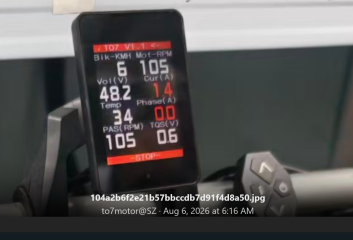
Max 36V battery is 42V? Why is the display showing 48.2V?
Dear Customer,

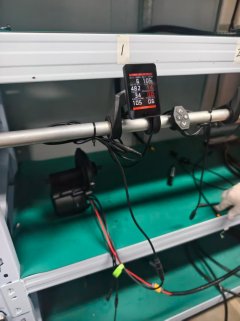
Good catch. The 48.2V shown in the photo is from our 48V aging test setup, not the 36V system the rider was talking about.

DM02 runs on 36V normally. A full charge on a 36V battery is around 42V. The 48.2V reading in the photo shouldn't be taken as the voltage of the 36V battery the rider is referring to. It was from the 48V test aging setup.

The photo definitely needs that context; thanks for pointing it out.

Toseven Support Team
 
FOC sounds interesting. (I had to look this up.)

I ride recumbent trikes. Our pedaling is laterally, not having body weight to press down with the actuate the normal torque strokes. So we are essentially bench-pressing in movement; we are laid back on a lawn chair on wheels. So our demands from a motor are worlds different from someone on a bicycle or MTB. All our power originates at each leg, with only a seat to press against with.
One's body weight is lifted by 80% so it is much easier to use ... until you stand up from a long ride .... then all your weight comes back.

Originally started with a TSDZ2 that ended up under-powered and fell physically apart after 110+ miles on a hard pack trail - right in a soft duff area. Went to a Bafang M625 cadence and rode close to 1100 miles before I had to ditch the motor as batteries for a CAN BUS version 1 became obsolete, and batteries do not last forever.
Since I am on GLP-1 medication, my goal is to lose weight. Also want to get my legs (knees and feet) doing better, as cadence really is only ghost pedaling. I wanted the TSDZ2 feeling back.

Went with a TSDZ16. It does not feel like the TSDZ2 days, yet it helps, and I can ride further on a 36V 17.5Ah battery than I ever could with an equivalent battery for the M625, and can climb grades MUCH EASIER & FASTER on the TSDZ16.

Main issue I see is with the limitation of the PAS system. 1 through 3 is more geared for MTB pedaling, and modes 5 through 9 are more lenient on input power to give assist. The displays only allow 5 modes.
Mode 3 is decent, although I prefer mode 4 as it gives me enough assist without being over-bearing. If I want speed, I drop to mode 2 to give me more drivetrain resistance to power with before spinning out the motor's end with excessive RPMs.
THAT, RPMs are a recumbent trike rider's nemesis. By the time we get to a comfortable speed, the assist kicks off due to too much RPM. Our only counter to this issue is installing a larger chainring.

Had a 44T chainring that felt great, but could not go faster than 10 MPH, 8 on average. Had to pull the Nuvinci n380 hub and go back to a cassette for an extra 2 MPH more. Now on a 46T chainring and I can get to 15 MPH fairly well, and if I pump it hard, thrashing like I was on an MTB, can get almost to 22 MPH - but I cannot hold the speed as I wear out fast. Cannot find a one-piece offset 50T chainring. But I don't want a bigger chainring as we do have a few 5% grades and some hills.

I prefer the torque assist for the health and 'bionic legs' abilities, yet I also want:
* reliability
* compatibility to recumbent trike riding
* ability to change parameters and PAS settings.

Is the TOSEVEN a recumbent trike friendly motor, or can it be adapted over to such?

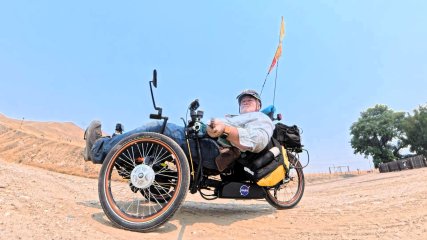
Photo gives an example of me on a Greenspeed Magnum recumbent trike, with TSDZ16 on board.

Thank you for answering our inquiries. I await a future response, and hopefully for goon news too. 🖖
 

Attachments

  • IMG_20260808_132059_00_034_2026-08-09_17-27-11_screenshot.jpg
    IMG_20260808_132059_00_034_2026-08-09_17-27-11_screenshot.jpg
    428.9 KB · Views: 7
FOC sounds interesting. (I had to look this up.)

I ride recumbent trikes. Our pedaling is laterally, not having body weight to press down with the actuate the normal torque strokes. So we are essentially bench-pressing in movement; we are laid back on a lawn chair on wheels. So our demands from a motor are worlds different from someone on a bicycle or MTB. All our power originates at each leg, with only a seat to press against with.
One's body weight is lifted by 80% so it is much easier to use ... until you stand up from a long ride .... then all your weight comes back.

Originally started with a TSDZ2 that ended up under-powered and fell physically apart after 110+ miles on a hard pack trail - right in a soft duff area. Went to a Bafang M625 cadence and rode close to 1100 miles before I had to ditch the motor as batteries for a CAN BUS version 1 became obsolete, and batteries do not last forever.
Since I am on GLP-1 medication, my goal is to lose weight. Also want to get my legs (knees and feet) doing better, as cadence really is only ghost pedaling. I wanted the TSDZ2 feeling back.

Went with a TSDZ16. It does not feel like the TSDZ2 days, yet it helps, and I can ride further on a 36V 17.5Ah battery than I ever could with an equivalent battery for the M625, and can climb grades MUCH EASIER & FASTER on the TSDZ16.

Main issue I see is with the limitation of the PAS system. 1 through 3 is more geared for MTB pedaling, and modes 5 through 9 are more lenient on input power to give assist. The displays only allow 5 modes.
Mode 3 is decent, although I prefer mode 4 as it gives me enough assist without being over-bearing. If I want speed, I drop to mode 2 to give me more drivetrain resistance to power with before spinning out the motor's end with excessive RPMs.
THAT, RPMs are a recumbent trike rider's nemesis. By the time we get to a comfortable speed, the assist kicks off due to too much RPM. Our only counter to this issue is installing a larger chainring.

Had a 44T chainring that felt great, but could not go faster than 10 MPH, 8 on average. Had to pull the Nuvinci n380 hub and go back to a cassette for an extra 2 MPH more. Now on a 46T chainring and I can get to 15 MPH fairly well, and if I pump it hard, thrashing like I was on an MTB, can get almost to 22 MPH - but I cannot hold the speed as I wear out fast. Cannot find a one-piece offset 50T chainring. But I don't want a bigger chainring as we do have a few 5% grades and some hills.

I prefer the torque assist for the health and 'bionic legs' abilities, yet I also want:
* reliability
* compatibility to recumbent trike riding
* ability to change parameters and PAS settings.

Is the TOSEVEN a recumbent trike friendly motor, or can it be adapted over to such?

Photo gives an example of me on a Greenspeed Magnum recumbent trike, with TSDZ16 on board.

Thank you for answering our inquiries. I await a future response, and hopefully for goon news too. 🖖
Dear Customer,

Thanks for sharing the photos.

Please note that your recumbent trike is fully compatible with our DM motor. We've actually done installs on this type of trike before, so we know it works.

And we really appreciate you sharing your thoughts on RPM. On recumbents, the way chainring size, gearing, cadence, and speed interact is often totally different from a standard bike, so this is exactly the kind of detail we need to look at.

Meanwhile, our DM motor gives the users quite a bit of room to tweak the assist curve. So if the default PAS settings don't feel right for your riding style, you can adjust it via the display; that's actually where this system shines.

If you're interested in moving forward, please let us know your current setup, and we'll help you figure out the best configuration.

Thanks again for the detailed info; your feedback is really valuable to us.

Toseven Support Team
 
Currently have a Greenspeed Magnum XL with 68mm bottom bracket, 34/11 cassette in the rear. Have a 1,000 watt motor currently, but the way this whole e-bike fascicle is going maybe best to stick with 750 watts?

Have two 17.5Ah 48v batteries, that are currently using Anderson connectors. Am planning on swapping overt to XT60 connectors, but haven't due to TSDZ16 issues. Went through Johnny Nerd Out out of Oregon. Am assuming the batteries are compliant?
 
Currently have a Greenspeed Magnum XL with 68mm bottom bracket, 34/11 cassette in the rear. Have a 1,000 watt motor currently, but the way this whole e-bike fascicle is going maybe best to stick with 750 watts?

Have two 17.5Ah 48v batteries, that are currently using Anderson connectors. Am planning on swapping overt to XT60 connectors, but haven't due to TSDZ16 issues. Went through Johnny Nerd Out out of Oregon. Am assuming the batteries are compliant?
Dear Customer,

Thanks for your information. The Greenspeed Magnum XL is an excellent platform for recumbent trike conversions.

Please have our response below:

Based on US regulations, a 750W motor can keep you compliant and avoid unnecessary drivetrain heat.

Johnny is one of our most trusted US partners; we're confident he'll provide fully compliant, reliable products.

Compared to Anderson, XT60 handles sustained high-current output better, with superior vibration resistance and lower voltage drop over time, which is ideal for long-distance trike use.

If you're looking to replace your current setup with a 750W torque-sensing mid-drive, you may check out our TOSEVEN 750W system. It's built for optimized heat dissipation and precise torque filtering, and your 68mm bottom bracket is a standard size, fully compatible.

Please let us know if you need wiring diagrams or install tips for the Greenspeed build.


Toseven Support Team
 
Back
Top