• Hello ES! We could use some help to get us past the finish line on building the new knowledgebase for the forum.
    Can you donate? Please see our fundraising page. Thank you!

What motor should I get if I want to test out regen breaking?

Maybe I am missing something here, but I thought this was just a bench / lab demonstration of using an electric motor as a generator. Or do you need to build an actual bicycle with regen capability?
Yeah it is, but dont we need a battery/motor/controller to showcase how regen works? Since its also the final proj showing how once you have these components and everything it would be actually implementable on a bike so it could be a competitive/cheaper implementation of regen for small EVs, thats also why if we could get this to work and have time left, we could make a clone of a controller or something like that which would have the bare minimum to showcase regen breaking

My groupmates also mentioned that we might need a microcontroller as well, they were looking at an ESP32 for that, for the controls aspect of this project dont we need a controller to like take the battery and convert it to the motor, as well as controlling the torque/speed by regulating the current flow? and then the microcontroller will be used to read the sensors, monitor and send commands to the breaking system etc?


"The microcontroller would be like the brains right, when it gets input back from the sensors and stuff, we would then give info to the VESC etc and based on that, like adjustments to voltage, current etc is controlled. The controller is the interface between the battery and motor, so for ex when the battery starts feeding, controller converts it to PWM and sends it to each of the three respective phases and then starts spinning, and then when we want the reverse to happen (break), the microcotroller can read that input, command the VESC to now provide negative torque, so then it would start resisting against the foward motion (becomes acting like genrator) and allowing the reverse flow back into the battery through controller. With the controller we then can also monitor voltage for ex, so lets say person breaks really hard while load is spinning really fast so theres a lot of energy, and maybe the battery is already near capacity, the microcontroller can let the VESC know yo bro lets cap how much we send back "
- From my group member on why we need both
 
Last edited:
It seems like the best way to demonstrate it is to use two motors like in @stancecoke 's video. Sure, you could use a controller to combine the phases and regulate the output. Since this is on a bench, you could use a cheap A/C motor to drive the second motor acting as a generator. As far as demonstrating charging a drained battery, you could stack three 12V SLA's in series, like they use in old wheelchairs. It doesn't have to be an expensive lithium battery.
 
Huh, but wouldnt it be easier/cheaper if we use the same motor to act as both a generator and a motor?

Like what we want to show was a battery (Lithium ion in this case unless theres a cheaper alternative which are also safe) supplying DC voltage to the controller (the one you sent), and then it converts that DC to three phase currents for the BLDC DD motor, then when you break the motor will act as a generator, and the current will flow in opposite direction which will charge the battery?
 
When a bicycle is using regenerative braking, the motor isn't driving the bike. It is usually coasting downhill and the motor converts the kinetic energy of the bike to electricity, the electricity is used to charge the battery. When the motor is providing power to move the bicycle, it drains the battery and converts the electricity to kinetic energy. The motor cannot act as both a motor and a generator simultaneously.

To demonstrate regenerative braking on a bench, I am suggesting that you use a second motor to spin the first motor acting as a generator. That will simulate the bicycle coasting downhill to spin the motor. This setup is shown in @stancecoke 's video, except that you can just use a cheap AC motor to spin the bicycle motor instead of using two bicycle motors as he did. You can use 3 cheap 12V SLA batteries connected in a series (36V) connected to the controller to show that the bicycle motor is capable of spinning itself. Before lithium batteries became popular a decade or so ago, many people built ebikes with SLA batteries. They are just big and heavy and not as practical to carry on a bicycle.
 
When a bicycle is using regenerative braking, the motor isn't driving the bike. It is usually coasting downhill and the motor converts the kinetic energy of the bike to electricity, the electricity is used to charge the battery. When the motor is providing power to move the bicycle, it drains the battery and converts the electricity to kinetic energy. The motor cannot act as both a motor and a generator simultaneously.

To demonstrate regenerative braking on a bench, I am suggesting that you use a second motor to spin the first motor acting as a generator. That will simulate the bicycle coasting downhill to spin the motor. This setup is shown in @stancecoke 's video, except that you can just use a cheap AC motor to spin the bicycle motor instead of using two bicycle motors as he did. You can use 3 cheap 12V SLA batteries connected in a series (36V) connected to the controller to show that the bicycle motor is capable of spinning itself. Before lithium batteries became popular a decade or so ago, many people built ebikes with SLA batteries. They are just big and heavy and not as practical to carry on a bicycle.
Ahhhh I see, here I probably wont be able to talk for the rest of the day, and also gotta discuss w/ my group partners more about this, but I'll message you again probably in a few days to discuss more on this if thats okay with you! Thank you for all the help you and the rest of the community has been, and have a happy new year!
 
Yeah basically a $50 ebike controller could do this, no rocket science is needed unless part of the requirement is that you implement it yourself.
Controller wise i like VESCs because the regenerative braking at the low RPMs is pretty superior compared to other controllers i've tried.
But with some elbow grease learning how the programming works on those, you could get a better end result if that's important.

..in the case that the project means you have to implement regen yourself, you are a lucky guy, we have a lot of people on this forum who design controllers for fun who could advise.
 
Huh, but wouldnt it be easier/cheaper if we use the same motor to act as both a generator and a motor?
For that, you would need a really large flywheel that you could accelerate in motor mode and brake again in regenerative mode.
I don't see the aim for your project. What do you want to show?!
That a classical BLDC controller can work as a step down converter for motor operation and as a step up converter for regen operation is well known, that's just a matter of the firmware that sets the duty cycles of the half bridges.
Do you want to show the efficiency? Or do you want to develop your own controller?!
If you want to learn how FOC works with full four quadrant operation, I don't recommend the VESC, it's open source, but the code is a mess for a newbie...
I can recommend the links in this readme, they helped me a lot to learn the motor control stuff...

Helpful links:

vector-control-for-dummies

space-vector-pwm-intro

UM1052 - STM32F PMSM single/dual FOC SDK v4.3
 
Yeah it is, but dont we need a battery/motor/controller to showcase how regen works? Since its also the final proj showing how once you have these components and everything it would be actually implementable on a bike so it could be a competitive/cheaper implementation of regen for small EVs, thats also why if we could get this to work and have time left, we could make a clone of a controller or something like that which would have the bare minimum to showcase regen breaking
Well showcasing a lot easier than demonstrating. So do you just need to show a mock up and describe what each component does, or can’t it just be diagrams and pictures? I’m not sure how much more proof is necessary for something that is already implemented widely. You could just use the forum search and cite various projects to show how it’s been done for different applications. I saw a couple of recent projects with carts and 4 wheelers, so you can show how the different issues are solved along the way.
PS.make sure in your papers to spell it “regen braking”, in case they get picky about spelling. Is this for an economics class?
 
Last edited:
Hey @RunForTheHills

So basically my group decided to go with these as our motor/controller/battery & adapter
Motor: 24V/36V 200W 5 Inch Electric Scooter Motor Wheel with Solid Tire 5" Electric Brushless DC Gearless Hub Motor with Hall Sensor, Replacement Wheels - Amazon Canada
Controller: https://www.digikey.ca/en/products/...670?s=N4IgTCBcDaIEIFoDiAWAzARkQUQMoGEMQBdAXyA
Battery & Adapter: https://www.digikey.ca/en/products/detail/mean-well-usa-inc/GST60A12-P1J/7703712

So basically our goals are to
a) Showcase regen braking and get some energy back which we can store in a supercapacitor
b) Design our own controller based on the B-G431B-ESC --> requirement from prof
c) Design a buck/boost converter to step up/step down the req voltage/current

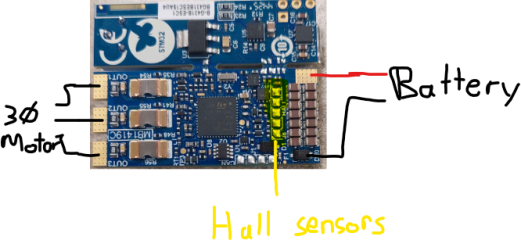
I just want to ask, how would we design our own controller/is it possible to based on the ESC that we have already? So like I saw online that ppl have built their designs using this esc by connecting the 5 hall effect sensor wires from motor to the esc, the single phase (positive/negative) battery wires to one end of the ESC, and the 3 phase wires from the motor to the other end of the esc like the diagram below

1772397794679.png
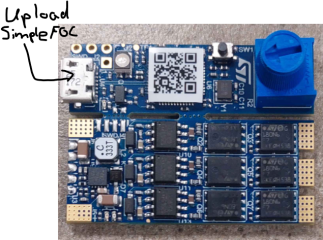
So Im wondering if its possible to just copy the components used from the schematics for only those things (like the resistors/mosfets etc), and we should be good? Im also not really sure on how we could add the code that we have to create on SimpleFOC to the controller in this case to handle speed and such, as im assuming on the actual controller we upload the SimpleFOC code through this port here. We do have potentiometers and stuff to change it, but yeah Im not sure how to first upload the code into the controller

1772398128546.png

Thanks a lot
 
Sorry, controller design is out of my wheelhouse. There are others here that are familiar with it.
Alright sounds good, do you think the current components are okay tho? Also for controller design, I'll prob start a new post as this post prob is uhhhh... lost behind all the newer posts haha, so Im guessing not much ppl will see it
 
So basically my group decided to go with these as our motor/controller/battery & adapter
Alright sounds good, do you think the current components are okay tho?
is your group ok with you questioning their decision? If the school isn’t teaching you enough to get the project done, maybe scale back on your goals, or add another member to your group with the specific technical knowledge.
 
The motor looks fine for your purpose. The controller is intended for RC applications and may not support the current requirements for the motor. I am not sure what the Meanwell power brick is for. It's not a battery.
 
is your group ok with you questioning their decision? If the school isn’t teaching you enough to get the project done, maybe scale back on your goals, or add another member to your group with the specific technical knowledge.
Yeah they are, we were also going off input from our professors/supervisors at the university as well
 
The motor looks fine for your purpose. The controller is intended for RC applications and may not support the current requirements for the motor. I am not sure what the Meanwell power brick is for. It's not a battery.
Uhhh regarding that, one of the profs mentioned we can cut open the wire/end of the adapter cord and just use the positive and negative ends of the thing as the battery
 
Uhhh regarding that, one of the profs mentioned we can cut open the wire/end of the adapter cord and just use the positive and negative ends of the thing as the battery
Lol! It can certainly provide DC power like a battery, but you can't charge it with regen braking like a battery. Unless you have changed the goal of the demonstration.
 
Lol! It can certainly provide DC power like a battery, but you can't charge it with regen braking like a battery. Unless you have changed the goal of the demonstration.
Oh we wont be charging it, one of our professors said they got multiple large capacitors/supercapacitors which we were planning on moving the regen backemf there instead of a "battery", and then we can just measure the voltage/current going into it etc
 
Oh we wont be charging it, one of our professors said they got multiple large capacitors/supercapacitors which we were planning on moving the regen backemf there instead of a "battery", and then we can just measure the voltage/current going into it etc
Just curious, what's the circuit look like that will accomplish that?
 
Back
Top