• Hello ES! We could use some help to get us past the finish line on building the new knowledgebase for the forum.
    Can you donate? Please see our fundraising page. Thank you!

Phaserunner v1(?) sensorless startup jerkiness

amberwolf

Administrator
Staff member
Joined
Aug 17, 2009
Messages
44,663
Location
Phoenix, AZ, USA, Earth, Sol, Local Bubble, Orion
Possibly related to this thread

(at minimum, that thread has technical details helpers in this thread may need).

I think the main problem is that the Ultramotor is a low-pole-count DD hubmotor, relative to most hubmotors. IIRC it's only 8 poles (16 large magnets) vs common DD hubs that have 23 poles (46 magnets). Big difference for the amount of signals per degree of rotation the controller can get as feedback from the rotor....


I've recently had a motor cable damage issue that killed one hall in the leftside Ultramotor on SB Cruiser. Repairing the hall requires unlacing half the wheel to pull an Ultramotor apart, so...I'd rather avoid this until I don't have a choice. ;)
Also, I don't know if the controller's hall input was damaged by the phase wire short; still have to test for that. If it was, then I *have* to run sensorless-only, and I really need to fix the behavior via teh controller settings, or else I have to replace the PRv1(?) with a generic type that doesn't do the FOC or the strong regen, etc. (like the old Grinfineon I used to use on that side, still mounted under the trike as a backup, IIRC).

I already had sensorless fallback mode enabled, so it still worked, but was very jerky trying to startup before it figured out the halls weren't working every single start from a stop. (of which I have more than a few on my daily commute). Aside from being painful and annoying to be shaken back and forth this hard, repeatedly, it's hard on the axle and dropouts.

Works fine once it's moving, until I slow down to a stop or near stop, at which point it constantly jerks back and forth again.

Easy to work around using Sensorless mode...except that this has the same problem trying to startup, and if I drop back to a low enough speed (don't know exactly how low, but in the 1mph or less range, speedometer not accurate that low).


I've poked around the Phaserunner Setup Suite and didn't see anything that I can tell for sure would change this behavior without screwing up normal behavior, and don't know which ones I might experiment with safely to try different things, most expecially without damaging the controller itself.

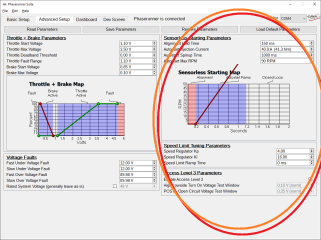
There is a section just for Sensorless Startup, and I could reduce the amps from the IIRC 45A there to something much smaller whcih should reduce it's ability to jerk the trike around, since the rightside wheel still has plenty of startup power to get it going the first tiny bit that lets the left one get into the sensorless-running-fine speed range.

But I don't know for sure that's what this setting means....


So...any ideas are appreciated; the more specific, the better.

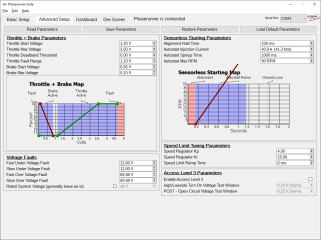
This image is from the other thread, as far as I know all of the settings shown should still be identical (the only thing I changed is turning off any use of the hall sensors)
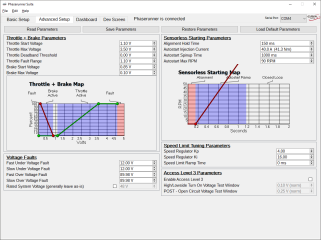
1752821020541.png
 
Maybe the short altered a setting somewhere? Happened to me on a CA V3, so maybe it can happen here too?

You can play with the Feedback Bandwidth Tuning settings. Check this help page and read about the various Regulation Control Loops. The Current Regulation Control Loop was where I noticed the biggest change in the jitter. I'd start there. Try changing one value at a time, when that's as good as it's going to get then move on to the next value. You might have to go back to the first value again. PLL Bandwidth can smooth acceleration further and Damping can effect this as well.

I found out that there are 2 different settings that are saved. One saves the motor default parameters and the other saves all other info. Meaning that if you do a "reset" of the controller, the motor parameters do not change. So if you want to purge your settings and start over, be sure to "reset" AND load any other motor default parameter, then back again, to "reset" the motor default parameters.
 
Last edited:
Well, personally I wouldn't call this "jitter". That's usually a slight rocking back and forfh when it should be holding a position, in my limited experiences with assorted motor control. So I'm not sure if the same "fixes" apply.

What is happening here is what I would call jerking: a large amount of rotation in the wrong direction, then at least that much in the right direction, then at least that much in the wrong direction, then back to the right direction. I'ts enough to shove the trike back and forth an inch or few and throw me around painfully.

If I'm at a slow enough speed, it doesnt' stop this jerking, normally, but a couple of times it has stopped jerking and placed extreme drag on the trike, as if it were trying to spin backwards for a couple of seconds, then it stops trying to do anything, then it resumes forward motion if I've sped up enough or resumes jerking if I have not.


As far as settings go...I don't want to clear any settings. I only want to fix this specific issue.

Operationally, the system works fine**** once ti's moving above about one mph (might be close to two; the speedo isn't responsive enough at those speeds to tell), just like it did sensored. So I don't want to mess with any settings that relate to normal operation.


So...if the tuning options within the Sensorless Start pane are the ones you're referring to for changing feedback/etc., then those I can play with...but it would be nice to have some idea of exactly where to start, parameter-wise, so I don't waste a lot of time messing with things and also so I don't change something the wrong way and break things. :(


****the only issue I really have with operation is that I wish the whole regen force thing was reversed--strongest regen at highest speed....but instead it's strongest below a speed at which I don't really need it as much, so I have to use my mechanical brakes first and then at some point at maybe half my 20mph top speed the regen begins to seriously work (it works above that, just not very much compared to lower speeds). That's part of what the other thread was about...but there's nothing I found so far that affects this).
 
What is happening here is what I would call jerking: a large amount of rotation in the wrong direction, then at least that much in the right direction, then at least that much in the wrong direction, then back to the right direction. I'ts enough to shove the trike back and forth an inch or few and throw me around painfully.
Oh, that is very different than what I've had and the Feedback Bandwidth Tuning settings may not help this. When I was tuning my motor, I never encountered the back and forth rotation you mention.

I DID have an issue when my motor wasn't operating correctly. I could hear the gears moving, but the wheel was still. That's when reloading a new "Default Parameter" for the motor ended up working. Loading the "default Parameter" cleared whatever setting was causing the rotation issue I had.
 
Oh, that is very different than what I've had and the Feedback Bandwidth Tuning settings may not help this. When I was tuning my motor,

FWIW, I'm not tuning my motor. It's already tuned, and was working fine.

The problem I am having is that a hall has failed, so now I have to run full sensorless.

This causes a startup problem, only at startup from a dead stop or attempting to run at around 1mph or less, maybe two (can't tell from the speedo reading).

The startup problem is that the wheel jerks back and forth before (usually) going forward in a perfectly normal fashion.


I never encountered the back and forth rotation you mention.

Well, if yours was a geared hubmotor, with a freewheeling clutch (indicated by it's making noise while spinning but not moving the wheel), then you wouldn't be able to have a rocking back and forth of the bike itself.

But you could have a repeated attempt to engage forward motion that might feel like a knocking, or pushing, as the motor core spins forward a bit, then the controller decides maybe its' not spnning (or not enough), then backwards, where it can freely spin, and the controller decides it's got to reverse direction again for whatever reason (since it would definitely be spinning now), and repeats this until at some point it decides things are working and it just keeps that direction.

The actual feel of it depends on the amount of torque your motor can make during the startup process at a stop--mine can make a fair bit, since between the two Ultramotors and Phaserunners, it only takes a few seconds to reach 20MPh from a dead stop, even with my couple hundred pounds and the trike's few hundred plus a couple hundred more pounds of groceries or whatever in the back.


I DID have an issue when my motor wasn't operating correctly. I could hear the gears moving, but the wheel was still. That's when reloading a new "Default Parameter" for the motor ended up working. Loading the "default Parameter" cleared whatever setting was causing the rotation issue I had.

Without being able to see what all your parameters were during the problem, and then after setting back to defaults, I couldn't say which was the culprit. But the most likely would be an incorrect autolearn. That should be fixed by simply running autolearn again, IIRC. (been a while since I had to do this)
 
Ahh. Ok. I’ve never set up sensorless parameters since I have a geared motor. I was only suggesting other settings that you could experiment with.

Not to go too far off topic, but I managed to get my motor spinning correctly only after loading default parameters. I did run the autotune many times, even reset the controller to try again, and that never worked. My only guess is, there was a deep setting (the culprit) that could only be corrected/cleared by loading a new default motor parameter.
 
Ahh. Ok. I’ve never set up sensorless parameters since I have a geared motor
FWIW, sensorless isn't exclusive to non-geared motors, and vice-versa. ;)

Sensorless just means not using any position sensors (UVW/ABC halls in the case of the Phaserunner) and only using motor phase feedback for position determination.

This can be in a geared or direct drive motor, in a hubmotor or a chain or belt drive, etc.

I used sensorless with a GMAC geared hub on the PRv6 after a mechanical problem physically damaged the hall board. (see the SB Cruiser thread for the whole series of posts on that). I couldn't ever get the PR to correctly operate with halls, even though after repairing the hall board, they did actually work in a static (manual) rotation test.

I had this same jerking back and forth issue with the GMAC in sensorless operation. Since it doesn't have a freewheel, it was basically a higher torque version of the same problem. However, probably because of the gear ratio allowing the motor to spin up faster to the point the PR can read the position by phase alone, the problem didn't happen for as long each time, so it didn't feel as bad.
 
Hey, i have not attempted to tune grin sensorless, but.. i was not happy with it on stock settings on my v1, not sure if v6 is better or if it's tuneable. ( someone correct me if i am wrong, and i may fish my phaserunner v1 out of the closet )

The VSS sensorless type drive on VESCs is absolutely fantastic though and you can tune observer gain up 2x or more in order to boost initial torque up... it does not have problems with sometimes reversing... and any funny motions happen only within the first second of acceleration, then as long as you are up to 30% of max rpm, it really operates like sensored.

I'm not sure what technical voodoo is involved, but i'm impressed.

Good plan B if the phaserunner sensorless can't be improved
 
Amberwolf, what do your Motor Settings look like? Specifically these options...

1753041718967.png
I'm curious about the Fault tolerant hall because of the description.....
1753042139225.png

Can you share a screeny of your Basic and Advanced tabs?

Hey Neptronix, the more you mention VESC, the more I want to try it. My buddy has a front motor that he is willing to give me, so I'm scoping out Spintend and other VESC to go dual motor at roughly 600W each. With a VESC, I can keep the VESC inside the bike frame. I still need to look at what regen with 2 motors would be like. I'll comb Amberwolfs trike, and other, build threads to get more ideas.
 
Amberwolf, what do your Motor Settings look like? Specifically these options...

View attachment 373718
I'm curious about the Fault tolerant hall because of the description.....
View attachment 373720
As noted in the first post in the thread, I had Fault Tolerant hall enabled, but that setting is now irrelevant because I have set Sensorless mode in Motor Position Sensor Type just above that, since I already know the halls won't work. ;)

It has the same jerky startup problem regardless of MPST setting, because of the broken hall, so it always has to work sensorless anyway.

If FTH is not enabled, and it's not set to sensorless, it will not operate the motor beyond a quick attempt because it isn't getting the third hall signal.


Can you share a screeny of your Basic and Advanced tabs?
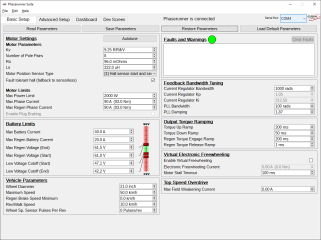
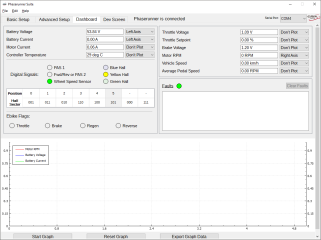
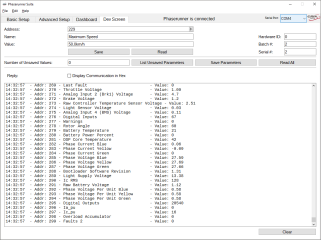
In the interest of knowledge, these are the settings last programmed in (except for the MPST sensorless setting):
PRv1-Advanced4.pngPRv1-Basic4.pngPRv1-Dashboard4.pngPRv1-Dev4.png

There's nothing in there that I would change, because the motor operates perfectly fine other than at startup, and *only* because of the sensorless issue. I don't want to change the operation of the system when it's actually spinning normally.

I would only want to change settings specific to the sensorless startup section, which I have a screenshot of at the first post in this thread. ;) (and is also included as the first one in the thumbnails above)


Hey, i have not attempted to tune grin sensorless, but.. i was not happy with it on stock settings on my v1, not sure if v6 is better or if it's tuneable. ( someone correct me if i am wrong, and i may fish my phaserunner v1 out of the closet )
Since this problem is on the v1 (or 2? don't know which it is)...I don't think it matters whether my v6 (on the other side of the trike) is more tunable? ;)


The VSS sensorless type drive on VESCs is absolutely fantastic though and you can tune observer gain up 2x or more in order to boost initial torque up... it does not have problems with sometimes reversing... and any funny motions happen only within the first second of acceleration, then as long as you are up to 30% of max rpm, it really operates like sensored.

I'm not sure what technical voodoo is involved, but i'm impressed.
It sounds good, but I don't really want to have to tune anything; the PR's both work perfectly fine *except* for the sensorless startup.

Well...other than the regen force being scaled the wrong way--high at low speeds, low at high speeds...but I'm used to it and the mechanical brake in front takes care of the rest so far. But I haven't seen any actual testing of any VESC under conditions like mine to prove that it works differently, and I don't really have time to be the fried guineapig.


Good plan B if the phaserunner sensorless can't be improved
That would require buying a new controller, which is not in the budget. I haven't seen an affordable (for me) VESC model that would be "guaranteed" reliable.

Then i'd have to build a completely waterproof casing for it, since it has to live under the trike where water splashes in our rare rains, and *will* be submerged during our once-a-year (sometimes twice) flash floods (which usually happen on my ride home from work). I haven't seen any VESC thread here that has anything good to say about waterproofing. :/


If I have to change the controller (if the PRv1 fails), I'll use the old Grinfineon; it's not FOC, and won't have much regen, but AFAICR it has good sensorless startup.

Or I can finish one of the Lebowski Honda IMA controllers i started a few years ago and *almost* finished, and see how those work for sensorless startup (if they can do it; I can't remember).
 
For now I'm considering just using a button on the bars to momentarily disable the leftside motor / PRv1(?) just for the startup process, then let go as soon as I'm moving. Have to figure out how to wire that up; most likely I'd just use a NC momentary button to interrupt the throttle signal out of the CAv3 to just that PRv1, as that's the simplest signal to deal with.

But I would need to use a relay to do this, as wiring the throttle signal all the way back up to the bars and then back down (some 20 feet of wire, I'd guess) would provide too many opportunities for problems. So the swithc on the bars would just control power (or more likely, ground) to the relay coil, and the relay would sit right there next to the PRv1 on it's heatsink plate, interrupting the throttle wiring directly inline with no detours or extra wire lengths.

While it's added complexity, it's much simpler than unlacing the motor, opening it, and replacing the hall. Or futzing around with all the PRv1's settings and possibly screwing up it's ability to run normally (or even breaking it).
 
Well...other than the regen force being scaled the wrong way--high at low speeds, low at high speeds...but I'm used to it and the mechanical brake in front takes care of the rest so far. But I haven't seen any actual testing of any VESC under conditions like mine to prove that it works differently, and I don't really have time to be the fried guineapig.

The VESC has better braking as the current increases quite a bit as you're coming to a stop. It does this better than any other controller i've used.

Then i'd have to build a completely waterproof casing for it, since it has to live under the trike where water splashes in our rare rains, and *will* be submerged during our once-a-year (sometimes twice) flash floods (which usually happen on my ride home from work). I haven't seen any VESC thread here that has anything good to say about waterproofing. :/

This is a real problem with a VESC. If you waterproof it then you also want a larger controller than you'd normally need to make up for the thermal handicap. That makes it more expensive.

I've ran my 100 phase cont. vesc in a triangle bag without a heatsink on it at average 30a batt and it did pretty well, i think for longer rides if i added a heatsink, it'd do better.
 
The VESC has better braking as the current increases quite a bit as you're coming to a stop.
That's the opposite of what's required.

Braking needs to be high force at faster speeds, to enable quick emergency deceleration--preferably strong enough to almost (or even actually) be able to lock up the wheel (just like my mechanical brake can).

Both the PR's already work the way you describe the VESC working, and I don't want that. :/

At present the braking is there, but insufficient by far, for the mass of the trike (let alone cargo) and rider, when at antyhing from 20mph down to say, 10mph. Below that it begins to get better, then there is a fairly sudden increase in braking force which continues down to virtually zero. Then I release the regen brake (left lever) and just keep holding the mechanical brake (right lever) full on, to keep from rolling if I'm on a slope, or just lightly to keep the brake lights on otherwise.


This is a real problem with a VESC. If you waterproof it then you also want a larger controller than you'd normally need to make up for the thermal handicap. That makes it more expensive.
There wouldn't be any thermal handicap, ;) because whatever solution I would have to make for it would include the same abiliyt to bolt it to a heatsink that the PR's have, if it doesn't have it's own heatsinking that I can simply leave exposed.

The PR's are just bolted to some aluminum plates that are bolted to the bottom of the trike. There's plenty of airlow, but the air temperature down there is up to 150F+ in the summer, right over the asphalt, when I'm stopped at a light where there's usually cars around me blocking off any breeze that might ohterwise help. :(

They've never overheated (none of the controllers have, AFAIK) but I don't know the controller temperatures (no way to see it live while riding); the motor temperature goes from wahtever ambient was up to about 60C by the time I get home in the summer, if I use no regen, or about 90C if I use regen normally.

I don't know what kind of FETs are typically used or how they are heatsinked, in VESCs today, but as long as they are mounted to a heat transfer bar/plate/etc I can work out how to get the heat out of that easily enough.


I've ran my 100 phase cont. vesc in a triangle bag without a heatsink on it at average 30a batt and it did pretty well, i think for longer rides if i added a heatsink, it'd do better.
I only need a few battery amps continuous for each controller; I see 800-1000w typically on the CA for total power usage while riding at the top speed of 20mph. (higher when there's wind)

At startup its at least four times that, perhaps 40A+ for each, decreasing rapidly, as I accelerate from a complete stop to 20mph in a few seconds. (remember, these are accelerating up to several hundred pounds+ at a time, at least a dozen times each way on my typical rides, for just 2-4 miles typically, then it may sit for hours).
 
Actually the braking amps are pretty even across the RPM range, only in the last few mph does the amps increase, which is perfect because it can come to a complete stop that way.

The regen feels a lot more like a mechanical brake and it's the only controller i've noticed has this characteristic.
 
For now I'm considering just using a button on the bars to momentarily disable the leftside motor / PRv1(?) just for the startup process, then let go as soon as I'm moving. Have to figure out how to wire that up; most likely I'd just use a NC momentary button to interrupt the throttle signal out of the CAv3 to just that PRv1, as that's the simplest signal to deal with.

IIUC, your problem motor is fed by PR via CA, in case it helps you:

Per CAv3 user manual, in the speed limit menu, there is "Strt Speed" speed setting, explanation of it is,

The minimum starting speed that must be reached before the CA will allow power application. This is useful for RC drives or systems with sensorless controllers that do not work well from a dead start. The rider must pedal the bike up to StrtSpeed before power is applied.
 
It's nothing to do with the CA.

It's only a problem because of the hall sensor failure.

The problem did not occur until the hall sensor failed.

The PR and motor on the other side of the trike does not have a problem; it is still running fully sensored.

The CA is not causing the problem.

I need to find out which setting *in the PR* to change *in the sensorless startup section of the Phaserunner Setup Suite* to stop or minimize the problem.
IIUC, your problem motor is fed by PR via CA, in case it helps you:

Per CAv3 user manual, in the speed limit menu, there is "Strt Speed" speed setting, explanation of it is,

The minimum starting speed that must be reached before the CA will allow power application. This is useful for RC drives or systems with sensorless controllers that do not work well from a dead start. The rider must pedal the bike up to StrtSpeed before power is applied.
 
Last edited:
Actually the braking amps are pretty even across the RPM range, only in the last few mph does the amps increase, which is perfect because it can come to a complete stop that way.
In my case, that's still the opposite of what I need.

I need higher braking forces at higher speeds, to come to an emergency stop in a much shorter distance.

I don't need higher braking forces at lower speeds, as those are more than sufficient already, plus I have the mechanical brake to hold it at a stop (since it wastes power to hold the motor in place at a stop, as there is nothing being generated by movement it can't be recovering anything).
 
Even if the problem has nothing to do with the CA, the CA can still help you out by telling the PR there's no throttle being applied until you are moving a little bit. Then the CA would start giving it throttle, but you'd already be moving, so the PR could figure out the sensor less operation without the rocking back and forth nonsense.

Would still need to get the CA a speed signal, though. Easier to do than fix hall sensors in the motor, though. Speed sensor and magnet can be setup outside on the frame/wheel/crank or one of the other motor's hall sensors can be used.

Personally, I have a CA and Baserunner system that's exactly the same. Has never started smooth ever. I always have to push off with my feet before applying throttle (or unfeathering the brake with WOT).
 
Even if the problem has nothing to do with the CA, the CA can still help you out by telling the PR there's no throttle being applied until you are moving a little bit. Then the CA would start giving it throttle, but you'd already be moving, so the PR could figure out the sensor less operation without the rocking back and forth nonsense.
Since I require the motors to do the startup and moving, then that won't help.

It would simply keep my other perfectly working motor/controller on the right side from doing the job I need it to do, which does perfeclty start from a stop with no issues, just like this one did beofre the hall was destroyed.


The CA is not a solution or a part of the problem, and nothing is going to be changed in that.

And while it is irrelevant for this issue, the CA already has a speed signal, from three magnets on the spokes of the front unpowered wheel to it's external wheel sensor. There is no speed signal from either PRv1 or PRv6 or their respective Ultramotors going to the CA.


I'll repeat:

I *only* can use a solution that will change the phaserunner's sensorless startup settings to correct or minimize the specific issue defined.


(obviously replacing the hall sensor will fix it too, but I don't know when I will be able to do all the required work to do this).
 
Pretty easy to wire one CA to one motor and one to the other IMO.

Why would I buy another CA and cut up my trike wiring, splice in all my stuff to that, find a place to mount it, go thru all the setup for it, etc., when there is a "page" of settings just to help with the situation I have, right in the PR?

If I want to keep the broken-hall motor/controller from jerking around at startup, I can just do what I said previously, and add a button / relay for that. :(

Would probably take an hour or less even if I do it "right" instead of the 10-minute hack, and cost nothing for parts I already have laying around, vs a couple hundred dollars in parts and several hours (at least) of time (assuming nothing goes wrong and I don't break anything else in the process of rewiring the CA's, splicing things in, etc). Would be faster and much cheaper and honestly less work to unlace the motor, open it, and replace the hall.


If I could just get replies that actually discuss the "page" of settings right in the Phaserunner Setup Suite just to help with the situation I have, as a solution, it would be helpful. :/
1752821020541.png
 
Back
Top