• Hello ES! We could use some help to get us past the finish line on building the new knowledgebase for the forum.
    Can you donate? Please see our fundraising page. Thank you!

Motor Design: How to pass the 250W power standard?

offGridDownUnder

Power poster
Joined
Aug 28, 2021
Messages
1,133
Location
New South Wales
This is a technical question, and I'd prefer not to discuss other issues here. I don't want philosophy, I am asking about practical engineering approaches.

For now, presume a 500W-rated Direct Drive hub motor. What internal modifications would lead to this motor failing a 500W power restriction and passing a 250W power restriction test?

Where I live, in a legal case, the authorities may seize a bike they suspect is unlawful, and subject it to testing to determine the matter. I don't care how likely this is, I want to know technically what could be done to ensure a motor passes the 250W continuous power test. Regardless of the source parts, a motor that is permanently modified to meet the restriction is probably defensible in court - replacing internal components to (truthfully) meet the standard, rather then relying on external configuration (which is explicitly disallowed by local laws).

I know that a 250W rated motor may pass 1000W or more for short times and that this is not what the limit means. The limit means that the motor will not provide 1000W for more than a short time (or anything beyond 250W for a short time, but can provide 250W indefinitely).
  • Is rewinding the motor the only way?
  • Is redesigning the casing to cause overheating the only way?
  • Is adding an internal circuit board that monitors power and time adequate?
I like the last because of my thought that this means the motor provides the same torque at the lower power levels as it does from the factory - it just won't maintain high power for long times.

But I'm not knowledgeable about motor power electrics and that's what I want to ask about. I am looking for a copy of the EU15194 spec and other sources for how the measurement is actually done for certification, but I think the general question can be addressed based on the general physics of DD motors, so I want to start learning about options.

Moderator - please move this to the best forum to be visible to people who know about motor physics. Thanks.
 
This is a technical question, and I'd prefer not to discuss other issues here. I don't want philosophy, I am asking about practical engineering approaches.

For now, presume a 500W-rated Direct Drive hub motor. What internal modifications would lead to this motor failing a 500W power restriction and passing a 250W power restriction test?

Where I live, in a legal case, the authorities may seize a bike they suspect is unlawful, and subject it to testing to determine the matter. I don't care how likely this is, I want to know technically what could be done to ensure a motor passes the 250W continuous power test. Regardless of the source parts, a motor that is permanently modified to meet the restriction is probably defensible in court - replacing internal components to (truthfully) meet the standard, rather then relying on external configuration (which is explicitly disallowed by local laws).

I know that a 250W rated motor may pass 1000W or more for short times and that this is not what the limit means. The limit means that the motor will not provide 1000W for more than a short time (or anything beyond 250W for a short time, but can provide 250W indefinitely).
  • Is rewinding the motor the only way?
  • Is redesigning the casing to cause overheating the only way?
  • Is adding an internal circuit board that monitors power and time adequate?
I like the last because of my thought that this means the motor provides the same torque at the lower power levels as it does from the factory - it just won't maintain high power for long times.

But I'm not knowledgeable about motor power electrics and that's what I want to ask about. I am looking for a copy of the EU15194 spec and other sources for how the measurement is actually done for certification, but I think the general question can be addressed based on the general physics of DD motors, so I want to start learning about options.

Moderator - please move this to the best forum to be visible to people who know about motor physics. Thanks.
So when they test, will they be testing until the motor fails, burns up? I'm not sure there's another way. An internal modification might be to open up the motor and put fuses in series with each phase wire that are sized to blow above 250W.
 
So when they test
I'm searching for the text of the specification. if you can find it, you'd help by posting the link here so others could read it as well.

I don't think destruction is required - I have seen references that suggest the motor throttling back is tested and adequate. I'll focus on getting the Australian legal spec - I have standing to get access and it's what I care about.

People who do know motor design can comment on what changes will distinguish between a 500W rated motor and a 250W rated motor in general.

I don't care if a manufacturer rates the changes required - the current laws do not exclude private engineering efforts. I want to know about motor power physics, and also I want to know what may pass the test - I understand I'll need to find a test specification to be certain.
 
I'm searching for the text of the specification. if you can find it, you'd help by posting the link here so others could read it as well.

I don't think destruction is required - I have seen references that suggest the motor throttling back is tested and adequate. I'll focus on getting the Australian legal spec - I have standing to get access and it's what I care about.

People who do know motor design can comment on what changes will distinguish between a 500W rated motor and a 250W rated motor in general.

I don't care if a manufacturer rates the changes required - the current laws do not exclude private engineering efforts. I want to know about motor power physics, and also I want to know what may pass the test - I understand I'll need to find a test specification to be certain.
Justin's take:
 
Its something I looked into once. I live in Europe (Ireland). If you read the European standard,EN 15194, reference is made to certification under the EN 60034-1 standard, where the 'continuous' rating has a specific meaning that seems to be calculated with some type of mechanical load test under thermal equilibrium conditions etc
I think its up to the bike manufacturer/supplier to get this certification as its expensive.

I think in practice, its mainly a certification issue. i.e. having 250w written on the motor etc.

I think the same motor can have different ratings to take into account the different environments so it can be sold to different markets or put to different uses.

Anyhow, an older outdated version of the document EN 60034-1 is available below. (70 pages pdf)
(Up to date copies are not free)
 
Last edited:
Justin's take
Justin isn't admissible in court, and this thread isn't about what Justin thinks.

Do you have any motor engineering expertise to contribute? Or do you have any knowledge of the 250W motor certification tests?

Other stuff can go in a thread you start to discuss other stuff.
 
Or do you have any knowledge of the 250W motor certification tests?
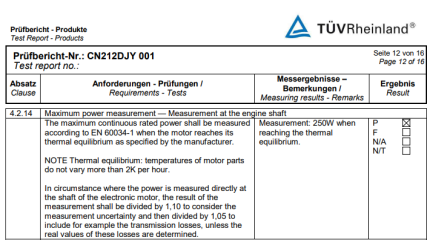
It is helpful to search for "EN 15194 Certification test report". You can find several PDFs, where the test methods are described. Example:

But especially the information about the maximum rated continous power measurement is tricky :)

1768292768938.png

In the quoted EN60034-1 a "maximum continous rated power" is not mentioned at all, see #5 o_O

Bosch says:
Rated continuous output describes the mechanical power that your drive unit can provide continuously without the components overheating or being damaged. Under EU law, the mechanical rated continuous output is limited to 250 W – this applies to all eBikes and eBike motors.

Perhaps you should add an algorithm to your controller firmware, that detects a test bench situation and adds a certain amount of id to the motor that produces no torque, just heat, to fool the tester. Bosch is experienced in doing such tweaks :ROFLMAO:
 
Last edited:
It is helpful to search for "EN 15194 Certification test report". You can find several PDFs, where the test methods are described. Example:

But especially the information about the maximum rated continous power measurement is tricky :)

View attachment 383223

In the quoted EN60034-1 a "maximum continous rated power" is not mentioned at all, see #5 o_O

Bosch says:


Perhaps you should add an algorithm to your controller firmware, that detects a test bench situation and adds a certain amount of id to the motor that produces no torque, just heat, to fool the tester. Bosch is experienced in doing such tweaks :ROFLMAO:
I think the sentence "The maximum continuous rated power shall be measured according to EN 60034-1........" should be read as "The maximum continuous rated power shall be measured according to EN 60034-1........" rather than as
"The maximum continuous rated power shall be measured according to EN 60034-1........"
There is a difference. EN60034-1 measures 'continuous rated power' and as you say makes no mention of 'maximum continuous rated power'
Also, I came across instances in industry where motors were rated at much lower temperatures than they were capable of for safety reasons to prevent burns to operators etc
 
Last edited:
A motor cannot generate more power that is provided by the controller.
If you only want 250W going to the motor them get a controller that can only provide 250W.
 
Also, I came across instances in industry where motors were rated at much lower temperatures than they were capable of for safety reasons to prevent burns to operators etc
Hmmm. That's a bag of worms?

That might suggest the manufacturer can rate the motor as they chose, but language I've read in the various State's ebike law explanations here suggest that the Police can test a seized motor - that means an independent standard to meet.

They would do this in pursuit of a charge of operating an unlicensed vehicle on the road - quite a different matter than riding a bike, and if there were significant liability or political issues they will do this. If an insurance company is involved, they would push very hard to have this in the hope of excusing themself from having to pay out. Or they might flatly assert it and it would fall on me (say) to prove them wrong.

One next step is for me to pursue details of what test authorities here might use to decide the question. I am considering the idea of re-manufacturing an existing motor to qualify. I do not have the capital to do this in quantity, but it is a legitimate reason to ask the relevant government bodies for the information. After I discover who those are.

There is still the question of what to do physically. Yes, that will depend on the requirements, but it's still true that "EN60034-1 measures 'continuous rated power'".

So, what does 'failure' mean? Perhaps failure does not mean 'explodes, killing all in the testing lab'. Maybe it can also mean 'cuts out'?

The 2007 copy of the EN60034 standard provided by @Sturmey says:
5.5.3 Motors
The rated output is the mechanical power available at the shaft and shall be expressed in
watts (W).

The EN15194 language suggests running the motor to temperature equilibrium, then noting that it can sustain shaft output of 250W, but not sustain shaft output greater than that - so how would the motor respond to 'greater than that' to signify failure? Would it just cut out?

The devil will be in the details, but I'm happy to hear comments on this way of thinking.
 
provided by the controller.
The rated continuous power is a property of the motor hardware, not of the controller firmware ;)
The only important thing in practice is a label on the motor that shows 250W. You can buy this label on eBay :ROFLMAO:
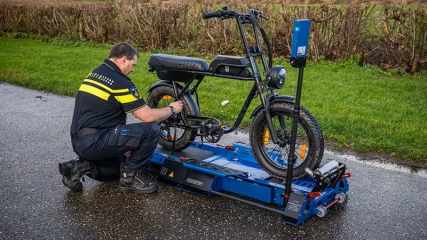
The police can measure the maximum power of a bike on a mobile test stand easily, but not the rated continuous power...
1768309253622.png
1768309039603.png
 
Last edited:
get a controller that can only provide 250W
Explicit language in the ebike laws here disallows solving the matter by external settings. It must be the motor on it's own that meets the 250W rating, however that is measured. By law here, the controller cannot be the solution.

Do you happen to know how Australia measures compliance with the 250W motor rating in cases where the manufacturer has not certified it (or if the Police or an insurance company thinks someone is lying)?
 
The only important thing in practice is a label on the motor that shows 250W.
As I wrote above, no. Not here. There are circumstances where tests will be required, and done by Police. I'm not interested in "maybe I'll get away with it". This is a thread about how to actually meet the requirement, hopefully by a permanent modification to an existing motor - as there are very few 250W rated rear hub motors.

Note: if disassembly of the motor to reverse the modification is required, I expect that qualifies as 'permanent'. It must be inherent in the motor without regard to the controller used.
 
There is a difficulty here in Ireland in the case of a third party accident . If the injured person can show that the offending bike is not a legitimate 250w ebike but instead is some kind of e-moped, they may be entitled to compensation as they were injured by a mechanical propelled vehicle instead of a bicycle. They may be able to do this as the bike may be seized by the police and be given a very close examination to see precisely what it is. There may be a lot of money at stake for the injured party.
There are some recommending that the best way to avoid this here is to purchase a fully built ebike from a (local or national) dealer supplied with a certificate of conformity. Without this certificate, it is unclear what type of bike you have.

 
Last edited:
If the injured person can show that the offending bike is not a legitimate 250w ebike but instead is some kind of e-moped
But how can he show that?! By pointing on the label on the motor?! It is well known, that every pre build bike with a Bosch middrive delivers much more than 250W continuously. No one writes in public, how this trick works, to get the official confirmation of the mystic 250W.
For DIY builds it's much safer, if the marking on the motor is done by laser, not by an adhesive label...
 
Last edited:
Do you have any motor engineering expertise to contribute? Or do you have any knowledge of the 250W motor certification tests?
Sort of. When I was in school 50 years ago, EE was mainly focused on power systems (motors and generators). Electronics and logic systems were just being developed. I did get interested in our schools electric car project that had won competitions a few years in a row. The car had regen and the school was on a hill, so we learned a bit about motors and generators at the same time. I stuck with that end of the business throughout my career, but I moved to management, but had several EEs working for me so got to keep up with developments.

I pretty much agree with Justin. Ratings for motors and generators is dependent on too many factors that aren’t standardized. It’s frustrating. I remember asking my engineers how much is that solar thermal plant was rated at, and then I’d get to hear about an hour of “it depends” for such a simple question. It depends on the criteria applied.

The only testing that counts is the criteria your government uses to test it. Nobody but they can tell you what that is.

What is your engineering background?
 
Last edited:
Justin isn't admissible in court, and this thread isn't about what Justin thinks.

Do you have any motor engineering expertise to contribute? Or do you have any knowledge of the 250W motor certification tests?

Other stuff can go in a thread you start to discuss other stuff.

I'm EU based and as far as I know, to be in compliance with UK & EU laws

When your bike is an EAPC​


An EAPC:
  • must have pedals that can be used to propel it
  • can have more than 2 wheels, for example a tricycle

It can be propelled up to 15.5mph without pedalling but only if it’s been approved.


Its electric motor:
  • must have a ‘continuous rated power’ output of no more than 250 watts
  • must not be able to propel the bike when it’s travelling at more than 15.5 miles per hour (mph)

What your EAPC must show​


Markings on the bike must show both:
  • the continuous rated power output
  • the bike manufacturer

It must also show either:
  • the battery’s voltage

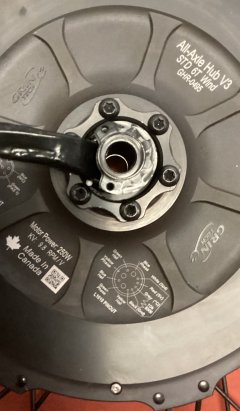
Because of these rules I chose to use Grin motors that are laser etched with 250W Max

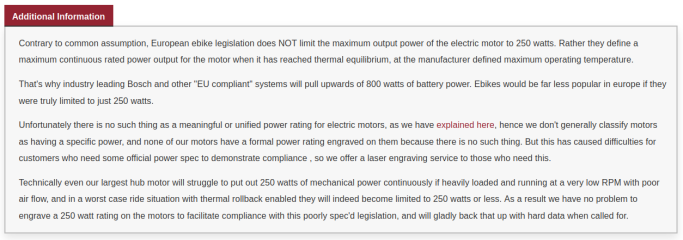
Which Grin claim to be able to "back up with hard data when called for" which I presume would be admissible in Court......


"European ebike legislation does NOT limit the maximum output power of the electric motor to 250 watts. Rather they define a
maximum continuous rated power output for the motor when it has reached thermal equilibrium, at the manufacturer defined maximum operating temperature"

Any tests performed by 3rd parties to test a motors power would theoretically have to match the motor manufactures testing procedure/parameters and rating when it has reached thermal equilibrium, at the manufacture defined maximum operating temperature.

Any 3rd party tests that were not performed according to the manufactures defined operating temperature would then, surely, be inadmissible in Court.

I'm hoping to never have to test this out in Court.


Screenshot from 2026-01-13 17-51-18.png

AllAxle250Wmax.jpg
 
Last edited:
"European ebike legislation does NOT limit the maximum output power of the electric motor to 250 watts. Rather they define a maximum continuous rated power output for the motor when it has reached thermal equilibrium, at the manufacturer defined maximum operating temperature"
I wonder whether Statorade would influence the results. Might make it worse, allowing high power at the same operating temps.
 
We know power output is proportional to torque x rpm. I have wondered how technically difficult it would be to map torque against rpm, and program a controller to deliver the full 250W output down to very low road speed, by modulating amps vs motor speed. By using this technique with a motor that is capable of high output torque, the power restrictions could be observed strictly, while allowing much better initial acceleration and steep climbing than a typical 250W machine. Perhaps it could even be programmed to exceed the statutory output for short durations, to mimic the power delivery of commercial bikes.

This is outside of my knowledge and expertise because I don't program controllers, but I am still curious how feasible it would be. I also wonder whether any commercial e-bikes use this method? If not, then why not?
 
I also wonder whether any commercial e-bikes use this method? If not, then why not?
Why should they??? The usual power of eBikes is much higher than 250W. The peak power is not limited at all. This 250W rated continous power is just a number on the paper.
 
Last edited:
In my experience, if you ask a sales person if something is possible they are almost always going to say yes. They usually don't bother to ask an engineer because that could cost them the sale. Politicians are the same way.
 
Back
Top