Suggestion for new firmware
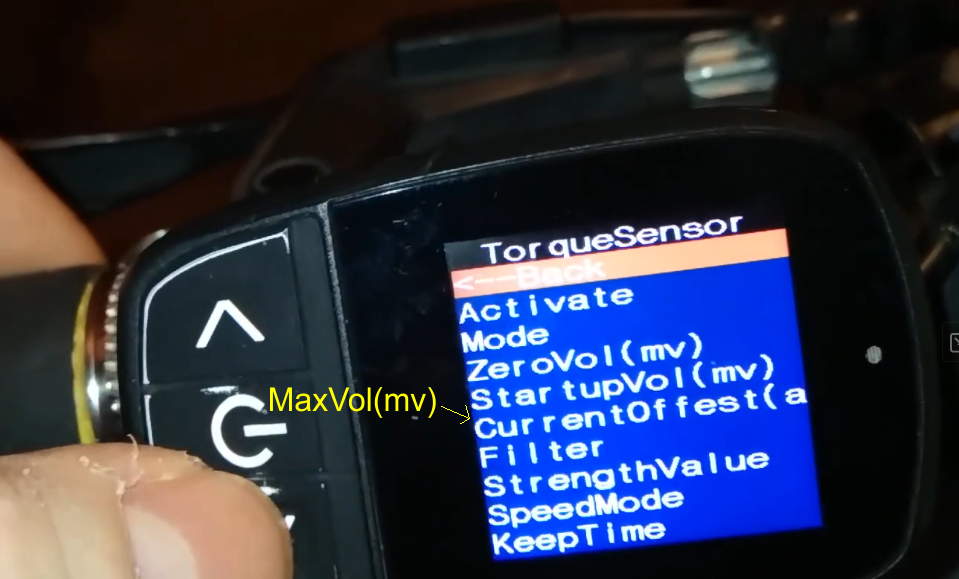
In torque sensor section add MaxVol(mv) option
Reason
We as community on dedicated discord channel have established that not every torque sensor acts in the same way.
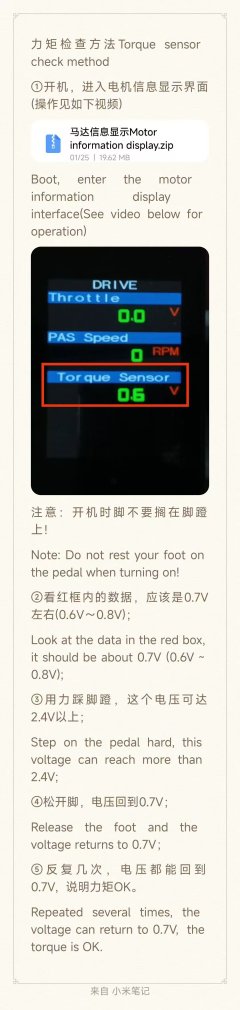
Some users report that they can reach max 3.0V relatively easily just by pressing harder on the pedal with their foot while standing still.
However my torque sensor appears to be less sensitive. I have to put a lot of force to reach 2.0V.
The highest value I have seen while riding uphill without assist was 2.5V.
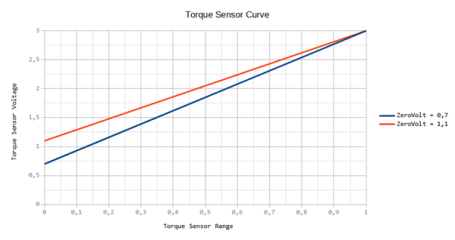
I believe that firmware uses fixed 3.0V as max for assist curve.
View attachment 391964
Added MaxVol option would allow me to compress whole range according to real max value I can achieve on my torque sensor. So instead of 3.0V I would like to set max to 2.5V. This would give me a better dynamic response.
Dear Customer,
Thanks for the detailed feedback. We actually saw this same old-vs-new sensor difference during our own R&D and production runs.
There are two different things here: the sensor's hardware output range, and how the controller interprets that signal for torque calculation and assist.
The analog front-end outputs roughly 0–3.3 V. Zero point depends on the sensor and calibration. The 3.3 V ceiling is from the analog circuit, not a firmware limit at 3.0 V.
We've changed the sensor characteristic over time. Earlier batches were more sensitive; users could reach the upper range with light pedaling. Strong assist feel, but the response wasn't as predictable as we wanted.
Newer calibration uses lower sensitivity and a wider linear range. Takes more pedal force to hit 3.0 V or above, which gives users better resolution across normal pedaling forces, and the assist feels smoother and more progressive.
On the "MaxVol" adjustment question:
When the DM motors first launched, we made many parameters adjustable, thinking power users would appreciate the flexibility. But after seeing many real-world cases, we also learned that some problems could be caused by parameter combinations that pushed the system outside its intended operating conditions.
The problem is that these parameters aren't independent.
Change torque scaling, and you change how pedal force maps to calculated torque, which changes assist and current draw. Factor in gearing, cadence, rider weight, terrain, a small adjustment can significantly change thermal and mechanical loads on the motor and gears.
And when something breaks, it's hard to tell from the outside if it was a component issue, a config issue, or both.
So we made a deliberate engineering decision: not every internal parameter needs to be user-tunable.
Not because we don't value community input; on the contrary, we do, and we rely on it. But we'd rather keep complex calibration on our side, so the user-facing system stays robust and predictable.
Of course, we should definitely do a better job documenting the recommended settings. But docs and user-accessible tuning are separate things. Some parameters are fine for diagnosis or factory use without being appropriate as everyday user settings.
In other words, we don't want to give riders access to every internal parameter just for the sake of having more settings. We would rather make sure the system works correctly without requiring the rider to understand or manage those parameters.
That's why we prefer handling torque sensor characteristics through controlled calibration strategies, rather than asking riders to manually tune a "MaxVol" value without knowing the exact characteristics of their individual sensor.
We do see value in providing diagnostic or calibration tools for advanced users and technicians. But for the average rider, we believe a motor that is properly calibrated and validated from the factory provides a much better experience than one that requires the rider to engineer the system themselves.
We'll pass your suggestion to our firmware team and consider whether there is a better way to compensate for unit-to-unit sensor variation.
And we really appreciate the thorough testing you've done on our DM system and the time you've taken to share your findings. This is exactly the kind of technical feedback that helps us keep improving our motor products.
Toseven Support Team