

If you search aluminum flat bar on Amazon, there are a lot of precut options to choose fromThat's comforting to know, I'll keep padding to a minimum then.
That's a good idea! I might end up attaching an aluminum sheet to the bottle brackets so I can easily mount the controller under the frame and give the battery more area to rest on. Between that and a bracket to keep the battery clear of the shock, I'd feel confident about the battery having enough area to rest on.
A few mm of ABS plastic surrounding the battery sounds doable, plus it would let me integrate a lock into the case. I'll look into how much time and money that will take as opposed to these other options. Thanks!

-
Hello ES! We could use some help to get us past the finish line on building the new knowledgebase for the forum.
Can you donate? Please see our fundraising page. Thank you!
You are using an out of date browser. It may not display this or other websites correctly.
You should upgrade or use an alternative browser.
You should upgrade or use an alternative browser.
Full Suspension Leaf Bike 1500W Build
- Thread starter GoFastGus
- Start date

When I was building my ebike, I used 6mm polycarbonate panel i cut into a strip and bent:

Nowadays, I would probably build a fiberglass box instead, but nevertheless this construction is still operational. I enclosed the battery pack itself in another layer of 2mm PC to allow removal for charging away from the bike:

The main box is held with 4 bolts going into water bottle mounts, as well as a pipe bracket around a top pipe. It's way more secure than any bag, imo.
Nowadays, I would probably build a fiberglass box instead, but nevertheless this construction is still operational. I enclosed the battery pack itself in another layer of 2mm PC to allow removal for charging away from the bike:
The main box is held with 4 bolts going into water bottle mounts, as well as a pipe bracket around a top pipe. It's way more secure than any bag, imo.

GoFastGus
⚡ Regular
I like this idea! I'd make a triangle of brackets out of metal with points to attach side panels. Then I'd make side panels out of ABS or wood. I could either hold the sides together using screws, or I could integrate a cabinet lock. If the brackets are connected to the frame and the side plates are connected to the brackets, that solves my battery mounting problem.When I was building my ebike, I used 6mm polycarbonate panel i cut into a strip and bent:
View attachment 388189
Nowadays, I would probably build a fiberglass box instead, but nevertheless this construction is still operational. I enclosed the battery pack itself in another layer of 2mm PC to allow removal for charging away from the bike:
View attachment 388190
The main box is held with 4 bolts going into water bottle mounts, as well as a pipe bracket around a top pipe. It's way more secure than any bag, imo.
GoFastGus
⚡ Regular
I'm not yet sure if I want to choose aluminum flat bar or steel sheet for my brackets. Thickness vs. strength is my primary concern, but price per sq foot matters a lot to me too. Thanks for the rec!If you search aluminum flat bar on Amazon, there are a lot of precut options to choose from
You probably don't need it. ABS is flexible, but if you form the perimeter of the enclosure using a single piece, once you bond/glue/epoxy the ends together, it get's pretty rigid. It doesn't need to be too rigid anyway, since you are really are only trying to distribute the weight across a larger surface area than the curved downtube does.I'm not yet sure if I want to choose aluminum flat bar or steel sheet for my brackets. Thickness vs. strength is my primary concern, but price per sq foot matters a lot to me too. Thanks for the rec!
GoFastGus
⚡ Regular
To clarify, are you saying I could use ABS for all my brackets? I need to make a bracket to hang my controller from the bottom tube of my frame (probably using flat top screws on the bottle brackets), a bracket to keep my battery clear of the suspension, and some sort of case for my battery. Buying ABS plastic is more expensive than used sheet steel by the sq. foot, so I'm inclined to use sheet metal for brackets supporting the battery so I don't need to buy as much ABS. Besides, the controller bracket would still provide more surface area for the battery pack.You probably don't need it. ABS is flexible, but if you form the perimeter of the enclosure using a single piece, once you bond/glue/epoxy the ends together, it get's pretty rigid. It doesn't need to be too rigid anyway, since you are really are only trying to distribute the weight across a larger surface area than the curved downtube does.
GoFastGus
⚡ Regular
As an additional reference, this is my rough CAD mockup of my bike frame's tubes, the battery (with padding), and the current version of my controller bracket. For reference, anything left of the dotted line would interfere with the suspension, so it is effectively where my back bracket will go. As you can see, everything is a very close fit, but if I took away the padding I would have a few extra mm on all sides for a case. Since making a case will be several hours worth of planning and work, I'll probably end up holding the battery in place using a ratchet strap or 1" wide hook and loop fasteners wrapped around all sides of the battery at first, since that's more readily available. Whatever case I design will need a reliable way of locating the battery to the frame.

To hold the battery on the frame, I recommend buying 3 of those:

And using the bottom part with two bolts going through the case. This is an inexpensive solution that works very well and you can buy an appropriate size for your given frame.
And using the bottom part with two bolts going through the case. This is an inexpensive solution that works very well and you can buy an appropriate size for your given frame.

GoFastGus
⚡ Regular
Looks interesting! What are they called?To hold the battery on the frame, I recommend buying 3 of those:
View attachment 388215
And using the bottom part with two bolts going through the case. This is an inexpensive solution that works very well and you can buy an appropriate size for your given frame.

scianiac
🚴♂️ Mega poster
- Joined
- Oct 24, 2018
- Messages
- 1,030
Based on your planning I assume you don't have a 3D printer — like you know how to use CAD clearly — so have you considered seeing if anybody you know has one or using one of the online services? Similarly using sendcutsend to cut the sheet aluminum, polycarb, whatever material you want.
I just remember the days when I would try to find just the right part at the hardware store or somewhere online, and they were always sorta right but then you try it and they don't quite fit and you spend forever just trying to bolts random bits together. Now I just design it exactly like I want — so it fits juuuust perfect — all the hardware ready to set right in and print it off. Doesn't fit, tweak it and print again, printers just make this type of stuff — mounting things, brackets, supports, cases, etc — so easy it's silly.
I just remember the days when I would try to find just the right part at the hardware store or somewhere online, and they were always sorta right but then you try it and they don't quite fit and you spend forever just trying to bolts random bits together. Now I just design it exactly like I want — so it fits juuuust perfect — all the hardware ready to set right in and print it off. Doesn't fit, tweak it and print again, printers just make this type of stuff — mounting things, brackets, supports, cases, etc — so easy it's silly.
Pipe clamps. You can always search-by-image as wellLooks interesting! What are they called?

And cheap. Filament is really cheap.Now I just design it exactly like I want — so it fits juuuust perfect — all the hardware ready to set right in and print it off. Doesn't fit, tweak it and print again, printers just make this type of stuff — mounting things, brackets, supports, cases, etc — so easy it's silly.
You can even make a removable battery by wedging it in the frame and securing with just one bolt somewhere, thats what I did.
Attachments

scianiac
🚴♂️ Mega poster
- Joined
- Oct 24, 2018
- Messages
- 1,030
God is it cheap, I print so much stuff out of this $8/kg Geeeeeeeeeeeeeeetech ABS and it prints great, strong, impact resistant, easy to solvent weld into large parts like battery cases, glorious.And cheap. Filament is really cheap.
GoFastGus
⚡ Regular
I have access to a 3D printer and PLA & PETG filament. I'd have to buy any other filament. I'll need to check bed size vs. part size.Based on your planning I assume you don't have a 3D printer — like you know how to use CAD clearly — so have you considered seeing if anybody you know has one or using one of the online services? Similarly using sendcutsend to cut the sheet aluminum, polycarb, whatever material you want.
Oh I 100% agree, I used a 3D printer for mocking up designs of my torque arms and other brackets.I just remember the days when I would try to find just the right part at the hardware store or somewhere online, and they were always sorta right but then you try it and they don't quite fit and you spend forever just trying to bolts random bits together. Now I just design it exactly like I want — so it fits juuuust perfect — all the hardware ready to set right in and print it off. Doesn't fit, tweak it and print again, printers just make this type of stuff — mounting things, brackets, supports, cases, etc — so easy it's silly.
GoFastGus
⚡ Regular
Thanks! I had tried reverse image searching without any luck, I'm not very good at it yet.Pipe clamps. You can always search-by-image as well
GoFastGus
⚡ Regular
My current game plan for mounting the battery is gonna use sheet steel and quarter-turn fasteners.

My plan is to have a bottom bracket that mounts onto the bottle bolts. It'll mount the controller under the down tube, and it'll have side tabs that line up with holes in the side panels that I can put quarter-turn fasteners through. I haven't cadded it up yet, but I'm gonna have top brackets that wrap over the top tube and attach to the side panel the same way. Each panel will have 4 fasteners, 2 on the top, 2 on the bottom. The shunt will probably be mounted on top of the top tube using the aforementioned brackets.
Cost breakdown: <$5 for the sheet steel, ~$20 for the 10 fasteners from Amazon.
Alternatively, I could design two half shells made from ABS that wrap around the frame using hose clamps. I'm not confident that a controller bracket made from bent ABS (let alone multiple pieces bonded together) would be able to reliably hold up the controller. What do other people think?
Cost breakdown: $10 for 1Kg of ABS filament, $5-10 for ABS bonding agent, spare hose clamps are free.
My plan is to have a bottom bracket that mounts onto the bottle bolts. It'll mount the controller under the down tube, and it'll have side tabs that line up with holes in the side panels that I can put quarter-turn fasteners through. I haven't cadded it up yet, but I'm gonna have top brackets that wrap over the top tube and attach to the side panel the same way. Each panel will have 4 fasteners, 2 on the top, 2 on the bottom. The shunt will probably be mounted on top of the top tube using the aforementioned brackets.
Cost breakdown: <$5 for the sheet steel, ~$20 for the 10 fasteners from Amazon.
Alternatively, I could design two half shells made from ABS that wrap around the frame using hose clamps. I'm not confident that a controller bracket made from bent ABS (let alone multiple pieces bonded together) would be able to reliably hold up the controller. What do other people think?
Cost breakdown: $10 for 1Kg of ABS filament, $5-10 for ABS bonding agent, spare hose clamps are free.
If it's a solid piece and not a print, and thick enough, then it will be more than strong enough. I still would prefer PC to ABS as that's a bit less brittle I think. If you print stuff, you can just make it stronger again if the first iteration breaks, it's really not a big deal. Controllers aren't that heavy either way.I'm not confident that a controller bracket made from bent ABS (let alone multiple pieces bonded together) would be able to reliably hold up the controller.
GoFastGus
⚡ Regular
Even if I heat and bend some 90 degree angles in the plastic?If it's a solid piece and not a print, and thick enough, then it will be more than strong enough.
Both are good picks, they both have good impact resistance and bending strength. I'd likely take ABS purely for price.I still would prefer PC to ABS as that's a bit less brittle I think.
If i was going to 3D print parts, I'd print out the side plates because there aren't any moments outside that concentrate stress at bends in the plastic, i.e. all fasteners are within and on the same plane as the side plate. (I think I'm using that terminology correctly?)If you print stuff, you can just make it stronger again if the first iteration breaks, it's really not a big deal. Controllers aren't that heavy either way.
scianiac
🚴♂️ Mega poster
- Joined
- Oct 24, 2018
- Messages
- 1,030
That depends a ton on what PC and how it's printed. ABS is pretty much all the same but I've tested some PC that's pretty shit and some that's incredibly impact resistant. And the issue often is part size and layer bonding on PC starts to lead to a weaker final part in some areas even with heated chamber and high temp printing. Sure you can add carbon to the PC to print larger parts without as much internal stress but there goes your impact resistance.I still would prefer PC to ABS as that's a bit less brittle I think.
I use so many ABS prints in way way higher stress parts than a controller mount and have had very few failures, normally not the part's fault.
GoFastGus
⚡ Regular
Update:
I put my bike shock bushings in a lathe so I could actually install the shock. Here's a pic of the shock installed (but not rebuilt, so only halfway done). It makes it a lot easier to transport around town and up stairs now, but it'll be even easier with a motor and brakes.

Speaking of brakes, the bane of my existence continues to haunt me. After inserting the Bleedzone bleeding edge adapter into the caliper's bleeding edge port and it clicking into place, I couldn't move any fluid into the caliper. After forcing the plunger down, I blew the adapter off the tube. Here's a photo of the aftermath after I re-attached the adapter fitting.

I tried to bleed the brakes both with and without the hose and lever attached, and had no success on either attempt. I'm starting to think the caliper is the root of the problem (and I'm cursing myself for saving $20 and buying a used caliper off of Amazon, basically forgoing a warranty). Are there ways to test that the caliper is truly the problem as opposed to something else? Are there other solutions besides asking Bleedzone for another tube to confirm the adapter fitting isn't the issue, buying another caliper, or just switching to a mineral oil system?
I put my bike shock bushings in a lathe so I could actually install the shock. Here's a pic of the shock installed (but not rebuilt, so only halfway done). It makes it a lot easier to transport around town and up stairs now, but it'll be even easier with a motor and brakes.
Speaking of brakes, the bane of my existence continues to haunt me. After inserting the Bleedzone bleeding edge adapter into the caliper's bleeding edge port and it clicking into place, I couldn't move any fluid into the caliper. After forcing the plunger down, I blew the adapter off the tube. Here's a photo of the aftermath after I re-attached the adapter fitting.
I tried to bleed the brakes both with and without the hose and lever attached, and had no success on either attempt. I'm starting to think the caliper is the root of the problem (and I'm cursing myself for saving $20 and buying a used caliper off of Amazon, basically forgoing a warranty). Are there ways to test that the caliper is truly the problem as opposed to something else? Are there other solutions besides asking Bleedzone for another tube to confirm the adapter fitting isn't the issue, buying another caliper, or just switching to a mineral oil system?
scianiac
🚴♂️ Mega poster
- Joined
- Oct 24, 2018
- Messages
- 1,030
You shouldn't have to apply very much pressure to push oil into the caliper if the lever reservoir is open and lever is not depressed. I'm not familiar with sram brakes so I'm just guessing based on the picture. You insert the adapter into that port and then it looks like you rotate the adapter which looses the bleed screw inside the port, if you didn't loosen it enough no oil can flow.

lnanek
🚴♂️ Mega poster
I've never bled SRAM brakes, but the Internet claims you also have to rotate the bleeding edge tool, not just click it in:After inserting the Bleedzone bleeding edge adapter into the caliper's bleeding edge port and it clicking into place, I couldn't move any fluid into the caliper.

GoFastGus
⚡ Regular
I thought I had unscrewed it enough, but i suppose not. I'll try again tomorrow.I've never bled SRAM brakes, but the Internet claims you also have to rotate the bleeding edge tool, not just click it in:
View attachment 388398
GoFastGus
⚡ Regular
It's been a couple months, figure I'll post an update about what I've been up to:
You all were right and then some about the brakes, I butchered the bleed process. After a few attempts and replacing o rings and compression fittings, the brakes work pretty well now. The brake handle is painted everywhere, including on top of the master cylinder port, which makes getting paint flakes into the brake fluid really easy if you overfill or get any fluid on the handle.
I rebuilt my Fox Float RP23 to the best of my ability. I replaced as many o rings as I could, I replaced the shock oil, and I bled the shock as best I could.
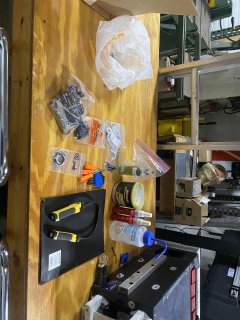
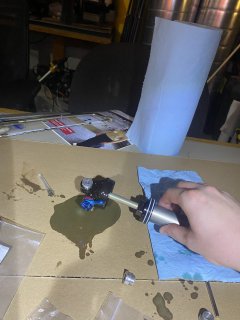
When trying to fill the IFP port, the shock puked oil out of the rebound adjustment knob. Gonna have to tear it down, find the problem, and rebuild it.
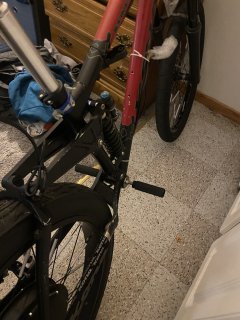
In less frustrating news, I made foot pegs out of bmx pegs, 3/8"-24 threaded rod, some nuts, and some washers. They hold up pretty well so far, I'll let y'all know if I make any more changes.
I also redesigned my right torque arm so it attaches to the frame via a bolt hole instead of snugly fitting into the corner. I still need to cut it out of metal.
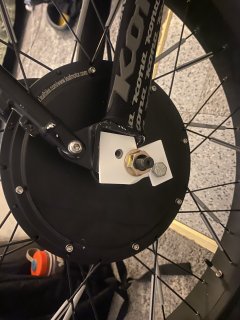
The bolt is 3/8"-24, so it'll be able to take all the punishment that the hollow axle side can give it.
I also finished mocking up my battery box. This is an older version where I still had the attachment tabs outside the triangle, but it fits my battery and controller.
This is what my current design looks like. As you can see, the controller will attach below the bottom tube using the C brackets. I still need to make it out of ABS plastic and purchase the quick release fasteners to hold it all together.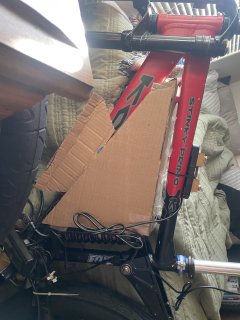
You all were right and then some about the brakes, I butchered the bleed process. After a few attempts and replacing o rings and compression fittings, the brakes work pretty well now. The brake handle is painted everywhere, including on top of the master cylinder port, which makes getting paint flakes into the brake fluid really easy if you overfill or get any fluid on the handle.
I rebuilt my Fox Float RP23 to the best of my ability. I replaced as many o rings as I could, I replaced the shock oil, and I bled the shock as best I could.
When trying to fill the IFP port, the shock puked oil out of the rebound adjustment knob. Gonna have to tear it down, find the problem, and rebuild it.
In less frustrating news, I made foot pegs out of bmx pegs, 3/8"-24 threaded rod, some nuts, and some washers. They hold up pretty well so far, I'll let y'all know if I make any more changes.
I also redesigned my right torque arm so it attaches to the frame via a bolt hole instead of snugly fitting into the corner. I still need to cut it out of metal.
The bolt is 3/8"-24, so it'll be able to take all the punishment that the hollow axle side can give it.
I also finished mocking up my battery box. This is an older version where I still had the attachment tabs outside the triangle, but it fits my battery and controller.
This is what my current design looks like. As you can see, the controller will attach below the bottom tube using the C brackets. I still need to make it out of ABS plastic and purchase the quick release fasteners to hold it all together.
Similar threads

- Replies
- 21
- Views
- 4,922

- Replies
- 14
- Views
- 7,297
- Replies
- 4
- Views
- 2,259


- Replies
- 26
- Views
- 13,895