• Hello ES! We could use some help to get us past the finish line on building the new knowledgebase for the forum.
    Can you donate? Please see our fundraising page. Thank you!

Fatbike or Full Suspension for next DIY College Ebike?

GoFastGus

⚡ Regular
Joined
Mar 31, 2025
Messages
217
Location
Madison, WI
Hi all, I'm planning my second ebike build after my first one got stolen. I'm at a crossroads between two directions for my build, and I'd love some input. My overall goals are something that's pretty fast, useable on streets that get brutalized by the freeze/thaw cycle, doesn't require frequent maintenance on the most expensive items, and doesn't cost a ridiculous amount for a college student.

Option 1:
2020 Framed Minnesota 2.0, size M (already own this bike)
Manitou Mastodon Comp Gen 3 fork, converted to dual crown (Rigid-hardtail debate thread for this bike)
Motor: QS205 4T rear hubmotor, laced in 24" or 26" wheel (still need to measure rear frame for maximum wheel width). NB Power might be a viable alternative if it weighs less. Welcome to other recs. Price, then power, then weight are my priorities.
Battery: 20S6P 21700 cells. Samsung 50S is the top choice at the moment. 80A continuous, 150A pulse BMS?
Controller: I need to do more research here. Phaserunner is an easy option. I think a Kelly KLS-7222H, a Sabvoton72150, or a Votol EM100 could also be good picks depending on shipping cost and ease of use. Not trying to open the can of worms of which make or model is better, just trying to figure out if any of these aren't compatible with the other listed parts so I can pick something else.
Display: My previous display was a UKC1, and I'd like something bigger. More info than just speed, watts, and charge would be nice, but my first priority is ease of reading at a quick glance (i.e. size). A TFT 750C would be my first pick, but I've only been able to find stuff showing its compatible with a Kelly or Sabvoton controller. Maybe an LCD8HU, but I think it's a similar size to a UKC1. Other recs totally welcomed!
Tires: 24x4 or 26x4 semi-slick tires (brand recs welcome)

Rough analog in the Ebikes.ca simulator:
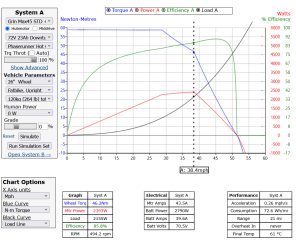
Fat Bike Sim 11-6.png
Design goals: 100lbs total. Top speed of over 60mph ideal, but 50mph acceptable. Greater than 25 mile range, preferably more. Under $2500 total if possible.

Option 2:
2010 Trek Remedy 7 (Don't own, would sell Framed Minnesota 2.0 & buy this)
Fox 40 or Rockshox Boxxer dual crown fork
Rear shock: don't have good idea of what upgrades are available for this specific frame, but I imagine something's necessary:
Swingarm: Necessary to upgrade if aluminum?
Motor: Leaf Bike 52V 1500W or 60V 2000W hub motor, 3T or 4T, 26" wheel, MXUS 3005 could also work.
Battery: EM3EV Jumbo Shark (14S5P, 52V 30A 17Ah) or Grin downtube (14S6P, 52V 40A 20Ah) These might not fit, I'd have to measure the frame if I bought it. If they don't fit, I'd explore what sort of 52V+ battery I could build.
Controller: Similar story to above. If I kept it under 60V, I could use a Grin Baserunner. There are probably also other good options from Kelly, Sabvoton, and Votol. Other controller recs are welcomed if this is the more viable option.
Display: Again, something large and easy to view with key stats. TFT 750C would be great, happy to hear other options.
Tires: 26x2.5 Maxxis Hookworms

Rough analog in Ebikes.ca sim:
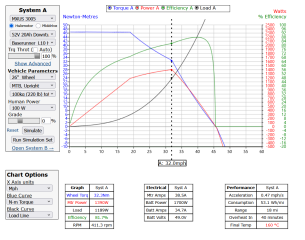
FS-MTB Sim 11-6.png
Design goals: Light enough to fit on the bus. Top speed of over 50mph ideal, but 45mph acceptable. Greater than 25 mile range, preferably more. Under $2500 total if possible.

Basically, is it worth it to sell my current bike and get an FS one instead? Does that project seem better conceived?
 
Last edited:
Just post you bike here when you get it and any issues or mods as you build it or other to learn. You come a long way quickly.
 
My overall goals are something that's pretty fast, useable on streets that get brutalized by the freeze/thaw cycle
My perception is that these are your first priorities. If correct, than I recommend full suspension no question. 2000-2010 downhill FS even better (longer suspension travel, beefier fork and frame in general, generally strong brakes, non-carbon fiber, usually inexpensive).

A hardtail bucks too much on rough roadways at speeds 20 MPH and above.
 
My perception is that these are your first priorities. If correct, than I recommend full suspension no question. 2000-2010 downhill FS even better (longer suspension travel, beefier fork and frame in general, generally strong brakes, non-carbon fiber, usually inexpensive).
Gotcha, I'm taking a look on ebay for frames rn. It looks like within my budget, my options are some early 2000s mostly single link bikes from brands like Giant, Specialized, Turner, etc. My understanding is wheelbase is key for stability at high speeds so I'm looking for something with a long frame and swingarm.
 
Although I ride NOS CBoardman full suspension framed ebikes now I also have an ebike based on the Giant Anthem frame and a Specialized Epic MSR M5 frame ready for a winter conversion. Have used the older Giant frames and they have been very good, but have to watch the frame layout around the BB if going for a mid-drive.
 
Last edited:
Given your performance goals, I'd recommend finding a steel-framed full-suspension downhill bike with disc brake compatibility, then upgrade at least the front brake to a hydraulic brake using a light-duty moto caliper with a fluid reservoir built into the lever. Then build up some DOT rims and put DOT rubber on it.

I'd also disguise it like a normal bicycle as much as possible in the context of the above, keeping the battery pack and controller hidden inside a case that looks like the frame and is painted the same color. Use a hub motor, then cover it with a rear wheel disc. Set it up with torque-sensing PAS, so you don't have to "clown pedal" at high speeds and have your legs actually adding thrust. Have a wide gearing range that is suitable for both unmotorized operation as well as high-speed operation, and everything in-between. This will deflect police attention. Have a switch to change between "unmotorized", "street legal", and "unrestricted" modes that uses a Cycle Analyst computer to set these limits, so that if the police do mess with you, you can at least claim to be operating it as a "street legal" ebike, provided they didn't see you flying by uphill at 50 mph.

The completed bike should be around 100-120 lbs.
 
Given your performance goals, I'd recommend finding a steel-framed full-suspension downhill bike with disc brake compatibility
I've been keeping an eye out for steel FS mtb frames, but they're a lot less common and usually more expensive than aluminum. I'll keep looking for steel frame recs.
then upgrade at least the front brake to a hydraulic brake using a light-duty moto caliper with a fluid reservoir built into the lever.
I need to do more research on this, but my cursory hunting turned up that calipers designed for the Surron et al. have the same IS or post mount bracket that bike forks have. This would let me run moto-style DOT brakes, but I'd still need to figure out a larger fluid reservoir.
Then build up some DOT rims and put DOT rubber on it.
I'm on the fence about bike v. DOT rims and tires. I really want the puncture resistance of DOT tires, but the extra ~10lbs of weight per wheel is making me think about the performance costs I'd be paying. As always, I need to do more research.
I'd also disguise it like a normal bicycle as much as possible in the context of the above, keeping the battery pack and controller hidden inside a case that looks like the frame and is painted the same color.
I'm definitely planning on making it as inconspicuous as possible to avoid attention from theives and cops.
Use a hub motor, then cover it with a rear wheel disc. Set it up with torque-sensing PAS, so you don't have to "clown pedal" at high speeds and have your legs actually adding thrust. Have a wide gearing range that is suitable for both unmotorized operation as well as high-speed operation, and everything in-between. This will deflect police attention.
I'm not certain if I'm going to set up a pedal drivetrain on this bike, at least at first:
1. I'm thinking about a single speed freewheel on a hub motor instead of the usual 7 speed (or 8 of 9, etc.) because it would give me more room for torque arms inside the frame. Although, if I'm going with a steel frame, I might be able to weld steel plates on to the dropouts to make torque arms.
2. If I'm building a powerful hub motor, then the pedal drivetrain is really just there for more torque when I'm going up a hill or starting and for getting better mileage with the bottom bracket. Certainly useful, but lower on my priority list than brakes, electric powertrain, etc.
Have a switch to change between "unmotorized", "street legal", and "unrestricted" modes that uses a Cycle Analyst computer to set these limits, so that if the police do mess with you, you can at least claim to be operating it as a "street legal" ebike, provided they didn't see you flying by uphill at 50 mph.
I still need to do more research about what a CA offers as compared to a controller, and how it would factor into my build. Unmotorized mode probably isn't happening, but a switch for a speed/wattage limit would be smart.
The completed bike should be around 100-120 lbs.
That's plenty heavy, I'll really need to start looking into moto brakes, kickstands, etc. for something like that.
 
I've been keeping an eye out for steel FS mtb frames, but they're a lot less common and usually more expensive than aluminum. I'll keep looking for steel frame recs.

Check craigslist for used bicycle examples. Search "full suspension" and "downhill". I have come across steel framed DH bikes, but they were all $3,000+ used, and relatively recently made. I was looking for something 15-ish years old in the < $1,000 price range, before I found an aluminum-framed full-suspension DB for $400 and settled on that, because I needed a back-up bike before taking my trike apart for upgrades. If I had to do it over again, I'd build the bike from the frame up, and I might do that someday, but that is going to probably be a $5,000 bike, JUST for the bike without any EV parts, because I want something that can handle highway speeds. My DB is safe to about 30 mph cruise speeds and although I occasionally go faster, my short wheelbase and cable-pull brakes make that dangerous.

I need to do more research on this, but my cursory hunting turned up that calipers designed for the Surron et al. have the same IS or post mount bracket that bike forks have. This would let me run moto-style DOT brakes, but I'd still need to figure out a larger fluid reservoir.

Here's an example of a lever with an integrated master cylinder, which you may be able to find cheaper elsewhere:

Left Hand Brake Master Cylinder

I'm on the fence about bike v. DOT rims and tires. I really want the puncture resistance of DOT tires, but the extra ~10lbs of weight per wheel is making me think about the performance costs I'd be paying. As always, I need to do more research.

You have to know what you're looking at with regard to tires. The added mass isn't much of a performance penalty, even while pedaling with a disabled motor, but it is the rolling resistance that will really slow me down with regard to cruising speed. Most DOT motorcycle/scooter/moped tires have terrible coefficient of rolling resistance values, often double or triple that of car tires. The 16" Mitas MC2 that I use on my trike are comparable in rolling resistance to Schwalbe Marathon Plus from what I can tell. If you want to do anything over 30 mph, you'll need tires capable of handling braking force from speed without failure, in addition to puncture resistance.

I'm definitely planning on making it as inconspicuous as possible to avoid attention from theives and cops.

I'm not certain if I'm going to set up a pedal drivetrain on this bike, at least at first:
1. I'm thinking about a single speed freewheel on a hub motor instead of the usual 7 speed (or 8 of 9, etc.) because it would give me more room for torque arms inside the frame. Although, if I'm going with a steel frame, I might be able to weld steel plates on to the dropouts to make torque arms.
2. If I'm building a powerful hub motor, then the pedal drivetrain is really just there for more torque when I'm going up a hill or starting and for getting better mileage with the bottom bracket. Certainly useful, but lower on my priority list than brakes, electric powertrain, etc.

A pedal drivetrain is always a great backup so that if something electronic fails, you're not stranded, in addition to being camouflage from both Karens and cops alike. A front triple setup with short crankarms(< 160mm) and a rear 7sp cluster can give you a 600% gearing range with the right component selection, and shorter crankarms allow faster pedaling cadence so that you can still add power at high speeds in top gear.

If you use a Leafbike 1500W 3T motor, you can fit a 7-speed freewheel into 135mm dropouts and confidently have use of all gears. This is a motor that out of the box can reliably handle about 4kW/150A phase current peak with no mods, and if you add a hubsink and ferrofluid, reliably 10kW/200A peak. It is also relatively lightweight, efficient, well-built, easily accessed/repaired, and efficient as far as hub motors go. You will need about 8-10kW do do 60 mph on an unfared diamond-framed bike.

I still need to do more research about what a CA offers as compared to a controller, and how it would factor into my build. Unmotorized mode probably isn't happening, but a switch for a speed/wattage limit would be smart.

The CA acts as a throttle between your controller and your motor. It is not a controller in and of itself, but a computer that hijacks your controller. It is greatly less proprietary than interfaces that come with other kits and allows you to easily program the operating parameters to your liking, which if you're going to run a high-powered setup, I highly recommend a CA with a high-current shunt.

As far as controllers go, an ASI BAC2000 is a great match for a Leafbike 1500W and will cooperate with a Cycle Analyst v3 if you can put the right connectors on all of the parts. This controller goes up to 72V nominal and 200A phase current. If you need something smaller and more easily hidden, look into electric skateboard controllers(eg. Flipsky).

Unmotorized mode probably isn't happening, but a switch for a speed/wattage limit would be smart.

If police are a worry, unmotorized mode may save your ass. Plus there's always the issue of electrical component failure, especially if you want to push enough power to do 60 mph. Lugging a 100+ lb bike home on foot 10+ miles is not my idea of fun.
 
Last edited:
Check craigslist for used bicycle examples. Search "full suspension" and "downhill".
Good advice, thanks!
Here's an example of a lever with an integrated master cylinder, which you may be able to find cheaper elsewhere:
Left Hand Brake Master Cylinder
Ohhhh THAT’s what you meant. I’ll be using something like that for DOT brakes to keep an eye on fluid level and color.
You have to know what you're looking at with regard to tires. The added mass isn't much of a performance penalty, even while pedaling with a disabled motor, but it is the rolling resistance that will really slow me down with regard to cruising speed.
Gotcha, that’s worth keeping in mind.
Most DOT motorcycle/scooter/moped tires have terrible coefficient of rolling resistance values, often double or triple that of car tires. The 16" Mitas MC2 that I use on my trike are comparable in rolling resistance to Schwalbe Marathon Plus from what I can tell. If you want to do anything over 30 mph, you'll need tires capable of handling braking force from speed without failure, in addition to puncture resistance.
What spec sheet values should I be looking for to determine rolling resistance?
A pedal drivetrain is always a great backup so that if something electronic fails, you're not stranded, in addition to being camouflage from both Karens and cops alike.
The stranded argument is a good one, had that problem plenty of times with the last bike.
A front triple setup with short crankarms(< 160mm) and a rear 7sp cluster can give you a 600% gearing range with the right component selection, and shorter crankarms allow faster pedaling cadence so that you can still add power at high speeds in top gear.
The short crank arms would be a necessity, don’t want to scrape anything in a corner.
If you use a Leafbike 1500W 3T motor, you can fit a 7-speed freewheel into 135mm dropouts and confidently have use of all gears.
My last build used that motor, a 135mm dropout mtb, and 8 of 9 on a 9 speed cassette (Sheldon Brown style, was supposed to work with the original drivetrain). The clearances were tight enough that it would fit, but not rotate. Part of my issue was I put washers on the opposite side to center the wheel in the frame. If I’m custom building a wheel I should be able to prevent this.
The CA acts as a throttle between your controller and your motor. It is not a controller in and of itself, but a computer that hijacks your controller. It is greatly less proprietary than interfaces that come with other kits and allows you to easily program the operating parameters to your liking, which if you're going to run a high-powered setup, I highly recommend a CA with a high-current shunt.
Gotcha! When you say it acts like a throttle, does that impact throttle function with a controller?
As far as controllers go, an ASI BAC2000 is a great match for a Leafbike 1500W and will cooperate with a Cycle Analyst v3 if you can put the right connectors on all of the parts. This controller goes up to 72V nominal and 200A phase current. If you need something smaller and more easily hidden, look into electric skateboard controllers(eg. Flipsky).
I’ve heard ASIs arent as user friendly as compared to a Kelly or Sabvoton controller, but comparability with parts is the number one goal. I need to do more research into what controller will work for me.
 
What spec sheet values should I be looking for to determine rolling resistance?

I'm not aware of any spec sheet values for motorcycle/moped/scooter tires. For bicycle tires, there is Bicycle Rolling Resistance | Rolling Resistance Tests

I am aware that university-based solar car teams who don't have access to proper solar car tires often use Mitas MC2; there are universities that have lab-tested Crr values for various tires and concluded the Mitas MC2 was the best one available for their application, but they did not publish the Crr figures. There are equivalents to the MC2 in other sizes from Mitas or Sava besides 16" DOT(comparable to 20" bicycle), but I don't know what model they are called.

Gotcha! When you say it acts like a throttle, does that impact throttle function with a controller?

Yes, which is why you plug the throttle into the Cycle Analyst instead, which will allow you to have a throttle in place of your controller's default.
 
I'm not aware of any spec sheet values for motorcycle/moped/scooter tires. For bicycle tires, there is Bicycle Rolling Resistance | Rolling Resistance Tests
I’ll take a look at that, thanks!
I am aware that university-based solar car teams who don't have access to proper solar car tires often use Mitas MC2; there are universities that have lab-tested Crr values for various tires and concluded the Mitas MC2 was the best one available for their application, but they did not publish the Crr figures. There are equivalents to the MC2 in other sizes from Mitas or Sava besides 16" DOT(comparable to 20" bicycle), but I don't know what model they are called.
Yeah I’d be looking for 19” rims and tires, maybe 21” if the geometry and tire selections work better. I’ll look for good affordable equivalents.
 
If you're going to go with DOT rims, generally, bicycle tires won't fit. One of the exceptions where there is a tire size compatibility is between 406mm/20" bicycle and 16" DOT tires.

If you're going to use bicycle tires, use bicycle rims. If you're going to use DOT tires, you will need a rim where the DOT tire will fit, which in the vast majority of cases where that tire will fit will be on DOT rims.

You can make 16" DOT tires fit 20" BMX rims, according to these topics:


As for other sizes of DOT wheel readily able to fit a bicycle tire, or DOT tires that fit larger sizes of bicycle wheels, I'm at a loss as to the possibilities available on today's market. That will take some investigation.
 
In effect what you want is my Hyper29er. See the ebike builds section. You're opting for a hub motor which adds 10 or 12 lbs but eliminates custom chain drive hassles.

Full suspension is a must. Fatbike tires and wheels absolutely suck for serious road handling and are only suited to snow or sand despite the thousands being sold...

Flipsky 75200 controllers are cheap, dependable, and very good performers.

Also, I have 100 newish Samsung 50s for sale as we speak- see 'used for sale section'. Problem is shipping which AFAIK is limited to 5lbs...
 
Last edited:
If you're going to go with DOT rims, generally, bicycle tires won't fit. One of the exceptions where there is a tire size compatibility is between 406mm/20" bicycle and 16" DOT tires.
If you're going to use bicycle tires, use bicycle rims. If you're going to use DOT tires, you will need a rim where the DOT tire will fit, which in the vast majority of cases where that tire will fit will be on DOT rims.
You can make 16" DOT tires fit 20" BMX rims, according to these topics:
Thanks for the reading recs, I'll take a look!
As for other sizes of DOT wheel readily able to fit a bicycle tire, or DOT tires that fit larger sizes of bicycle wheels, I'm at a loss as to the possibilities available on today's market. That will take some investigation.
I'm more looking at 19"moto / 24" bike or 21" moto / 26" bike. I know changing a front wheel from 26" to 20" OD would change the head tube angle by several degrees, but I'm not sure if you can make up for that with a longer fork or how different the suspension performance would be then.
 
In effect what you want is my Hyper29er. See the ebike builds section. You're opting for a hub motor which adds 10 or 12 lbs but eliminates custom chain drive hassles.
I'll give your build thread a read, thanks!
Full suspension is a must. Fatbike tires and wheels absolutely suck for serious road handling and are only suited to snow or sand despite the thousands being sold...
That seems to be the conclusion that I'm coming to as well.
Flipsky 75200 controllers are cheap, dependable, and very good performers.
Thanks for the rec!
Also, I have 100 newish Samsung 50s for sale as we speak- see 'used for sale section'. Problem is shipping which AFAIK is limited to 5lbs...
I'm still a ways off from building a battery but I'll keep that in mind. Thanks!
 
Hi Gus, I have a few DIY e bikes in full suspension MTB frames with a 26" front wheel and a 20" rear hub motor, also bmx bars to further lift the front. I like the feeling, and recommend the style, and the smaller rim seems to outpace my 26" e bike when I ride with guests.
 
I always now seem to prefer full suspension mullet e-bikes at the moment either a 27.5" front and a 26" rear or a 29" front and a 27.5" rear combo, I ride the 27.5" front and a 26" rear thro' tight forest run and the 29" front and a 27.5" rear on fast tracks etc.
 
Yep, my 26" rear hub ebike has a 29" front wheel with bmx bars, it's a full suspension Motobecane
 
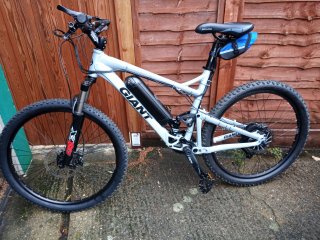
Although I have a Giant Trance with a a 27.5" front and a 26" rear setup with a Bafang 500w rear hub, I now tend to ride my pair of 27.5" front and a 26" rear and 29" front and a 27.5" rear combos which have the TSDZ2(B) mid-drives as they seem to be better balanced and lighter plus due to the torque sensing I get more range. These two do have small batteries as I lightweights with about 30 mile range, I do have another with a 48v 15ah battery for longer rides but I also have a range extender kit.
 

Attachments

  • trance-3.jpg
    trance-3.jpg
    1.5 MB · Views: 10
  • mad7.jpg
    mad7.jpg
    4.4 MB · Views: 10
Back
Top