• Hello ES! We could use some help to get us past the finish line on building the new knowledgebase for the forum.
    Can you donate? Please see our fundraising page. Thank you!

Type of switch to cut off Y-cable for charging batteries in parallel

a_manchego

🧲 New user
Joined
Aug 3, 2025
Messages
5
Location
Quebec, Canada
Hello, I'm a novice at electronics and have a question I hope is not too simple or stupid.

I'm connecting two new 36v battery packs in parallel to power a front hub motor on my cargo bike. All materials supplied by Grin. The max amperage output of each battery is around 35A.

For charging, I'm planning to follow Grin's recommendation of disconnecting the Y-cable before charging, every time, to prevent back flow.

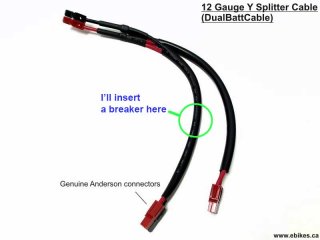
However, I'd like to avoid actually physically disconnecting the Anderson connectors. It seems to me that if I add a breaker or switch to one of the Y-cable lines, it would have the desired effect? I attached a picture.

If this is the case, is there a switch or breaker you would recommend? Ideally small, ideally water resistant. It will be mounted under my bike frame so there is space for a couple of inches in length and width. The switch would need to cut the connection on both wires, positive and negative, is that correct?

I like the idea of a breaker-type switch because it's harder to accidentally switch back on. A rocker type switch seems like an easy one to trip by accident. But breakers seem to be bigger boxes physically.

Thanks very much
 

Attachments

  • breaker.jpg
    breaker.jpg
    26.6 KB · Views: 4
The Anderson connectors are almost as easy to disconnect as flipping a switch and the contacts are covered, so there isn't a risk of a short. I would just keep it simple and unplug them one at a time when charging. Or you could unplug both them and plug the charger directly into the Anderson connector on each battery when charging them. Are you using a Satiator to charge them?

If you have to use a switch, just make sure it is rated for the voltage and current you will be using it at. You only need to switch the positive wire. https://www.amazon.com/Ampper-Batte...8-2-spons&sp_csd=d2lkZ2V0TmFtZT1zcF9hdGY&th=1

718K1yiT9KL._SL1500_.jpg
 
The Anderson connectors are almost as easy to disconnect as flipping a switch and the contacts are covered, so there isn't a risk of a short. I would just keep it simple and unplug them one at a time when charging. Or you could unplug both them and plug the charger directly into the Anderson connector on each battery when charging them. Are you using a Satiator to charge them?
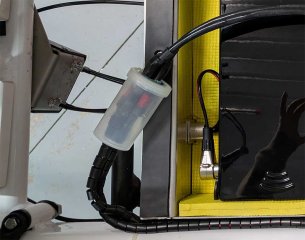
Yeah my setup currently leaves the Anderson connectors accessible. I also put them in a ghetto spray shield (the pillbox in photo). But I'd rather tuck the connectors away more securely and have only a switch exposed. Thanks for the suggested switch, I'll look it over.

I am using a Satiator to charge but via the batteries' XLR charging ports. So if I understand correctly, when charging one battery, there is no danger of current flowing back into the other battery via the negative wire? Is this because when the system is turned off, power won't be flowing past the cycle analyst and controller?

What do you mean by back flow?
Charge coming out of the discharge port of one battery and flowing back into the discharge port of the other battery.
 

Attachments

  • pillbox.jpg
    pillbox.jpg
    65.9 KB · Views: 4
If the batteries are connected in parallel and have the same SOC (state of charge), they they will both charge simultaneously. Really, a 36V 10S4P battery is made up of 4 parallel rows of 10 3.7V cells connected in series. So 40 individual cells. Each cell (cylindrical battery) is charged simultaneously.
 
I have a stack of six of the original Grin 36V LIGO batteries and always charge them all at once (with one Satiator). Occasionally, One battery at the end of the stack has an issue charging and I take it out of the stack and charge it separately.
 
There is one potential issue with your idea. Let's say you run both batteries down to 30V. Flip your switch and charge battery #1 up to 42V. Then you charge battery #2 to 42V. Flip the switch and you're ready to go.

You have to remember not to flip that switch til both batteries are charged. If you do, then you get that "backflow", Keep this in mind, because connecting a full pack to an empty one really is not good. So the common advice is to check the batteries with a meter.

For your other question, current flows in a loop. If you open that loop in either the positive or negative path, it shuts off the current. The dual pole switches are used for an extra element of safety/redundancy.
 
There is one potential issue with your idea. Let's say you run both batteries down to 30V. Flip your switch and charge battery #1 up to 42V. Then you charge battery #2 to 42V. Flip the switch and you're ready to go.

You have to remember not to flip that switch til both batteries are charged. If you do, then you get that "backflow", Keep this in mind, because connecting a full pack to an empty one really is not good. So the common advice is to check the batteries with a meter.
Yes, that is a good heads-up. I'm pretty reliable on routine operations so normally it wouldn't be a problem. But it is another argument for getting a second Satiator and charging both batteries at the same time.
 
Out of my league, but the fuse used on the Grin Anderson tap is used here to power lights. Self reset fuse used here on 48V and 36V.

1767308316106.png1767308411885.png
 
Back
Top