• Hello ES! We could use some help to get us past the finish line on building the new knowledgebase for the forum.
    Can you donate? Please see our fundraising page. Thank you!

Temporary power outages and motor noise

Victor Dupont

Established
Joined
Jun 24, 2025
Messages
66
Location
France
Hi there!

My partner’s electric bicycle is no longer working properly.

The symptoms evolved, but to summarize today’s situation, when riding it after stopping to pedal, motor often won’t turn back on, unless we bring the bike to a standstill. And when motor is on, it makes a lot of noise.

Here’s a video:


Complete history of the symptoms​


For the complete history, my partner purchased it second hand, from someone who seemed very trustworthy and very careful with the bike. The bike didn’t have a scratch and was working perfectly for a week.

The only event we can think of between the moment when it was working and when it stopped was a time when we put the electric bike in the trunk of our car, together with my bike, and at some point my bike tipped and fell on her electric bike. But it wasn’t a big shock really.

After that, the motor didn’t work at all. The display lit fine, but the motor never.

I tried to mess with it, unplugged and replugged every cabled, tested a lot of things. While doing so I got the bike to fall from shoulder height when it was hanging from a low tree.

After all this fiddling, now the symptoms are what I described: when we start riding it the motor starts, when we stop pedaling it stops, and when we start pedaling again it often won’t restart, not always though, .

If we then stop the bike, meaning bring its actual speed to 0, without doing anything else, not changing any controller setting or whatever, and start pedalling again, most of the time it kicks back in instantly.

Conversely, if I keep riding the bike without the motor kicking in, even if I'm going downhill for a few seconds and not pedalling, the motor will not kick back in when I start pedalling again.

It will only kick back in after bringing the bike to a standstill.

Also, when motor runs it makes a lot of grinding noise and big vibrations. The whole back of the bike shakes.

When I hang the bike on the tree again and try to reproduce the issue, the motor noise is significantly lower, I wouldn’t notice that it is wrong. Also it always starts back, I couldn’t reproduce that behaviour when bike is hanging from the tree, basically with no real load. I move the pedal by hand, motor starts, I stop pedalling, it stops, I move the pedal again, it restarts, etc. Basically normal behaviour. Here's a video:


Tests I made​


I did all the tests listed here, except for those that require a device to turn the wheels at constant speed: https://electricbike.com/forum/foru...-motor-s-phase-wiring-hall-sensors-and-wiring. All the other tests I did, and they all passed successfully.

I opened up the motor, suspecting loose magnets. Although I didn’t manage to separate the rotor from the stator, looking at them together I didn’t notice anything weird. This is my first time trying to repair an electric bike, but everything seemed normal. The bike is a foldable Megamo Park and I think it’s a Shengyi DGWX2 motor.

I also checked for broken teeth from the planetary gears but didn’t find anything.

The casing where the gears meet with the wheel had a very slight bit of slightly rusty colored stuff, but very little, and nowhere else.

Hypotheses​


The noise made me suspect a problem with the motor, but intermittent power outages don’t seem to me to be related. Power outages would have made me think of a controller issue.

I would also tend to rule out a battery problem, since the display is always lit no matter what.

Does anybody have any idea what the cause could be?

Thanks a lot in advance for your help!
 
Last edited:
The most likely problem is cable damage to the motor wire where it exits from the motor casing or axle. It's very common, and can happen without leaving any big external sign, as it can break conductors in the tiny hall sensor signal or power or ground wires without breaking the outer jacket or insulation, if they get pinched hard enough.

Sometimes there is visible cable jacket damage, usually where it enters the axle or motor casing, where the metal edge cut into the jacket and then further into one or more of the wires.

You may be able to locate cable damage that causes an intermittent fault, even when there's no external sign, by moving the motor cable slightly in various ways and places while the motor is in operation.

If the problem is a steady issue this usually requires opening the motor and controller, and testing continuity of all the wires to verify every one makes a full connection from the PCB of the controller to it's connection point in the motor, with no faults anywhere between.


With some of the waterproof connectors used on motors, they can be quite hard to fully plug in, and feel connected when they aren't. The phase wire pins are usualy longer than the sensor pins, and may make a good connection while the halls / etc don't.


You mention "power outages" in the last section of the post, but I didn't see those listed in the symptoms before that. If you mean an actual power loss, where there are no lights, no display, system will not turn on at all, no battery meter, etc., so your statement right after that negates it being a power outage.

That said: Power outages are usually a battery connection fault, when they're intermittent, and can be any part of the battery wiring between battery and controller, *or* inside the battery including the cell balance/sense wires to the BMS.
 
Thanks A LOT for the very swift and significant help!

I'll read it again carefully and try troubleshooting that way.

To clear a potential misunderstanding: when I said "power outage", I only referred to the fact that the motor is not turning on. The display is always on.

I have new data, freshly arrived from my latest test: actually when the symptom happens, meaning I pedal, motor starts, I stop pedalling, motor stops, I start pedalling again and motor doesn't kick in again, I just noticed that if I stop the bike completely, meaning I reach speed 0 mph, and start pedalling again, then it kicks back in again.

So it seems it's not a matter of waiting long enough. It seems to be a matter of bringing the bike back to speed 0. After that it kicks back in almost always. Conversely, I can stop pedalling for a while, and keep riding the bike without the motor for a while, it won't kick back in unless I stop the bike entirely. To avoid further misunderstanding: by "stopping the bike" I am only referring to its actual speed, I am not turning anything off, neither controller, nor battery etc. I just reach a standstill and start again, as if at a red light.
 
By the way, just a followup question to understand: if it's a damaged cable, how does that lead to a huge motor noise with vibration?

Thanks again VERY MUCH for the help
 
To clear a potential misunderstanding: when I said "power outage", I only referred to the fact that the motor is not turning on. The display is always on.

I have new data, freshly arrived from my latest test: actually when the symptom happens, meaning I pedal, motor starts, I stop pedalling, motor stops, I start pedalling again and motor doesn't kick in again, I just noticed that if I stop the bike completely, meaning I reach speed 0 mph, and start pedalling again, then it kicks back in again.

So it seems it's not a matter of waiting long enough. It seems to be a matter of bringing the bike back to speed 0. After that it kicks back in almost always. Conversely, I can stop pedalling for a while, and keep riding the bike without the motor for a while, it won't kick back in unless I stop the bike entirely. To avoid further misunderstanding: by "stopping the bike" I am only referring to its actual speed, I am not turning anything off, neither controller, nor battery etc. I just reach a standstill and start again, as if at a red light.
That behavior is probably the controller entering a fault state and requiring a complete stop to try to reset itself.


For any situation where a system has to remain unused for some amount of time before it will operate again (usually a few minutes), then if the motor has a temperature sensor built in (or hte controller does), the controller may also detect overheating and shutdown operation of the motor until temperature drops below the limit. Overheating can happen because of mistimed motor currents from the controller getting wrong or insufficient timing info from the motor sensors, etc.


By the way, just a followup question to understand: if it's a damaged cable, how does that lead to a huge motor noise with vibration?
If the controller can't read the motor position signals (halls) it can't send the correct timing of phase currents to drive the motor, so the pulses don't line up with the magnets on the rotor as it spins, and that can cause mechanical noises, etc.

The same can happen if one of the phases isn't connected--the two that are spin the motor but not evenly, and timing can be thrown off.
 
Wow thank you again VERY MUCH for the very swift and very helpful answer.

About overheating, I had indeed in mind a thermistor thing. But the fact that if I bring the bike to a standstill and instantly start pedalling again, it instantly kicks back in, made me think that in the end it's not a temperature problem. If the matter were a given amount of time I have to wait, I would have thought indeed that it's because I have to wait for temperature to decrease. But since it's unrelated to time, I'm thinking it's probably your first explanation: that the controller has to reset itself from its error state.

Again thank you very much for all this information. It makes a lot of sense. I'll re-read it over and try testing the bike with it. I'll report when I have new information.

Already a huge thank you
 
If I understand correctly what was tested, then yes, it should rule it out. But the only thing that makes sense for the kind of symptoms you get is a problem with the controller being able to correclty detect motor rotation / position, or being able to correctly drive the motor phases (which is usually a result of the other issue).
 
Thanks again VERY MUCH for the very swift and helpful reply.

It is really good to know.

I will test again, more carefully and more in depth.

I'll report when I have some news.

Again a huge thank you
 
Hi there!


Here are the news.

I spent a weekend on this bike.

The general conclusion is that I didn’t spot anything that seemed to explain the problem.

I checked continuity of the whole hall sensor loop. I checked continuity of all wires coming in and out of the controller. I opened up the motor and didn’t notice anything special.

The only thing I noticed were some of the small black plastic stuff between the magnets in the motor sticking out. I don’t know whether I can or should push them back into alignment.

IMG_2930 copy.jpg


IMG_2931 copy.jpg


I also did more testing, and was able to reproduce the issue even without load, meaning I put the bike upside down, turned on pedal assist, pedalled, and sometimes after a while motor refused to start again.

More precisely, here are the tests I did.

First I tried jiggling the motor cable while motor is running. I did that by putting the bike upside down and pedalling. I didn’t see any impact of moving the cable on the motor. It still kept running the same.

Second I opened the controller and checked for continuity between all cables, from their socket to the solder on the board. Everything seemed well.

I checked the controller’s board for anything that looked weird. Didn’t see anything.

I opened the motor and checked for continuity between the wires at the socket and the solder on the board. I did that for all hall sensor wires and the white wire. Basically all 6 small cables.

I also checked for continuity between each phase pin on the cable and the connection with the windings on the motor. One of the winding connection I couldn’t get continuity, maybe because I couldn’t touch it with my multimeter probe, but all phase pins got continuity with one another, and with the other two winding connections on the motor. So I guess it’s just that I couldn’t touch one of the connections with my probe on the motor.

I also checked the phase wires by shorting them manually by pairs, and then trying to turn the wheel. I felt the cogging resistance as expected, whatever the pair. And then shorting all three together, the more constant resistance.

I also wired everything back together, with controller still open, and measured voltage on each hall sensor wire solder, turning the wheel a little bit each time. Voltage oscillated from 0 to 3.28 V alternatively, looking perfectly normal.

IMG_2969 copy.jpg


IMG_2976 copy.jpg


Thus it seems to me that the whole hall sensor loop is working perfectly.

Unless it behaves differently with the controller put back into place, and the bike moving.

I also checked voltage at the pedal sensor wire solder on the controller’s board. It seemed to correctly report each time a magnet passes in front of the sensor.

I also looked for shorts anywhere I could but didn’t find any.

Here are pictures of the motor, in case you notice anything:

IMG_2926 copy.jpg


IMG_2927 copy.jpg


IMG_2928 copy.jpg


IMG_2935 copy.jpg


Do you have any idea what the problem could be, or what to test next?

I was thinking of trying to swap phase wires
, just to see what would happen. I read that I can do it if I don’t put too much load, and monitor current intensity to make sure it doesn’t go too high. Do you know whether in my case I could risk damaging something if I try this?

Any other idea is welcome too.

Thanks again very much for all the help!
 
Any other idea is welcome too.

Thanks again very much for all the help!
Just verifying how you are troubleshooting. I’m assuming that you are eliminating other variables while testing, meaning if you have brake cutoffs or other non essential components, that they are disconnected during your testing. In other words, only the battery and motor cables, display and PAS sensor are connected.
 
Any other idea is welcome too.

Thanks again very much for all the help!
The noise you get from the motor is because the controller can't drive the motor in synchronisation with the commutation pulses. The normal reason is a damaged motor cable or a motor connector not making good contact.

The problem is that if you try to drive the motor when it can't sychronise, there's a high probability of consequential damage - in particular, blown or compromised MOSFETs in the controller, so that's the next thing you need to check. You can get a good idea if there are any problems by measuring the resistance between each phase wire and the battery positive, then to the negative so you get 6 resistance results. Each group of three should be the same as each other and in the range somewhere around 6k to 24k,
 
Thanks a lot for your replies and your help!

Yes, unfortunately I confirm that I unplugged all non essential parts, meaning the brake cutoffs and the lamp. Only the motor cables, battery, display and pedal sensor remain.

About MOSFETs, thanks for this new idea. I'll test them and will let you know.

About swapping phase wires, the reason why I was mentioning it is because from my understanding, I was thinking that maybe the symptoms I am experiencing are the same as when phase wires are incorrectly paired. I was thinking that maybe the following scenario occurred: the bike stopped working completely because of a loose cable connection somewhere. When I started repairing it, I unplugged everything, and maybe I didn't take note of the correct pairing of motor phase wires with controller phase wires. Maybe they are not supposed to go yellow to yellow, blue to blue and green to green. Since I replugged everything, the loose cable connection was solved, but maybe the phase wires are incorrectly paired, and I now get these symptoms.

What do you think?

Otherwise I was wondering whether it could be that while repairing it, somehow I could have pressed very long on the display buttons, and that would have reset the controller settings, thus changing the correct phase wire pairing?

Anyway, do you think it would be risky to try swapping phase wires?

Again a very big thank you for all the help!
 
If hte phase wires were swapped and the halsl werendt, the motr would probably not run correctly at all, not just an intermittent issue. If the probelm and noise is constant, and wasnt'there before the repair, then yes, it could be a swapped wire if they were not connected the same way as hbefore (color matching is often not used).

There areabunch of posts and threads about determingint he correct hall /phase wireing combination if you need more info on doing that, but if the halsl wireswere never swapped around or altered, only phase, then you should be able to just try swapping the aphses in pairs and qwuickly find the right order again.
 
Hi guys!

So I got back home and resumed testing.

Unfortunately, still no clue what is wrong.

First I tested transistors, they seem fine:

IMG_3215.JPG

Second I tried swapping phase wires. Most combinations didn’t seem to start the motor at all, and the last one seemed to make it harder to pedal than without any assist. It was also making a little bit of noise.

I'd like to clarify the situation. I said "temporary" in the thread's title, only because the motor starts, and after a while it refuses to start again, unless I bring the bike to a standstill. But the problem is always there. The noise is also always there. Thus I don't really think it qualifies as an "intermittent" issue.

At this point I am starting to despair. I don’t know what else to test. Any idea would be greatly appreciated.

Thanks again a lot for the help!
 
Hi guys,

I have new info!

I am hopeful that this will be enough for you to know what's wrong, especially the new observations I made with motor running without wheel.

Summary:
1. I was able to fully reproduce the behaviour with bike upside down
2. I did more tests to try and find a bad contact somewhere, to no avail
3. I noticed that controller heats faster than motor
4. I tried running with controller open to cool it, but behaviour was the same
5. I noticed that when I stop the wheel abruptly, motor is more likely to start again after
6. I noticed a slight wobble of the planetary gear plate
7. I ran the motor without wheel, and noticed that the planetary gear plate is rotating slowly when motor is running
8. I also noticed that when motor refuses to start again, it moves a tiny bit, and moves back the opposite direction when I stop to pedal
9. Lastly, I noticed that at the moment when motor starts or stops, the planetary gear plate turns a lot, abruptly
10. I also checked for loose magnets

Here are the details.

1. Problem fully reproduced upside down

I was able to do so by simply switching the bike to an easier gear, thus asking more work from the motor.

In such setting, the problem was fully reproduced: noise louder than normal, and motor often refusing to start again after stopping to pedal and starting to pedal again.

2. Tests for bad contacts

With bike upside down and motor running, we tried moving every cable everywhere, putting controller in different places, etc. There was no change whatsoever to the noise and behaviour.

3. Controller heats faster than motor

While doing these tests I regularly touched the motor's casing and the controller. The controller heated up faster than the motor, even though there was no load on the bike, only the wheel.

After a while motor heated up as well, but controller first, and I would tend to say, controller more.

4. Cooling controller didn't change anything

I tried taking controller out of its case, circuit completely out in the open, and running that way. I was thinking it would cool it down, and thus if the problem came from a thermistor, the behaviour would change.

No change.

5. Stopping the wheel abruptly seemed to help

When doing those tests upside down, after motor ran and I stopped pedalling, if I started pedalling again and motor didn't start, I had two choices:
- waiting for the wheel to reach a standstill by itself
- or grabbing the wheel with my hand to stop it abruptly

I noticed that if I grabbed the wheel abruptly, and then started pedalling again, motor was way more likely to start again. Conversely, if I waited for the wheel to reach a standstill by itself and then started pedalling again, it was much less likely to kick back in.

I thought it looked like the shock was probably putting something back into place.

6. Planetary gear plate wobbles a bit

I don't know whether that's enough to be a problem:


7. Planetary gear plate is rotating slowly when motor runs

I set everything up differently for new tests, and that yielded new observations.

I put the motor on the bike, but without the wheel. Thus I just used the bike's body as a vice essentially.

I plugged everything together, and was thus able to "throttle" by just turning the pedal.

To be clear: the bike's chain wasn't connected to anything, so the only movement came from electricity sent by the controller.

Here's a video showing clearly the motor refusing to start again after stopping to pedal. The noise is me turning the pedal, but the chain isn't connected to anything. Thus when I turn, the motor should start.


In such setting, I was able to observe that the planetary gear plate is rotating slowly when motor runs:


(again noise is just me turning the pedal)

I don't know whether this rotation of the plate is normal.

I am not sure whether the inner part of the plate, with the keyway, is also turning, or whether it's only the outer part. I wasn't able to reproduce it today, and the videos are not clear enough to distinguish.

8. Motor moves a bit when it is refusing to start again

Another observation, which seemed to me very interesting, was that when motor refuses to start again, when I start pedalling, it moves a little bit.

When I stop pedalling, it moves back that same little bit, into the place it was before.

It thus seems that it's trying to start, but is blocked.

I was thinking this would probably make it clear to you where the problem comes from:


(again noise is just me turning the pedal)

9. Planetary gear plate turns abruptly when motor starts or stops

Still in the same set up, the last observation was that when motor starts, and when it stops, the planetary gear plate suddenly turns a lot, abruptly.

It does so in the same direction, whether motor is stopping or starting:


I don't know whether that is normal or whether it's a hint to the problem.

(again noise is just me turning the pedal)

10. I checked for loose magnets

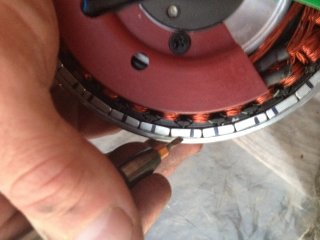
I don't know whether my check was sufficient. I used a small screwdriver and tried to push every magnet towards the center, but lightly, and without separating the rotor from the stator:

IMG_3236.JPG

I didn't notice any movement.

That's it for the news

Do these new pieces of information give you any hint as to the origin of the problem?

Does it still look to you to be an electric issue?


Thank you again very much for your help!
 
Last edited:
Hi guys,


Just wanted to check in, in case you had missed my latest updates.

I am stuck, I don't know what to do to move forward.

Any idea is welcome.

Thanks again very much for the past help!
 
I suspect the controller, since you said you did the electrical tests on the hall sensors, apparently right on the circuit board, but you haven't ruled out a fault in the cable. motor connector and upstream onto the controller. You might consider just giving up on the analytics and throwing money on a new controller/display, gambling that it works. Or find someone willing to plug the motor into their working controller to show whether the motor is suspect,

The motor noise vibration is not there when the bike starts normally, and then appears if it restarts? No noise if you stop and then start again? Suggests you've got a bad connection to the Halls or a bad Hall. .

You have a lot of energy, taking the whole motor apart. EVen spinning it without the housing, I admire that, but I don't think you have enough gear to test this problem.
 
Thanks a lot for the reply!
I suspect the controller, since you said you did the electrical tests on the hall sensors, apparently right on the circuit board, but you haven't ruled out a fault in the cable. motor connector and upstream onto the controller.
Are you referring to the troubleshooting in general, or to my latest experiment? In my latest experiment, I unplugged the phase wires, and to make sure there is no wire issue from the hall sensors to the controller, I made sure to measure voltage on each hall sensor wire solder point during 10 seconds while turning the pedal, before measuring phase wire solder points. That way I wanted to be sure that the signals from phase wires are stable, and could not be a cause of change of phase wire output voltage.

Given these precisions, does it still seem to you that the controller still could be innocent?

You might consider just giving up on the analytics and throwing money on a new controller/display, gambling that it works. Or find someone willing to plug the motor into their working controller to show whether the motor is suspect,
Yes I have been willing to do that.

I would love to be able to plug a known good controller. The thing is, I don't have any at hand. I could buy one, but apart from the money matter, I feel like it would also be a waste of many resources if my controller is not the problem.

Also I am a bit scared to plug someone else's controller onto my bike and vice versa. Since I am starting, I am afraid I might damage their controller or motor or bike in general.

Conversely, I feel like the methodology I came up with in my latest experiment, if it turns out to be meaningful, could be very useful to many people who are not bike repair professionals. It would enable anyone with a multimeter to test the behaviour of their controller without having to buy another one, and even without having to wait for it to arrive.

The motor noise vibration is not there when the bike starts normally, and then appears if it restarts? No noise if you stop and then start again? Suggests you've got a bad connection to the Halls or a bad Hall. .
The motor noise vibration is always there.

The symptoms are twofold. The first is this constant motor noise. The second is the fact that sometimes it doesn't restart.
You have a lot of energy, taking the whole motor apart. EVen spinning it without the housing, I admire that, but I don't think you have enough gear to test this problem.
Thank you very much! I really appreciate your encouragements.
 
After that, the motor didn’t work at all. The display lit fine, but the motor never.

I tried to mess with it, unplugged and replugged every cabled, tested a lot of things. While doing so I got the bike to fall from shoulder height when it was hanging from a low tree.

After all this fiddling, now the symptoms are what I described: when we start riding it the motor starts, when we stop pedaling it stops, and when we start pedaling again it often won’t restart, not always though, .

So the motor stopped working, and didn’t start working again until it dropped from the tree?
 
I recommend you find out why your hall sensor output signal patterns are different between your first and second testing.
I.E. One on, two on, one on, two on, ect… is the correct pattern as in the first test.


Regards,
T.C.
 
So the motor stopped working, and didn’t start working again until it dropped from the tree?
It's almost correct. It stopped working completely. After that I fiddled with a lot of stuff, unplugging and replugging. During this fiddling it fell from the tree. After this fiddling it started working again, but with the current symptoms.

I can't tell whether it's exactly after dropping from the tree, because I hadn't tested right before and right after. I only know the state before starting to fiddle, and after a first fiddling session.

Let me know if it's unclear.

Thanks a lot for the help!
 
I recommend you find out why your hall sensor output signal patterns are different between your first and second testing.
I.E. One on, two on, one on, two on, ect… is the correct pattern as in the first test.


Regards,
T.C.
Thanks a lot for the help!

Which "second testing" are you referring to?

If you are referring to the latest measurements I made, measuring phase wire output, then I didn't follow any particular hall sensor order. I just wrote the different positions myself before, then turned the wheel randomly, and measured the hall sensor output to know where I had landed. Thus the order is not a measurement, it's just me writing them randomly.
 
Back
Top