• Hello ES! We could use some help to get us past the finish line on building the new knowledgebase for the forum.
    Can you donate? Please see our fundraising page. Thank you!

Nissan Leaf motor at 60V, 1/6 the power?

yabert

Regular
Joined
Apr 23, 2016
Messages
250
As many know, the Leaf motor is interesting to use without his transmission because it come with his own front flange and bearing when compare to Tesla, GM, Kia motor.
Design to run at 360V nominal it can output 80-160 kW (depend of inverter years / up to 400A / over 250 Nm) and spin up to 10 000 rpm.
What kind of power I can expect at 60V?
Let say 400A 60V controller.
From my understanding of motors, the Leaf motor will be able to output the same 250 Nm, but I don't know at how much rpm.
Also, can I expect 1/6 the power at 1/6 the voltage (60V x 6 = 360V)?

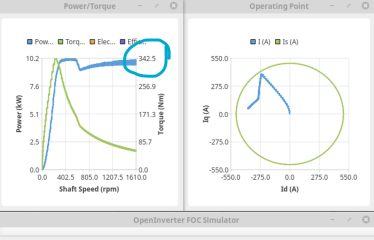
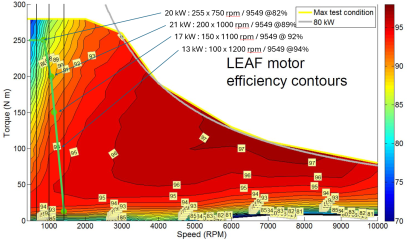
In short, I would like to know if I can expect the green line I draw on the graph below or if this completly wrong.
Thanks
1755120162341.png
 
I think your speed is probably in the general ballpark with some big assumptions but I don't think the torque is, when I looked it up the phase resistance of the leaf motor I found it's 230mOhms so at 60v you can only pull what 260 phase current at locked rotor if I did my math right? So I think your torque is going to be far less and start dropping off after that. Just looking up the Kv of the leaf I found a thread of somebody doing this very thing, I guess for use to power a boat. End of this page.
 
Thanks a lot, really usefull info and link.
So I think your torque is going to be far less and start dropping off after that.
Yeah, so power will also be really low and start dropping off after that.
From the open inverter page linked, it's question of 8-10 kW at 48V with peak power at only 350-400 rpm.
Really is it can be that bad?
 
I mean it make sense if you take a few things into account, the actual Kv is pretty low and that 10k RPM I think is with quite a bit of field weakening/MTPA and they do talk about it in that thread and while you can do the same at a lower voltage peak power RPM is going to be pretty low. As in peak power comes lower in the RPM range if the RPM range includes FW regardless of the range. That and you just can't drive any more current than the resistance of the motor allows, that's just ohms law, so when you combine them, power is torque times rpm so get a lot less power.
 
You might want to consider one of the starter/alternator motors from a mild hybrid car. Hyundai and Buick had some nice looking ones that run at lower voltages.
 
You might want to consider one of the starter/alternator motors from a mild hybrid car.
Yes, I also think about this. Seem really rare.
I've found eTorque from Ram 1500 thread on endless sphere.

But I think I could be disappointed.
I don't see how a 30-40 lbs ''alternator'' can output more power continuously than a 130 lbs Leaf motor, even at 60V.
 
the actual Kv is pretty low and that 10k RPM I think is with quite a bit of field weakening
Do you think that a Tesla 3 rear motor able to spin 18k rpm can do better than Leaf motor at 60V?
 
I don't see how a 30-40 lbs ''alternator'' can output more power continuously than a 130 lbs Leaf motor, even at 60V.
I mean you are conflating can output and can input, you can only output as much power from a motor as you can put in it, output cannot be more than input and you are input limited here.

Do you think that a Tesla 3 rear motor able to spin 18k rpm can do better than Leaf motor at 60V?
Probably not enough that it matters.

I don't even get what you are trying to do, even if you can find a very large motor wound hot enough to run at 60v it won't be a good idea. There are very good reasons why these EV motors run at such high voltage.
 
I don't even get what you are trying to do
I'm trying to find a high quality, reliable, water cooled and low cost motor for direct drive application of a solar Cat: Solar Catamaran, EV motor controller

60V is determined by voltage limit of 48V solar components.
Direct drive is simply so nice when compare to higher rpm motor implying belt/pulley or gearbox.

800 to 1000 rpm is acceptable depending of propeller diameter and pitch. But the big question is a Leaf motor can output 8-10 kW at those rpm and 60V?
 
Last edited:
For ideas, have you seen this page ?
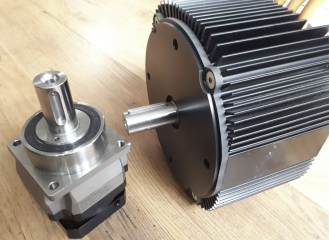
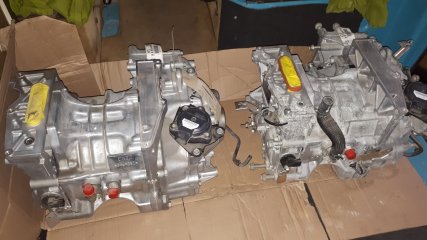
Sure! I have what you can see in picture at home.
Still, I don't like prices and belt/pulley or gearbox.
35Nm (120Nm peak) from the motenergy motor don't match well the 100Nm (340Nm peak) torque of the Leaf motor IMHO.

But I understand that 340Nm is impossible to reach at 60V.... or maybe up to 250 rpm only.

1755193371760.png
 
Isn't torque related to phase amps and speed(rpm) to voltage x kv?.
At 10Kw battery power output: 10Kw/60V=167amps(battery)
Motor voltage is usually about 66% of battery voltage, thus about 40V max motor voltage.
Assuming 85% over all system efficient, power output at motor output shaft is 8.5Kw(11.3hp(mechanical power)).
 
Based on information shared here and on openinverter forum, I've modified the graph from post 1.
The power curve could look like the green line at 60V.
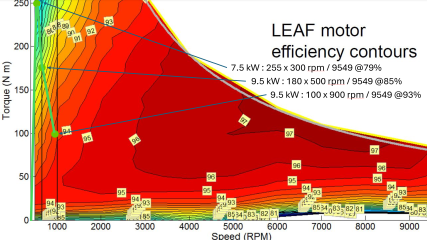
Still interesting to me... if the efficiency from this graph is still good.
Is there reasons for the efficiency to be way worst at 60V compare to this graph at 360V?

1755219202527.png
 
I think the efficiency would be the same as the graph, motor losses are magnetic which are based primarily on RPM and resistive losses based on current hence the chart. You are not changing either of these variables assuming you do run it at those points. But notice how those high torque low RPM areas get much less efficient, you don't want to find yourself there unintentionally because you need more torque than you thought.

You are operating in a very narrow range all for 10kw which could easily be done with a much smaller motor which will operate at high efficiency over a wider range.
 
I think the efficiency would be the same as the graph, motor losses are magnetic which are based primarily on RPM and resistive losses based on current hence the chart.
Nice!!!

notice how those high torque low RPM areas get much less efficient, you don't want to find yourself there unintentionally because you need more torque than you thought.
Boat and propeller are a bit different than car/bike and tire. If I need more torque the rpm will drop quickly as the load, then the speed.
I will have to find the perfect propeller and play with FW to stay in the 800-1000 rpm range at cruising speed.

You are operating in a very narrow range all for 10kw which could easily be done with a much smaller motor which will operate at high efficiency over a wider range.
Yes, I'm sad to discover this. But what are alternative to a 300-500$ rugged, high quality Leaf motor?
The Motenergy ME1616 seem the only other choice to me. But 1200$, 92% efficiency max and absolutly imply belt/pulley or gearbox 🫤
 
I assume that chart was with MTPA so messing with the FW will probably decrease efficiency over the ideal values used in that chart.

I'm sure there are motors out there but idk at this price point. Have you looked at any hybrid motors, many hybrids I think operate at much lower voltages, motors are probably about as cheap and should have plenty of power.

Other option would be just a higher voltage solar system but I assume the high voltage solar parts are more expensive as they are mainly used by commercial installations.
 
Have you looked at any hybrid motors
Yes, Prius stuff work at 650V, Highlander/Rav4 rear diff motor work at 288V and are air cooled.
Don't know much about 48V hybrid except the eTroque from Ram 1500 who look like a big alternator and probably don't output much continuously.
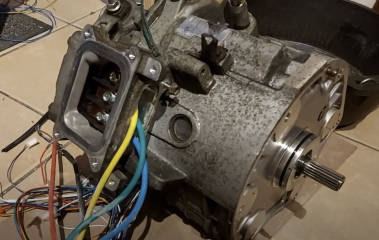
Maybe the Mitsubishi Outlander PHEV Rear Electric Motor. Anyone have more information about this one?
1755273438679.png
 
I've seen people use the 1st and 2nd gen honda hybrid motors which ran around 150v and I think might have been water cooled, they are a rather interesting design though so to connect them to something you need to mount them to a frame or some sort. Not easy to find information about any of these motors though.
 
I've found this.
Is this can give any idea if it is the Leaf motor or the Outlander rear motor who will spin the faster at 60V?

1755284333090.png
 
Maybe, interesting the resistance for the leaf there is 23.4 not the 230 in that other post, I'm guessing that other guy just misplaced a ".". If it is indeed 23.4 that does make the Leaf capable of a lot more peak torque although doesn't help you that much since it's torque at RPM you need and that probably only moves that up slightly.

As for the outlander motor, the thing you need is a higher Kv and with a lower flux linkage it could have a higher Kv but without knowing other parts of the motor that is mostly a guess.
 
interesting the resistance for the leaf there is 23.4 not the 230 in that other post
I hope it's the case. This would make more sense as a Tesla 3 rear motor have 0.00475 Ω phase resistance.
 
Back
Top