• Hello ES! We could use some help to get us past the finish line on building the new knowledgebase for the forum.
    Can you donate? Please see our fundraising page. Thank you!

HELP! RH212 Installation, Need Advice

Harpo

New here
Joined
Jun 5, 2026
Messages
20
Location
Iowa
Just received my RH212 kit, and having a major issue with installation. I installed a Shimano 8sp cassette, it fits fine with no spacer, but when installed the axle flat is deeply recessed below the lock ring. If I grind down a washer to reach it I will be at 140mm+ axle length.

This is going on a Terratrike Rover, very stout steel frame, not bendable. Grin told me this will fit 135mm dropouts, but I don't see any way.

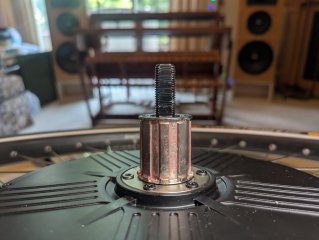
The attached pic shows the freehub with only a lockring, axle flat is below ring even without a cassette!

Suggestions?

Thanks in advance,
Garry
 

Attachments

  • ringonly.jpg
    ringonly.jpg
    2.3 MB · Views: 10
Were any spacers included with the motor?
135mm dropouts are usually ~137mm.

Steel dropouts will easily tolerate being spread a few mm if needed.
 
Were any spacers included with the motor?
135mm dropouts are usually ~137mm.

Steel dropouts will easily tolerate being spread a few mm if needed.
They supplied a single 2mm x 20mm washer with flats, it is not thick enough to reach the outside of the lock ring.

Even if it were, I'd still need another ~2mm for the chain to fit the smallest sprocket. That would put me at ~139mm, and I can't see that happening with this frame.
 
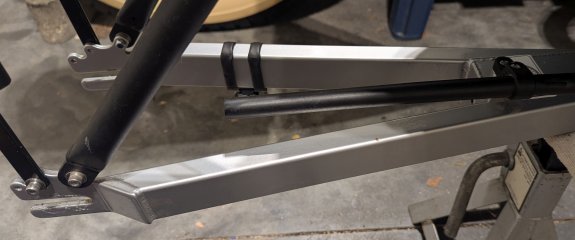
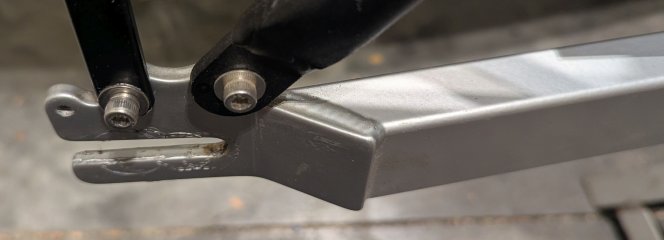
Pics of the dropouts. Steel frame, very stout. I was told this would fit 135mm, and that's what I measure!
 

Attachments

  • do1.jpg
    do1.jpg
    529.6 KB · Views: 10
  • do2.jpg
    do2.jpg
    521.6 KB · Views: 10
  • 135mmA.jpg
    135mmA.jpg
    456 KB · Views: 10
With the lockring installed, can the motor go into the frame without having to stretch the dropout by hand?
Too tight a fit already?
 
I think this is the wrong freehub body. There is no way the axle flat should be below the lock ring.
 
Here's a thought.
The bike can probably tolerate another 1mm of spacing. That's all you need to get it spinning.
You could possibly delete the tallest gear ( very unlikely you'll use it with such a powerful motor in a small wheel ) and put a spacer in it's place.

If you said you had super stiff aluminum chainstays, i'd say avoid trying to jam it in, but steel? it bends well.

Seller states 135mm width, but this is likely before a revision to the motor that made the case stronger.
https://ebikes.ca/amfile/file/download/file/96/
Current specs could be wrong and the motor sounds wider than stated.
In the case of your bike that could be grounds for a return.

I think this is the wrong freehub body. There is no way the axle flat should be below the lock ring.

Looks similar to the one i received a few years ago and i remember having to pack on some spacers.
 
Yep, that drawing clearly shows the flat standing substantially above the freehub body. Mine does not, it is recessed inside it.

Before I ordered I discussed specs with Grin, the main one being it must fit in a 135mm dropout. They assured me it would:

"The RH212 is indeed designed for a standard 135mm rear dropout and we spec our rear hub motors with an M14 axle with 10mm flats."

That drawing also shows definitive flats on both drive and cable side, but this axle has a substantial taper on the cable side and very small flats.
 
Here's a thought.
The bike can probably tolerate another 1mm of spacing. That's all you need to get it spinning.
You could possibly delete the tallest gear ( very unlikely you'll use it with such a powerful motor in a small wheel ) and put a spacer in it's place.
I'm not sure you can just delete the tallest gear, since they usually have the serrations that the lockring grabs onto to keep it from loosening. If it were me, I'd return it and get a freewheel version. DD hubs are maintenance free, except for the freewheel or freehub and cassette, and if the pawls wear out, swapping the freewheel is much easier than removing the freehub and replacing it. Plus, you don't need more than a few gears for that motor, if you even shift at all, so a 6 or 7 speed freewheel would provide a lot more clearance.

1785030097167.png
 
^-- that could work, you only need another 1mm on each side.

That drawing also shows definitive flats on both drive and cable side, but this axle has a substantial taper on the cable side and very small flats.

Yeah i'm not happy with that part of it's design either. I ended up putting a little spacer on the cable side to improve contact.
I had a Grin v7 torque arm on both sides to make up for the slight weakness.

Hassles like these were forgiven once i fired this motor up 😅
 
"Cold setting" with a piece of all-thread isn't going to happen here. This thing is literally built like a trailer hitch, and any attempt to bend is just going to flare the dropouts into a "V" or break a weld. 135mm, maybe 136mm but that is all you're going to get.
 

Attachments

  • fork1.jpg
    fork1.jpg
    409.8 KB · Views: 8
  • fork2.jpg
    fork2.jpg
    267.6 KB · Views: 8
If you search on the dimensional diagrams for any dd hub motor models (MXUS, QS, etc.), you’ll see variations on what is considered the 135mm dropout dimension. Some clearly, some more vague.. I’ve only seen a few that include the necessary washer on the inside of the dropout. Some make it even clearer, showing both the axle flat dimensions, and the dimension with the spacer washers, and some show a dotted representation of the dropout with or without the washers in place. The dimension itself is accurate, but the DIYer needs to know to add the washer dimension in for the real world dropout dimension..
The diagram provided by Grin on their rh212 page appears to not include the washers in the 135mm measurement, but it’s not the best diagram. This probably represents the majority of hubs in diagrams I’ve looked at. I think I mentioned this in a past thread and included a diagram of a MXUS hub that was the best example I’ve seen that clearly showed all dimensions including the axle flat and washer widths and dotted dropouts. A+ as far as diagrams go.


What appears to be clear is that the axle flat extends beyond the free hub body, which you could point to as your reason for returning the unit.
 
Last edited:
"Cold setting" with a piece of all-thread isn't going to happen here. This thing is literally built like a trailer hitch, and any attempt to bend is just going to flare the dropouts into a "V" or break a weld. 135mm, maybe 136mm but that is all you're going to get.
Do you weld? You could convert your dropouts to clamping dropouts by welding on some plates to reinforce the current dropouts, but have tabs that you could add a clamping bolt to. Then you could get away with only one washer, on the freehub side to clear the lock ring. If you’re picky and you could redish your wheel a millimeter over to recenter it, but I don’t think it would make a difference. You might need to grind down the diameter of the spacer washer based on looking at your first pic. I had to do that once with a freewheel, before just switching to one with fewer gears.

Check this thread to see some clamping dropouts ideas
 
The plot thickens... To achieve anything close to 135mm, the dropout must rest against the shoulder where the axle flat begins. But where do you route the cable? Sharp 90° underneath the dropout? Carve a notch in the dropout to clear it? They've already carved away one entire shoulder with that groove, I don't see any workable options.
 

Attachments

  • groove1.jpg
    groove1.jpg
    482.2 KB · Views: 7
Do you weld? You could convert your dropouts to clamping dropouts by welding on some plates to reinforce the current dropouts, but have tabs that you could add a clamping bolt to. Then you could get away with only one washer, on the freehub side to clear the lock ring. If you’re picky and you could redish your wheel a millimeter over to recenter it, but I don’t think it would make a difference. You might need to grind down the diameter of the spacer washer based on looking at your first pic. I had to do that once with a freewheel, before just switching to one with fewer gears.

Check this thread to see some clamping dropouts ideas
Yes, I weld - but I really don't want to hack up this chassis, and this was supposed to be a drop-in fit. That's why I paid 2x the cost of other kits, and it should fit as promised.
 
The plot thickens... To achieve anything close to 135mm, the dropout must rest against the shoulder where the axle flat begins. But where do you route the cable? Sharp 90° underneath the dropout? Carve a notch in the dropout to clear it? They've already carved away one entire shoulder with that groove, I don't see any workable options.
That’s not uncommon. Check pics of a few DD hub (MXUS, QS motor, etc.). The cable will bend, but the trick is to zip tie it so it doesn’t rub on the brake rotor, if you’re using one.

1785111617184.png
 
Yes, I weld - but I really don't want to hack up this chassis, and this was supposed to be a drop-in fit. That's why I paid 2x the cost of other kits, and it should fit as promised.
So what will you do? Wish it to work? If you’re not returning it, then it’s a sunk cost, which means you’re choosing to adapt.
Start with one washer.
 
I think this is the wrong freehub body. There is no way the axle flat should be below the lock ring.

It makes sense to me that you reply to your email chain with Grin, point Grin support at this, and send them the pictures, and ask them to verify what they have sent you.

All we can do is take what you say at face value and suggest hacks.

Be sure to send the measurement pictures and the others.
 
Btw, I emailed Grin before even starting this thread, no response yet. I thought maybe someone in this community had seen the issue and the cure was simple, but I'm quickly learning there is little to no standardization in this industry and measurements often don't mean what they say.

Being old and a lifelong mechanic/machinist I find this fascinating. Digging deeper into Grin's site, I find that even their newest "All Axle" hub motor with "135mm Slotted Dropout" adaptors in fact measures 138mm. I come from a time where measurements were accurate and parts matched engineering drawings, thus my confusion.

So bottom line, I'm both older and wiser when it comes to ebike parts. It seems to be a world where what I would term "cobbling" is the norm, not the exception.

Still, the best regulator of any industry is the consumer... Perhaps if more consumers had higher expectations the industry would fall into line? Optimistic I know, but why not?

Regardless, I can "cobble" with the best of them. Or rather, I can properly modify parts and systems in a safe way to do what they were represented to do. But given the prices of Grin motors vs the rest of the industry, I still don't feel that should be necessary.

Regards,
Garry
 
135mm in bike terms actually means 135-140mm. Average bike dropouts are 136-138mm uncompressed because they know how wide the variance is.
Tires and rims can also vary +/- 3mm versus their stated dimensions.
I can give more examples but this is an average day in bike world.

Generally, you can't get around this by spending more money.
 
135mm in bike terms actually means 135-140mm.
I think "ebike terms" might be a better fit. I've ordered hubs, rims, spokes, tires, cassettes, and many other bike parts that meet specifications precisely, and most don't even publish engineering drawings. Grin does but their parts don't match...

In any event, I made it very clear in my numerous emails with Grin that I had to meet the 135mm spec precisely, and this was before I placed my order. They assured me the RH212 would meet that measurement. It might have been better to ask here first lol.
 
Perhaps if more consumers had higher expectations the industry would fall into line?

To an extent, yes. But a '48V' battery is a class, not a precise unchanging value the battery will present. This can apply to various of the items involved in ebikes - but this is an observation, not intending a contradiction of what you are concerned about.
 
Back
Top