

Hello,
I'm new to e-bikes, but have been "unfortunately"(or not) been pushed down the rabbit-hole of e-bikes by a friend of mine. He is trying to convince me (and he is almost there) to buy an e-bike, but I have been reluctant to do so because of range. I was of the opinion that if you want at least 100-150km range the bike will be very heavy and that will have a very bad consequences on parts made for bicycles (especially off-road).
He was of the opinion that technologies have moved on and now it's not that far off to get to that range, and that was the start of the rabbit-whole...
After some "rabbit-holing" I came to the conclusion that so far no one (and probably for a good reason) has tried to combine two mid-drive motors in one bike (granted one is technically a hub motor) to overcome some drawbacks of different systems.
So for a climbing mountains (which is what I like), I was thinking of combining "normal" mid-drive motor in a Qulbix Q140MD frame that will sit in the bottom bracket slot, and that motor to be connected to a direct drive motor in the place that the Q140MD frame has for that purpose, so this way the normal geared mid-drive motor will provide enough push for the direct-drive motor not to stall and be in optimal rpm, this way you can still have regen braking. Since air-drag is the biggest enemy to biking in terms of efficiency, I was thinking of staying at the 15-25km/h range for speed. I know that speed is really slow and probably not very fun, but we are after range.
So lets say a 72V battery with like 60Ah that can fit in the Q140MD and have Toseven DM01, that "spins up" a leaf hub dd motor that will act as the regen-brake and cruise mode and we keep the whole system throttle free and only use the torque sensing of the DM01 to manage the speed (so we are not tempted to abuse the power).
I know that there is no such thing as free energy, but the question here would be, can the first (DM01) work with less power needed, then the DD "wastes" in heat during acceleration.
I'm sure there is a plethora of things I'm missing in the whole picture, but it was fun exercise.
How would you guys go about and plan for a monster range? I know that it all depends on many other factors, but still a bit food for thought.
Thanks for the time.
P.S. I asked "The intellect" to try and predict a hypothetical range on a 150kg rider + bike, using the dual motor and pedaling with 100W and using a 65Ah battery at 72V. The split of the terrain for this "simulation" was 30% flat, 30% mild incline/rolling hills, 40% steep mountain terrain, and here is what it spat out:
This unique build is a high-torque, heavy-duty "dual-mid-drive" hybrid designed for mountain mastery and efficiency. It leverages the Qulbix Q140MD moto-style frame to carry a massive 4.7kWh battery, powering two distinct motor systems controlled via a Cycle Analyst V3 (CA3).
The Mechanical Drive Train
Electrical & Control Specs
Performance Estimates (150kg Rider + Bike)
Key Build Constraints Verified
P.S.S. I tried the same config with different motors on their own and non of them came close to getting that range. May be there is something to it, or more likely I missed something obvious.
I'm new to e-bikes, but have been "unfortunately"(or not) been pushed down the rabbit-hole of e-bikes by a friend of mine. He is trying to convince me (and he is almost there) to buy an e-bike, but I have been reluctant to do so because of range. I was of the opinion that if you want at least 100-150km range the bike will be very heavy and that will have a very bad consequences on parts made for bicycles (especially off-road).
He was of the opinion that technologies have moved on and now it's not that far off to get to that range, and that was the start of the rabbit-whole...
After some "rabbit-holing" I came to the conclusion that so far no one (and probably for a good reason) has tried to combine two mid-drive motors in one bike (granted one is technically a hub motor) to overcome some drawbacks of different systems.
So for a climbing mountains (which is what I like), I was thinking of combining "normal" mid-drive motor in a Qulbix Q140MD frame that will sit in the bottom bracket slot, and that motor to be connected to a direct drive motor in the place that the Q140MD frame has for that purpose, so this way the normal geared mid-drive motor will provide enough push for the direct-drive motor not to stall and be in optimal rpm, this way you can still have regen braking. Since air-drag is the biggest enemy to biking in terms of efficiency, I was thinking of staying at the 15-25km/h range for speed. I know that speed is really slow and probably not very fun, but we are after range.
So lets say a 72V battery with like 60Ah that can fit in the Q140MD and have Toseven DM01, that "spins up" a leaf hub dd motor that will act as the regen-brake and cruise mode and we keep the whole system throttle free and only use the torque sensing of the DM01 to manage the speed (so we are not tempted to abuse the power).
I know that there is no such thing as free energy, but the question here would be, can the first (DM01) work with less power needed, then the DD "wastes" in heat during acceleration.
I'm sure there is a plethora of things I'm missing in the whole picture, but it was fun exercise.
How would you guys go about and plan for a monster range? I know that it all depends on many other factors, but still a bit food for thought.
Thanks for the time.
P.S. I asked "The intellect" to try and predict a hypothetical range on a 150kg rider + bike, using the dual motor and pedaling with 100W and using a 65Ah battery at 72V. The split of the terrain for this "simulation" was 30% flat, 30% mild incline/rolling hills, 40% steep mountain terrain, and here is what it spat out:
This unique build is a high-torque, heavy-duty "dual-mid-drive" hybrid designed for mountain mastery and efficiency. It leverages the Qulbix Q140MD moto-style frame to carry a massive 4.7kWh battery, powering two distinct motor systems controlled via a Cycle Analyst V3 (CA3).
The Mechanical Drive Train
- Stage 1 (Primary): A Toseven DM01 mid-drive motor (with torque sensor) is mounted at the bottom bracket. It drives the Leaf motor using a 24T sprocket.
- Stage 2 (Intermediate): A Leafe 2000W Direct Drive motor acts as a secondary power stage. It receives power from the DM01 via a 12T sprocket and outputs power to the rear wheel via another 12T sprocket.
- Stage 3 (Final): The power reaches a 19-inch motorcycle rim (dual-sport tire) via a 42T rear sprocket.
- Chain: The entire system uses motorcycle-grade chain (#420 or #428) for maximum durability under high torque.
Electrical & Control Specs
- Power Source: 72V 65Ah (4,680Wh) battery with 21700 cells and a 200A Dynamic BMS.
- Primary Controller: Fardriver ND72450 (14kW capable) managing the Leaf motor.
- System Logic: Controlled via Cycle Analyst V3, which limits total battery draw to 60A (~4.3kW).
- User Input: No throttle. The system is entirely "pedal assist," triggered by the DM01’s torque sensor. You provide 100W of human power, which the CA3 scales up across both motors.
Performance Estimates (150kg Rider + Bike)
- Top Speed: Electronically capped at 30 km/h.
- Range: Approximately 90–103 km (based on 30% flat, 30% rolling, 40% steep mountain).
- Efficiency Features:
- Regen Braking: The Leaf motor provides electromagnetic braking on descents, recovering ~10% energy and saving your mechanical brakes.
- Dual-Motor Efficiency: The CA3 balances the load between the high-reduction DM01 and the high-torque Leaf 11T winding to keep them in their efficiency "sweet spots."
Key Build Constraints Verified
- DM01 Sprocket (24T): Diameter (~102mm) is well within the 240mm limit of your 120mm cranks.
- Rear Sprocket (42T): Diameter (~178mm) is well under your 230mm maximum limit.
- Middle Sprockets: Both are 12T, meeting your minimum requirement.
P.S.S. I tried the same config with different motors on their own and non of them came close to getting that range. May be there is something to it, or more likely I missed something obvious.
Last edited:


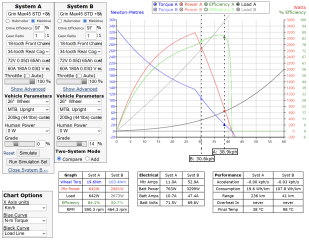

 Full Mechanical & Electrical Specifications
 Gear Performance Matrix (Based on 90 RPM Human Cadence)
