
Apartunis
⚡ Regular
When was the last time you went 100 to 150 km on a bicycle? People often want things in an ebike they do not really want.

If I had a bicycle that would require of me to pedal with less then 100W human power and get that range on a mixed terrain, I would have done it. That is the whole point. I can tell you of plenty a times where I have gone over 150km in a day with that kind of speed on my 50cc motorcycle. If that kind of set up actually manages to get anywhere near that kind of range in the real world. I guarantee you I'll find uses for it.When was the last time you went 100 to 150 km on a bicycle? People often want things in an ebike they do not really want.

Even with my cushy seat, my ass can only manage about 50 miles tops now. That's at my preferred average riding speed of ~20 mph. My usual rides are about 30 miles, or an hour and a half in the saddle, and taking a few breaks to look at stuff or getting something to eat, I'm out of the house for 3 or 4 hours. Simulator says I can go 96 miles if I had a better seatWhen was the last time you went 100 to 150 km on a bicycle? People often want things in an ebike they do not really want.
..
Even with my cushy seat, my ass can only manage about 50 miles tops now.
Upright bicycle frames are the problem, aggravated by the racing industry refusal to permit recumbents.

I mean I feel like it's hard to say that when basically nobody has tried other shapes of two wheeled vehicle. Like — saying they work better for most people when most people have not compared them is unfair. I think normal bikes do work just fine and one is not superior — I just have to assume a lot of the low popularity of other vehicle shapes is historical, due to lack of development, being too weird for people to try, etc. I've always wanted to try a recumbent E-moto build.That sad excuse is pushing 100 years old now and way past its expiration date. Normal bikes are normal because they work best for most people most of the time. Bents are special needs bikes.
When was the last time you went 100 to 150 km on a bicycle? People often want things in an ebike they do not really want.
If it were easy and people were moral, everybody would ride a bicycle.
Trying to do everything with the same tool leads you stepwise to a comically humongous pickup truck which spoils things for everyone.

Well I wouldn't try to push the envelope too far myself, nothing wrong with having a Gas powered bike for the long trips.I can tell you of plenty a times where I have gone over 150km in a day with that kind of speed on my 50cc motorcycle. If that kind of set up actually manages to get anywhere near that kind of range in the real world. I guarantee you I'll find uses for it.
The 197 dropout spacing could be a problem. Hopefully Grin can make an adapter.Update:
I've taken into consideration all of the advises given to me and decided on the following:
I ordered today the Surly Moonlander 2.0 with the 9 speed gearbox as the base for my bike, this thing is the closest I could find in terms of ticking all of the boxes needed for what I want a bike to do.
How does this compare to what I previously had in mind?
Well my first idea was centered around full suspension frame and that is rather involved in terms of fabrication if I wanted a custom one, and it had to be a custom one since the only commercially available one is the Q140MD from Qulbix. I did reach out to them and asked if they could modify the BB of the normal frame to accept the pinion gearbox, but it was to much of a hassle for them, and I don't blame them, I really didn't expect them to accommodate my delusional ideas, so that is all good, but that kinda left me with the only option for a full suspension frame to be a custom one, and that for a first build is a no go.
How does the Moonlander 2.0 with the 9speed pinion fit in?
Well the frame is rated as an expedition-grade/all-terrain overlanding (whatever that means), and it should be plenty strong for batteries etc. It comes heavy out of the box, so after fitting motor and batteries it will be less or similar in weight to a custom frame. The difference here will be that I will have to use the hub motor in the rear wheel, but that frame is the closest to a "bolt-on" solution I could find (considering the Grin Max45) while still having a pinion gearbox before the motor. That frame also has two nice "compartments" for batteries. One is just behind the rear tire and the seat post, and the other is the middle triangle, so this way I the only "custom" part of this will be the batteries, and those two places give options for a "smaller" and a bigger battery, that way I can only carry a battery according to the adventure.
This is where we are at. I'm hoping to get the bike in a couple of weeks and start plan things. I will most likely ride the bike as is for the summer, because my summer job is at the beach, that way I'll have time to get use to this beast and contact Grin, and plan for the conversion.
Thank you guys for all of your time and comments, much appreciated. Will keep you posted on further developments.
I think the "normal" version rear motor with the 10speed shimano freewheel hub with integrated torque sensor comes in that specific dropout size. I'll just need to get a single speed spacer adapter with the right size sprocket and that should be all good.The 197 dropout spacing could be a problem. Hopefully Grin can make an adapter.
The factory rim and tire will be just fine unless the tire pressure is super low maybe but at some point spinning tires on rims seems pretty rare. I've only had it happen with extreme amounts of torque, very low tire pressure and very old tires where the rubber on the bead was partially rubbed through, I ended up fixing it with bead locks though as I like my low tire pressure. I think though those tires will suck up a fair amount of battery.I think the "normal" version rear motor with the 10speed shimano freewheel hub with integrated torque sensor comes in that specific dropout size. I'll just need to get a single speed spacer adapter with the right size sprocket and that should be all good.
I think the most amount of trouble I will have is in terms of rims + tires. The "normal" 24inch 6inch wide tires are certainly not rated for any sort of electric power assist. I haven't yet looked up the specs of those rims + tires, but I recon if I just put a hub motor on them, as they come from the box, the rim will spin off the tire immediately. I'll like to keep the original rim+tire set as the non-assisted version and build a different set for the powered version.
Technically a triplet.(or twin brother?)
I ordered today the Surly Moonlander 2.0 with the 9 speed gearbox as the base for my bike, this thing is the closest I could find in terms of ticking all of the boxes needed for what I want a bike to do.
That's not really how electric motors work, switching the battery voltage while keeping the motor the same will do basically nothing. Technically there is probably some very very slight change due to switching losses or something. To change electrical "gears" you have to change the motor winding and even then the advantages are slight unless your operating speed range is massive. This isn't unheard of, that is having two sets of windings that you can switch into parallel or series but it's pretty rare and again only works if the speed range is quite large, which based on his conservative top speed isn't the case.I thought of a way to widen your power delivery speed range. If you have two batteries of the same voltage and two controllers, you could switch between half voltage and double current or double voltage and half current. You could use a big multipole switch to change batteries between series and parallel and to switch between one controller and the other. If the motor is rated to take the higher current then you would have a mountain climbing speed range and a faster but lower torque operating range for roads and less steep terrain.
That's not really how electric motors work, switching the battery voltage while keeping the motor the same will do basically nothing.
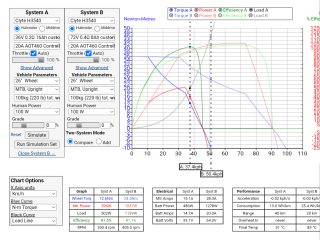
It depends on what you're looking for. Higher peak current is higher peak torque (or percieved power), but that's applies to peak of the torque curve, that is at stall on an electric motor. For my ebike riding, that peak isn't of much use, but for a wheelchair trying to get up a curb, it might be. Raising the voltage shifts the torque curve so there is a much greater torque advantage at ebike speeds. This is why, given a choice between the two, as long as the peak torque of the higher voltage system is adequate, I'd choose higher voltage, and just keep it that way rather than switching back and forth.What I was suggesting was having for example a 48V 25A controller alongside a 24V 50A controller that get switched over when the batteries are changed from series to parallel. With any given single motor winding, the motor will find a lower efficient speed at lower voltage, even if the higher voltage controller can serve up the same maximum current from a stop. Which it probably can not.
The low voltage configuration will most likely give more torque at low speed, but definitely will deliver better efficiency and less heat at low speed.

I understood exactly what you meant, it's just not correct. The same motor, at the same speed and phase current will be basically identically efficiency wise if you change the controller input voltage in this range (yes if you like change it from 2V to 300V or something you are going to start to get some weird very extreme switching and inductive losses). The lower voltage config will give exactly the same torque if the phase current is the same and the efficiency will be basically the same.What I was suggesting was having for example a 48V 25A controller alongside a 24V 50A controller that get switched over when the batteries are changed from series to parallel. With any given single motor winding, the motor will find a lower efficient speed at lower voltage, even if the higher voltage controller can serve up the same maximum current from a stop. Which it probably can not.
The low voltage configuration will most likely give more torque at low speed, but definitely will deliver better efficiency and less heat at low speed.


 www.teslarati.com

Many EVs do this, has nothing to do with the motor, they change the battery pack from series to parallel for charging depending on the charging infrastructure available. I mean it says it right there in the article, has nothing to do with motor efficiency.I think Rivian does have several patents on throwing switches to reconfigure the voltage of batteries. E.g.:
Rivian patent application hints at 900V fast charging capabilities
A recently published Rivian patent application titled “Configurable Battery Pack for Fast Charge” describes a method of switching between battery pack connection types to allow for both 450V and 900V fast charging without the need for specialized components. The invention was filed in both the...
No idea if they found it valuable enough to put in a production system, but they did seem to find it valuable enough to pay the patent fees
4. The method of claim 1, wherein if the load requires a high current, the method comprises manipulating the power transfer between the first energy storage system and the second energy storage system by configuring the first energy storage system in parallel with the second energy storage system.
5. The method of claim 1, wherein if the load requires a voltage higher than each of the first energy storage system and the second energy storage system, the method comprises manipulating the power transfer between the first energy storage system and the second energy storage system by configuring the first energy storage system in series with the second energy storage system.


I understood exactly what you meant, it's just not correct. The same motor, at the same speed and phase current will be basically identically efficiency wise if you change the controller input voltage in this range


