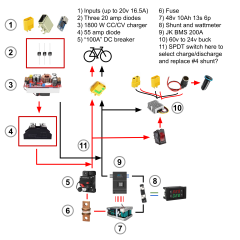
- Should I use three diodes (pictured at #2) to isolate each choice of input, or a SP3T switch rated for 20A and 20V? Worried about frying the PD Trigger board by sending 300+ watts up into it’s output pads from the XT60 input.
FWIW, you don't send wattage anywhere. Any voltage applied to one port wired in direct parallel to anohter port is applied to boht. No current flows unless there is a circuit connection that allows this on the other port, so no watts are dissipated.
If the PDTB output has no protection against voltage placed upon it from outside, then you need to provide whatever protection it says it requires, or prevent voltage from being applied to it's output.
- I like that diodes are small, cheap, omnipresent, and require no user input.
- Should I use a 50+ amp diode (pictured at #4) to stop battery voltage and the bike’s regenerative braking from going into the output side of the charger (#3), or use a SPDT switch (around spot #11) capable of ~ 50 amps DC to select “charge mode” or “ride mode”? Again, I like diodes for the four reasons listed above but am here to learn.
Diodes work, but they have a voltage drop across them and a resistance, so they generate heat. That heat has to be able to go somewhere, so you'll need to account for that.
The diodes have to be rated for the current and voltage you're going to use with them. YOu state in the diagram up to 16.5A at 20v. So the diodes must be rated for a minimum of those things.
Let's say you have 16.5A at 20v coming in. The diode will probably drop about 0.7 to 1v, you'll have to check the datasheet for the specific one you use for voltage drop at current--it goes up as current does. We'll assume 1v at 16.5A, so 16.5 watts of heat being created in the diode. In a tiny space, this is enough to solder with, so....
For the bigger diode to the controller, then without a current draw listed for the controller, we'll assume the full 55A listed in the diagram. Voltages higher than hundreds of volts could be generated by regen depending on the motor winding, speed, controller design, etc, so the diode should be rated for that. A high current diode may have a higher voltage drop, so we'll assume it has 1.5v of drop at max current, so ssuming a max current draw of 55A during traction operation (regen won't have any current, blocked by diode), then 55 x 1.5 is 82.5 watts of heat you have to get rid of. This may require a large passive heatsink and significant airflow during riding, or a smaller heatsink for a high-airflow fan (that will use up some small bit of your range).
Actual watts of heat produced depend on current and voltage drop at that current, so you would either just plan on worst-case and go with that all the time, or make something that adapts to the actual heat conditions (thermally-controlled fan, etc).
If the heat is low enough then a simple passive heatsink exposed to airflow while riding is sufficient.
- Is a fuse (#6) really necessary, or can one get away with just a DC breaker switch instead (#5)?
how fast does the breaker operate under the conditions you expect to require it to trip?
If it isn't as fast as it needs to react, then a fast-acting fuse should be used.
Keep in mind that breakers, like switches, can fail stuck on, welding together, preventing them from doing the job of breaking the circuit. A fuse doesn't have that problem, as long as it is correctly rated for the application in both voltage and current. (read up on fuse usage / specification at the fuse manufacturer websites--the big names have documentation on their product lines to help you pick the right one).
Also...unless using a genuine product with a reliable datasheet, you won't actually know that the fuse or breaker will actually do it's job in the failure conditions it's there to prevent damage in.
There are lots of cheap clones of pretty much any product you can imagine. If you find a seller with a product that is a lot cheaper than the same name brand at places like mouser, digikey, etc., there's a significant chance it is not the real thing, and may be a re-marked or otherwise counterfeit product that you cannot know the actual specifications for no matter what they say it is.
If you are using a safety product, you want it to actually do the job you install it for. So don't use one you don't absolutely trust to be what it says it is, and to do the job you need it to do.
- Will this spot for a shunt and wattmeter allow for both charge and discharge amp monitoring? Is there any decent cheap wattmeter + shunt for measuring around 6 amps for charging and around 25 amps for riding? I hear that all the inexpensive ones are terrible with their amp accuracy, would one with a trim potentiometer fix that?
How accurate do you need it to be? Most are within a few percent if thats good enough.
True accuracy requires calibration, so it not only has to have an adjustment, you also have to have a known-accurate measurement device to use as a reference when adjusting it. It's accuracy will be one limit to how accurate your adjusted device could be.
If all you want is repeatability, then any of htem will probably measure the same thing the same way each time.
- Will the buck converter (#10) be fine when regenerative braking occurs and reverses the flow of electricity?
Does the converter handle this situation by design, under the conditions you will use it in, at the voltages and currents that will be experienced?
If not, you'll have to test this.
Keep in mind with no battery load on the battery bus of the controller, the voltage will spike very high very quickly, and can destroy the controller itself. As long as the battery doesn't get disconnected or blocked from receiving the regen current (meaning it's BMS never shuts down for whatever reason during regen), then the voltage won't spike, it'll just go up to whatever the controller is designed to output (and any settings it has).