• Hello ES! We could use some help to get us past the finish line on building the new knowledgebase for the forum.
    Can you donate? Please see our fundraising page. Thank you!

Pedal Car into Remote Control ( VEVOR )

CarolNSA

New here
Joined
Aug 22, 2025
Messages
17
Location
Texas
Hello all , as you can tell by my posts I am somewhat new to the forums and I wanted to say hey before I start with the millions of things I would like to ask.

First I'll start off by saying that I have been reading the forums a bit. I like to search first to see if anyone else has encountered the same issue , or even close to the same issue I have when recently joining a forum.
I didn't actually expect it this time but still search of the motor " MY6812 " motor. I found a few things but not close enough to what I'm looking for. Even though the RC lawnmower concept IS the directing I'm working on.



So the basics first.
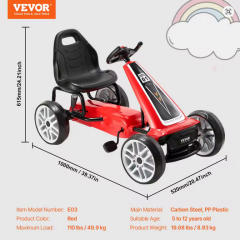
I bought this pedal car.

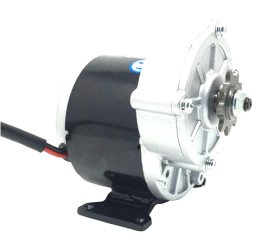
Then this motor.

Then this PWM ??? Because I thought I might need one. Even though I didn't / kinda don't know what it is.
Amazon.com: tatoko DC Speed Controller DC 6-60V 12V 24V 36V 48V 30A PWM DC Motor Speed Controller, Stepless Speed Regulation Start Stop Switch for Motor : Industrial & Scientific

( I was initially thinking it was something that would let me use my Ryboi 18v batteries as an input and drop the output down to 12vdc for the motor , but I've been reading a bit more and now thinking NOPE !!! )


So now on to the starting of what's going on.

This project IS NOT for a kid. This project is for a Star Wars Pit Droid like in the Video I HOPE I'm able to include.
As a member of The 501st Legion and I've been working on this for some time , but being a bit older and my concentration not being the best, i KNOW when I need help.

So to continue , this is meant to be a Remote Controlled Car for a 3D Printed Pit Droid that weighs under 20 pounds. When we do Charity events having things of this nature helps he kids eyes light up and brings their smiles out to help'em forget whatever it is they are going through.

So , the starting of my issues , is I DO NOT KNOW WHAT I'M DOING ! Hahahahaha

I've played around with small electronics and had a bike and all that but this is over my head.
I've been able to somewhat take the Pedal car apart and make a servo are for the front wheels ( that I THINK is going to be used under a different power source )
As it is now , I'm stuck with not understand the sprockets and chains and their size relations.
I contacted the manufacturer and they told me that The VEVOR Kids Pedal Go Kart uses a 10-tooth sprocket and fits a #40/41 bicycle Chain.
Chain Compatibility Details
• Chain Type: #40/41
• Pitch: 0.5 inches (12.7 mm)
• Roller Diameter: 0.312 inches (7.92 mm)
• Width Between Inner Plates:
• #40: 0.312 inches (7.92 mm)
• #41: 0.306 inches (7.77 mm)

So I'm not sure if this motor I have will even work on the Chain that on the pedal car.
I also am curious does the placement of the motor make a difference. ( back by the back wheels - middle of pedal car )
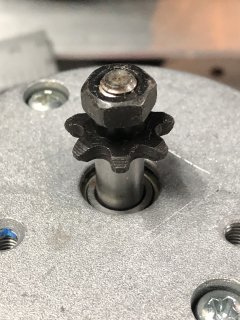
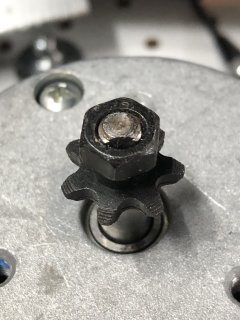
HOW do I remove the sprocket off of this motor ?

I have several other questions but I don't want to overload anyone with all this right off the bat !

Thank You for getting this far.


Attachments

  • IMG_0422.JPEG
    IMG_0422.JPEG
    405.7 KB · Views: 1
  • IMG_0423.JPEG
    IMG_0423.JPEG
    752.8 KB · Views: 0
  • IMG_0425.JPEG
    IMG_0425.JPEG
    591.1 KB · Views: 1
  • IMG_0426.JPEG
    IMG_0426.JPEG
    776.4 KB · Views: 1
  • IMG_0429.JPEG
    IMG_0429.JPEG
    731.9 KB · Views: 1
With that motor, the car will go about 100mph. You probably want more gear reduction between the motor and wheels.
They make geared brushed motors that would likely be more in the right speed range. Search for MY1016. These come with standard bicycle chain sprockets.

Here's one on Amazon:
MY1016 Motor

1755879385209.png
 
With that motor, the car will go about 100mph. You probably want more gear reduction between the motor and wheels.
They make geared brushed motors that would likely be more in the right speed range. Search for MY1016. These come with standard bicycle chain sprockets.

Here's one on Amazon:
MY1016 Motor

View attachment 375955
Thank You for your response , as I said above I don't know what I'm doing so ANY input IS HELPFUL , as well as the more the merrier. I like forums like this because people get to see SO MANY different ways different people do things.

I went to the link and saw the price and the voltage. I'm sorry to say , I just can't afford it. I DO still have the ability to send the motor back till the 7th September , however the cost of the other one isn't something I can swing. Same as the voltage.

I have 6 Ryobi One Plus 18volt batteries and IF I can get away with it , that's the power source I was intending on using. I got a step down thing ( Amazon.com: Vibit 18 V to 12 V Step-Down Converter for Ryobi 18 V Battery, DC Power Adapter, Voltage Reducer Transformer 180 W Buck Converter Regulator for Golf Cart RC Car Truck Light & DIY : Electronics ) that converts the 18v down to 12 which I can also use for other purposes so wanting to go this way was more of an investment .


Can I ask if the power PWM mentioned above would help with lowering the speed , or , ( as I was thinking, ) would getting a larger sprocket and replacing the one on there now help ?

I AM all for sending the motor I have back , and getting a bicycle one , but I'm TRYING to keep it around the same price and same voltage. ( 12VDC )


I looked a bit and saw this one. Do you think this one would work ? It's a lower cost and is 12v ?


Attachments

  • Screenshot 2025-08-22 at 15-51-06 Order Details.png
    Screenshot 2025-08-22 at 15-51-06 Order Details.png
    43 KB · Views: 2
Last edited:
I installed a 24V 20Ah A123 Lifepo battery in the Kettcar from my Kids and the geared motor mentioned above.
The kettcar we have is much heavier than yours. On flat grounds the motor reaches a little more speed as they can reach without motor which is 18kph. I would not go for less voltage if you have to carry a little load, because uphill the motor drwas 500W and not more at 24V. For our heavy Kettcar the motor is a little to weak. If you use less voltage the power will also be less.
If you don't need high speeds and are always an flat surfaces 18V will shure be enough.

Link to my thread on a german forum.
 
Last edited:
Thank You for your response. I like it ! I went to your German Forum and read , ( OK OK , looked at the pictures , hahaha ) and was like , COOL !

I did also look at the 24V 20Ah A123 Lifepo battery ... YIKES !!!!!!!!!!!! Grin , For me , that's 100% for sure out...

I also seen the the second motor , the one I got today , does not have the expanded gear box ( ??? ) on the side. I'm guessing that's the step down gears so that it - WON'T - go as fast ???

And you are correct in guessing that this will only be ran on flat surfaces.

I'm curious though , the brackets and for that build you did , did you fabricate'em or were they store bought ?
 
Your pwm board will reduce speed and also power of the motor.
As your thing is light, I would just try if 12V is still enough.
The other way is change gearing.
I think the ratio from the geared motor is 1 to 8.

I made the brakets myself.

The kettcar can be used as a two seater and my Kids can still drive it with one seat, they are now 13 years old and 1,65m big.
 
Last edited:
So now on to the starting of what's going on.

This project IS NOT for a kid. This project is for a Star Wars Pit Droid like in the Video I HOPE I'm able to include.
As a member of The 501st Legion and I've been working on this for some time , but being a bit older and my concentration not being the best, i KNOW when I need help.

So to continue , this is meant to be a Remote Controlled Car for a 3D Printed Pit Droid that weighs under 20 pounds.
If you want this to be easy, I would recommend using an existing RC car and putting the shell on that. ;)

It's been done (not by me) with things like a Lexx-790-head-platform, and a K-9 (Doctor Who / Sarah Jane Adventures), for things I've seen in person.


If you prefer to DIY the whole thing, you don't need much of a motor to move 20lbs at slow speeds. (<walking, presumably)

If you don't need to operate the DUM itself, just move it around on the kart, the whole thing is pretty simple.

If you need to operate the DUM's arms, etc., or even just turn it's head, that's getting more complex (possibly very, depending on what you want to do).


If it's that lightweight, 20lbs, you can probably use your Ryobi tools (the drill, for instance) as the motor. Kind of expensive as a motor if it's permanently mounted, but you can find these things at goodwills and other thrift stores; as long as they'll run on your batteries (same voltage) you can make a physical adapter for the batteries to connect to them. (probably 3d printable patterns out there for this already).


If you're willing to look around, there are quite a lot of motorized things you can find at thrift stores and yard sales and the like that will already have a motor you can use, and possibly electronics to drive / control it. Easiest to pick one that already goes the speed range you want this to move at.


BTW, you can probably use the motor you already have, but you'd probably have to make a reduction for it. It'd be easier to get one made for a low-speed system., like a kid's kickscooter (razor, etc). Or one with the gear reduction built in like Fechter pointed at.

If you get a motor tha'ts intended for a higher voltag,e then wehn you run it at a lower voltage it will run proportinally slower. Like if you get a 36v motor, and run it on 18v, it'll go about half the speed it is rated to go, so a 300rpm motor would run at 150rpm max instead. a 24v motor would run about 2/3 of the speed on 18v. Etc. A lower voltage motor would run *faster*, proportinally, so a 12v motor would run about half again as fast on 18v--(meaning, if it was all setup to go 10mph at full throttle at 12v, running it on 18v would mean 15mph instead).


You will also need a speed controller (ESC). The one you previously linked will drive the motor...but you need one that your remote / receiver unit will be able to control. Most of those use a PWM output (like RC servos take), so your ESC needs a PWM input to work with them. If you use a receiver that has an analog 0-5v output for the drive motor, then you can use the type of ESC you linked.

So, what remote are you going to use? Do you already have a receiver to send commands to the servo/etc?


Other thoughts:

Is the steering servo already setup and working, and does it have sufficient force to pivot the wheels at the rate you'll need for steering at the speed you'll be going? (each servo is rated for a certain amount of force at a certain amount of distance from it's shaft; it takes a certain amount of force to move the steering mechanism at a certain rate to allow for maneuvering, based partly on the load on the steering (friction, etc)).

It's important to use a servo that can supply enough force to move something, and can do it as fast as it is needed...a less powerful servo might move a load more slowly, or it might not move it at all. (there are also different movement angle limits available, so the servo has to be able to move far enough).

You can look at similar-sized RC cars and trucks that people say perform / steer well, and use a similar-capability servo, mounted in the same way with the same arm length to the same piont on the same style steering pivot to get similar results to theirs, if necessary.
 
If you want this to be easy, I would recommend using an existing RC car and putting the shell on that. ;)

It's been done (not by me) with things like a Lexx-790-head-platform, and a K-9 (Doctor Who / Sarah Jane Adventures), for things I've seen in person.


If you prefer to DIY the whole thing, you don't need much of a motor to move 20lbs at slow speeds. (<walking, presumably)

If you don't need to operate the DUM itself, just move it around on the kart, the whole thing is pretty simple.

If you need to operate the DUM's arms, etc., or even just turn it's head, that's getting more complex (possibly very, depending on what you want to do).


If it's that lightweight, 20lbs, you can probably use your Ryobi tools (the drill, for instance) as the motor. Kind of expensive as a motor if it's permanently mounted, but you can find these things at goodwills and other thrift stores; as long as they'll run on your batteries (same voltage) you can make a physical adapter for the batteries to connect to them. (probably 3d printable patterns out there for this already).


If you're willing to look around, there are quite a lot of motorized things you can find at thrift stores and yard sales and the like that will already have a motor you can use, and possibly electronics to drive / control it. Easiest to pick one that already goes the speed range you want this to move at.


BTW, you can probably use the motor you already have, but you'd probably have to make a reduction for it. It'd be easier to get one made for a low-speed system., like a kid's kickscooter (razor, etc). Or one with the gear reduction built in like Fechter pointed at.

If you get a motor tha'ts intended for a higher voltag,e then wehn you run it at a lower voltage it will run proportinally slower. Like if you get a 36v motor, and run it on 18v, it'll go about half the speed it is rated to go, so a 300rpm motor would run at 150rpm max instead. a 24v motor would run about 2/3 of the speed on 18v. Etc. A lower voltage motor would run *faster*, proportinally, so a 12v motor would run about half again as fast on 18v--(meaning, if it was all setup to go 10mph at full throttle at 12v, running it on 18v would mean 15mph instead).


You will also need a speed controller (ESC). The one you previously linked will drive the motor...but you need one that your remote / receiver unit will be able to control. Most of those use a PWM output (like RC servos take), so your ESC needs a PWM input to work with them. If you use a receiver that has an analog 0-5v output for the drive motor, then you can use the type of ESC you linked.

So, what remote are you going to use? Do you already have a receiver to send commands to the servo/etc?


Other thoughts:

Is the steering servo already setup and working, and does it have sufficient force to pivot the wheels at the rate you'll need for steering at the speed you'll be going? (each servo is rated for a certain amount of force at a certain amount of distance from it's shaft; it takes a certain amount of force to move the steering mechanism at a certain rate to allow for maneuvering, based partly on the load on the steering (friction, etc)).

It's important to use a servo that can supply enough force to move something, and can do it as fast as it is needed...a less powerful servo might move a load more slowly, or it might not move it at all. (there are also different movement angle limits available, so the servo has to be able to move far enough).

You can look at similar-sized RC cars and trucks that people say perform / steer well, and use a similar-capability servo, mounted in the same way with the same arm length to the same piont on the same style steering pivot to get similar results to theirs, if necessary.
THANK YOU for your comments. I'm HONESTLY appreciative of them and love the detail you went into.

This is a somewhat larger than the race cars I've seen. It's an actual Pedal car for kids. It's rated for up to 66 pounds and the pedal car itself weighs right at 15 pounds. ( 14.55 pounds )


You are spot on when you say I'll be walking. Most likely behind it a bit or off to the side somewhere as I'm making it Remote Controlled so as not to ruin the illusion of the Pit Droid Driving.

I don't know what a DUM is but am going to look once I finish this response.

When you say DUM , I think you're talking about . . . . YES , The arms and heard... HOWEVER , I am JUST going to be moving his head. I've already got that down with a 4 channel RC.
Channel 1 head left-right
Channel 2 up-down. C
Channel 3 for forward backward of Pedal Car , ( IF the motor allows it )
Channel 4 left - right of steering wheel.

His legs will be mounted with magnets on pedals so when Pedal Car move , his legs will look like he's peddling.

I DO have a few Ryobi tools. Most were Birthday and Christmas gifts over the years so I do have a few batteries as well.

There are a few 3DP items online at thingiverse , but I did purchase a 18v step down to 12v already as I see it as an investment that can be used for other things.

I looked at what Fechter posted and wanted to get it , but it's out of my price range and the wrong voltage.
I DID purchase one related to the link Fechter sent me that was within my price range AND ( WOO HOO ) was also a 12 volt.
Just in case though , I did also contact the manufacturer to see HOW I get the sprocket off the one I already got. Hahaha

I did see a few that had the extra stuff on the side , ( I think that's the step down gearing ) and were either 24 , 36 , or 46V. I liked the design of'em but again not at the price point I wanted.

And I KNOW y'all know BY FAR more than I do , but can I not mess up the motor itself by running it at a lower voltage that what it's rated for ? This is something I've been curious about for a while as I've been planing this project.

I'm going to look to see what an ESC is when I'm done posting. My thoughts were to find a reasonable power output using the PWM and setting it at that so the pedal car won't go any faster ? ? ? It seems now I'm going to have to buy something else. Hahahahaha I know I know it always happens.

In your Other thoughts part you asked about the steering servo. I'm including it's information for your input. And a Video as well. I have already made an aluminum " arm " that mounts to the wheel that's directly attached to the servo as the plastic one that came with it , I am sure will fail over time. At least with an aluminum one , it MIGHT ( hahaha ) last longer.

The pivoting aspect ??? I didn't think of that !!! THANK YOU !!!

Right now , I honestly don't know. It DOES have a decent amount of force ( torque ) to it , and I know the smooth shiny plastic wheel on a non carpeted floor IS going to help , but I'm going to have to update y'all once I get to that point.
The " good thing " here is that the speed will 95% of the time be at a SLOW walking pace. At these events I'm representing a World Wide Charitable Organization so running over people would NOT be a good thing ! Hahahahahaha

I couldn't upload the mp4 file , but it shows the servo connected to the front wheels and working.
 

Attachments

  • Screenshot 2025-05-16 at 14-13-24 VEVOR Kids Pedal Go Kart 4 Wheel Off-Road Pedal Ride On Toys...png
    Screenshot 2025-05-16 at 14-13-24 VEVOR Kids Pedal Go Kart 4 Wheel Off-Road Pedal Ride On Toys...png
    291.8 KB · Views: 2
  • My Servo Specs.jpg
    My Servo Specs.jpg
    36.1 KB · Views: 2
Your pwm board will reduce speed and also power of the motor.
As your thing is light, I would just try if 12V is still enough.
The other way is change gearing.
I think the ratio from the geared motor is 1 to 8.

I made the brakets myself.

The kettcar can be used as a two seater and my Kids can still drive it with one seat, they are now 13 years old and 1,65m big.
Thank You for your response. Ya know out of everything here , I DO NOT have breaks !!! I'm HOPING that they wont be needed as the events I've done in the past , the speed is so slow , but if you have ANY info or how an RC Car at ths size can have breaks , PLEASE let me know.
 
With lower voltage you also have lower current and lower power overall. As long as the motor is turning it won't burn.
 
RC cars brake by shorting the motor. This is done by the controller.

I think the motor you got does not have any internal gearing. If you know the RPM of the motor, the number of gear teeth, and the wheel diameter, it's possible to do the math on what the no-load speed would be (like with the wheel lifted off the ground). You really want the no-load speed to be in a reasonable range so the motor isn't overloaded. You can always make it go slower by using less throttle, but if it's geared too fast, the motor can overheat. My guess is you want as much gear reduction as you have room for.
 
RC cars brake by shorting the motor. This is done by the controller.

I think the motor you got does not have any internal gearing. If you know the RPM of the motor, the number of gear teeth, and the wheel diameter, it's possible to do the math on what the no-load speed would be (like with the wheel lifted off the ground). You really want the no-load speed to be in a reasonable range so the motor isn't overloaded. You can always make it go slower by using less throttle, but if it's geared too fast, the motor can overheat. My guess is you want as much gear reduction as you have room for.
Gonna be honest , I don't think this has anything like gear reduction. ( The one I already have that is ) As for the one I ordered after seeing your last reply , we will see ! Hahahaha

As it is right now , I am not in any kind of hurry. As I said I've been thinking about this for a few years and now actually got around to TRY to make it happen. I know in my mind I want it done TOMORROW though , but being a realist , that's not going to happen and I'm OK with it.

And so far I've not figured out how to wire all this up to make to be controlled remotely... But that going to take time.

The thing I kinda worry about though , how many things am I allowed to return to Amazon before they get mad !

Hahahaha
 
Wanting to keep people updated.

I've noticed several threads where people ask questions, get the answers they want , and that's the last ya see'em

Still waiting on parts but this is where I'm at now.

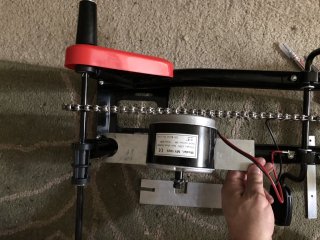
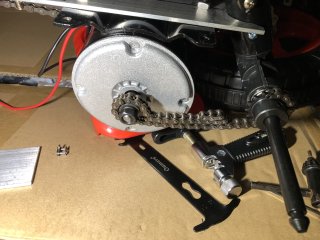
Not sure about placement of motor. Was thinking the closer it is to the read axle where the sprocket is gonna be , the better.
 

Attachments

  • IMG_0469.JPEG
    IMG_0469.JPEG
    614.7 KB · Views: 7
  • IMG_0470.JPEG
    IMG_0470.JPEG
    559.7 KB · Views: 6
  • IMG_0471.JPEG
    IMG_0471.JPEG
    560.8 KB · Views: 6
Wanting to keep people updated.

I've noticed several threads where people ask questions, get the answers they want , and that's the last ya see'em
Yes, we really appreciate seeing what comes of people's projects. It's not only fun, we learn stuff too. :)


Not sure about placement of motor. Was thinking the closer it is to the read axle where the sprocket is gonna be , the better.

Doesn't really matter for distance, for the space you ahve there. Technically the more links in teh chain hte more power loss, but that's not an issue for something like this, would be miniscule.


So use whatever makes mounting easier, and better chainline, clearances for other parts, etc.

The one thing that might be better is to use a distance that gives you the most engaged teeth on the smallest cog in the system. That spreads the power over more surface area for less wear. Not likely to be much of an issue for a system and usage like this.

I do presume the motor will be flipped the other way round eventually, though, right? ;)
 
And so far I've not figured out how to wire all this up to make to be controlled remotely... But that going to take time.
I described part of what you'll need previously, but with a question because that's necessary info to give you more detail:
You will also need a speed controller (ESC). The one you previously linked will drive the motor...but you need one that your remote / receiver unit will be able to control. Most of those use a PWM output (like RC servos take), so your ESC needs a PWM input to work with them. If you use a receiver that has an analog 0-5v output for the drive motor, then you can use the type of ESC you linked.

So, what remote are you going to use? Do you already have a receiver to send commands to the servo/etc?
 
I got lost in the replies but this is about the ESC mentioned above and where I said I didn't know what it was and would have to look into it.

I did. THANK YOU !!! Of course you DID help me out in a big time way because I had NO IDEA of what I needed to make all this get together and work ! Hahahaha

I did order one AFTER I realized that I ordered a Brushless motor one first. I don't think that can be used with a Brushed Motor , so I ordered one for a brushed motor. Hopefully it'll be in on Friday. I went to two bike shops and honestly they had no idea of what I was talking about. I wanted to keep business local , but seems that failed...
 
Correct. A brushless controller won't work.

How are you going to do the steering? I haven't seen RC servos that big (that are reasonably priced).
So being honest , I thnk I'm getting in over my head. As I've said before this is all new to me. I got this " ESC " and was doing all I could to connect it properly. NOPE !!!

I didn't want to damage the motor so I used a 6v 2000mah battery to power everything , JUST for the testing of course. ( I have the Ryobi 18 with a step down to 12 ready to go JUST for the motor itself ) But when things didn't work with the 6v , I figured I'd breadboard it to see where I'm messing up.
That too didn't work. There wasn't any instructions with it " ESC " . ( Even though in the image it seemed easy enough. I'm guessing now that maybe I need to stick with the 18v>6v for the motor and the 6v for the servo.

You are correct though. I have the 6v just for the servo I'm using for the front wheels... I'm thinking this entire project doesn't weigh more than 30 pounds total so before spending $30-40 bucks on a lead acid battery , I'd try the Ryobi first.

Anyway , it seems that didn't work either. I'm thinking I'll give it another go in the morning.

Now for an odd thing , that I WAS NOT expecting... I turned the power OFF using the switch on the " ESC " and walked away.

I came back and there was a SMELL !!! Yes nothing was powered up but the battery was warm, the wires were HOT and the insulation was starting to melt...

It seems I know I messed up, ( hahaha ) so I'm going to give it another try tomorrow.
 

Attachments

  • 61pIIyablQL._SL1500_.jpg
    61pIIyablQL._SL1500_.jpg
    106.9 KB · Views: 3
- Update

I didn't think this would be as difficult as it is. And I'm not even talking about the ESC . ( That I'm still reading and working on )

This is the chain link problem I remember as a kid that my Father helped me change bike chains a few times over the years. And I'm 99% for sure it was a hammer and a socket to knock the pin out and maybe wire pliers to get the pin back in. But Now they have tools specifically made for that. I got one and the dam pin thing won't cooperate ! So this is where I'm at now. Seems there might be enough slack in the chain for me to take off the back sprocket , put the chain on , then put the sprocket back on.

Still working on it...
 

Attachments

  • IMG_0510.JPEG
    IMG_0510.JPEG
    866.8 KB · Views: 6
Updating 10-07-2025

I've made progress And am trying to upload the 4k mp4 video file but it's not letting me. Took me awhile but was able to make the video a gif. It doesn't do it justice as you can not hear the tires peeling out on the pavement but still ya get the picture. Hahaha The tires are plastic and not griping the pavement because there isn't really much weight on the cart itself.

I am using the Ryobi 18v battery in this setup but found out ( the hard way ) that an 18v 4ah battery will drain SUPER FAST. Still trying to understand all the math and stuff but it seems I might have had it out there for under 10 minuets and I THINK it was a freshly charged battery.

I DID look at the motor though and it showed 12 Volt 28 Amp 250 Watt so I am 100% for sure the time has something to do with the watts or amps because the battery is an 18 volt.

Anyway , I just wanted to keep anyone who is interested in the progress ( what little there is ).


( I don't know much about how to determine the file sizes so I kept trying to make the gif shorter...

It finally worked...
 

Attachments

  • PitDroidBatteryTest3.gif
    PitDroidBatteryTest3.gif
    3.2 MB · Views: 6
  • Screenshot 2025-10-07 at 14-27-30 Pedal Car into Remote Control ( VEVOR ) Endless Sphere DIY E...png
    Screenshot 2025-10-07 at 14-27-30 Pedal Car into Remote Control ( VEVOR ) Endless Sphere DIY E...png
    146.5 KB · Views: 6
Nice!
You might want to look around for a bigger battery. I’ve also seen setups with multiple tool batteries in parallel.

With the hard wheels you should be able to make it drift nicely.

I think for videos you have to put them on YouTube and post a link to it here. I wish we could upload videos directly here.
 
I've made progress And am trying to upload the 4k mp4 video file but it's not letting me.
Best is post it to youtube and then put the yt page link here and it will show it inline in your posts.


I am using the Ryobi 18v battery in this setup but found out ( the hard way ) that an 18v 4ah battery will drain SUPER FAST. Still trying to understand all the math and stuff but it seems I might have had it out there for under 10 minuets and I THINK it was a freshly charged battery.

I DID look at the motor though and it showed 12 Volt 28 Amp 250 Watt so I am 100% for sure the time has something to do with the watts or amps because the battery is an 18 volt.
If you have a wattmeter, you can use that to determine amps drawn during usage. Some show average and peak, some just peak.

When you know how many amps are being used, and you know how long you need it to run, you can multiply the two to get Amp Hours. (Ah).

Knowing that, youc an then see how many batteries of a certain Ah size you'll need to get the runtime you want.

If you can't measure hte battery amps being drawn by the motor controller, you can look at the motor *controller* to see what it's curretn limit is labelled as, and use that as a guesstimate of Amps, and multiply *that* times the hours you need it to run. (if less than an hour, the number is less than one, like .75 for 3/4 of an hour, etc).


you can also reverse the numbers...if you are getting 10 minutes of runtime, tha'ts 0.17 hours. The pack is 4Ah, so assuming you were able to use all 4Ah, that's 4Ah / 0.17 hours (to cancel out the hours and leave you with only amps) = 23.5A.

So if you want to run for an hour, you need about 24Ah or more, or at least six of those 4Ah battery packs.
 
Nice!
You might want to look around for a bigger battery. I’ve also seen setups with multiple tool batteries in parallel.

With the hard wheels you should be able to make it drift nicely.

I think for videos you have to put them on YouTube and post a link to it here. I wish we could upload videos directly here.
I've been reading , as time permits of course and it seems that the Volts of the battery does not have much to do with it because it is over. It's the amps. It seems I NEED to buy a battery that has AT LEAST the 28 amps that the motor is rated for... Still trying to understand ,and it seems youtube is my best friend right now ! Hahaha I'll work on the videos and getting it / them here soon...

Thank You again for your response.
 
Back
Top