• Hello ES! We could use some help to get us past the finish line on building the new knowledgebase for the forum.
    Can you donate? Please see our fundraising page. Thank you!

Nissan Leaf motor at 60V, 1/6 the power?

I think the torque should be a linear function of RPM.
Umm? What this mean about the torque capacity of the ME1507 at 1200 rpm?
I mean, this motor can do 120 Nm, but I bet it is actually limited to 24 Nm at around 1200 rpm.
From my understanding, 0.026 V/rpm mean around 31.2V at 1200 rpm. Leaf push 3 kW*, so only 24Nm is generate from the ME1507.

If that is right, is there a manner to increase the voltage at motor terminal (so, the torque) without a motor controller?

*I tested with 12S NMC battery, so 45V nominal.
 
Do you have a way to measure the current in the shorted phase wires?

Spec sheet says Phase to Phase winding resistance is 0.027 Ohms.
If the BEMF at 1200 rpm is 31.2v, then the current would be around 1150A (yikes!).
Spec sheet says Maximum current 600Arms during 1min.
Torque constant 0.20 Nm/Amp, so 231Nm.

It seems like something isn't right. You should be getting more load out of it.

I can't think of any easy way to get more load. Something like a controller trying to run it in the opposite direction.

A way to mechanically measure the torque would be nice.
 
The resistance in the shorted phase circuit must be a lot higher than 0.027 ohms indicated in the spec sheet.
At 305A, it should be 61Nm.

You could try the second Leaf motor and see what happens. Seems like a lot of work.
Locking the rotor would be another option, but the VESC isn't going to be happy with that. Most controllers will hit the current limit with a locked rotor then shut off due to safety mechanism.
 
You could try the second Leaf motor and see what happens. Seems like a lot of work.
Yes. Especially as I already have the ME1507 connect to a 1500A EZkontrol controller to test everything.
Simply that this controller don't work sensorless and I don't know how to connect the encoder to the controller as I said post #54 Nissan Leaf motor at 60V, 1/6 the power?

I bet if I can connect this encoder to the ME1507, this one will be able to regen at higher current/higher torque.
 
At 305A, it should be 61Nm.
But that probably not good as 61Nm at 1200 rpm should be 7.6 kW and I don't ever see more than 3 kW out of the battery.
I think my 24 Nm is more representative of what happen.
I don't think you can get more regen load than shorting the phase wires.
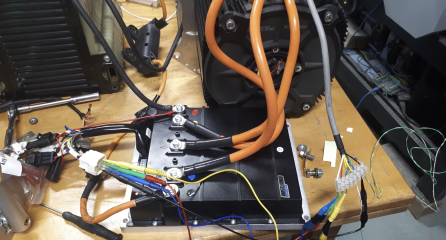
I would like to understand why, but sadly I don't understand this.
I've seen publish 80 Nm at 400A and 120 Nm at 600A for this ME1507 motor, so I don't see how it could not give more torque when connected to a proper controller.

I hope I will be able to connect this encoder correctly.
 
There might be something wrong with your motor. With all the phase wires shorted and spinning fast, something should be getting very hot. Measuring the phase to phase resistance is hard unless you have a special meter.
 
Ok, a friend way smarter with electronic than me come home and help me connect the ME1507 encoder to the EZkontrol.
Put the power supply to the encoder with 5V and I'm now able to regen strongly and stall the Leaf shaft.
More tests to come to answer the question of this tittle thread.

1758973917724.png
 
I wonder what kind of phase current you're getting when it's full braking.
Set at 500A it was reaching near 500A.
I set it to 600A and it reach now near 600A.
No doubt that ''little'' ME1507 motor have some trouble to take the torque of the Leaf at low rpm (700-1500).

More tests and data to come 😁
 
VESC expert, I'm calling you...
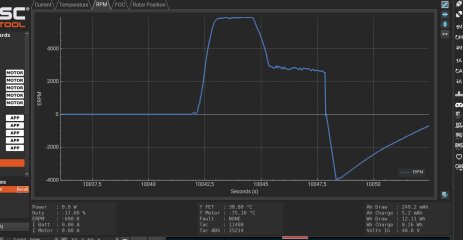
So, the Leaf motor fight the ME1507 motor with 12S battery at 48V, VESC phase amps set at 300A and absolute max current 450A , I started the day with big disappointment.
Only around 3,3 kW (battery) with FW at 0A. Peak rpm at 820 and decreasing at 640 under load.

Test-1.4.JPG

Test-1.3.JPG

Test-1.1.JPG

Test-1.2.JPG

Then, FW at 300A current max, my expectation was high, but despite peak rpm reaching near 1250 rpm, peak power was roughly the same at 3.3 kW.

Test-2.1.JPG

Test-2.2.JPG

To continue...
 
Last edited:
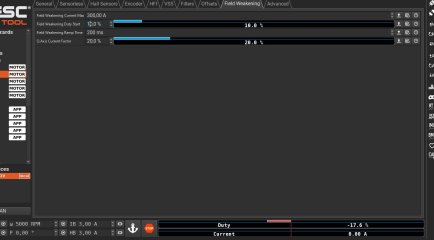
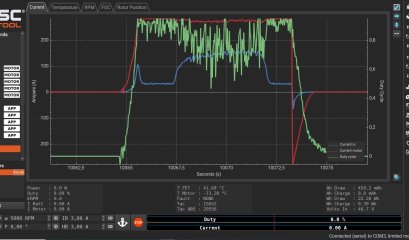
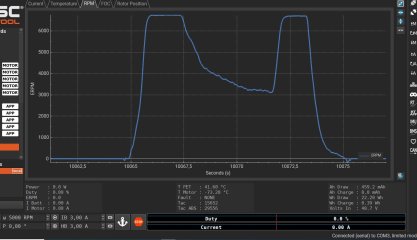
So, I modified some parameters and verify the effects on Leaf motor power or rpm and I find that dropping the Feild weakening duty start to 10% instead of 90% change quit a bit the result.
Peak rpm now at over 1600 and peak power around 7.2 kW at over 800 rpm.
Promising! But now I would like to know why and if there is other parameter to play with to increase power capability of the Leaf motor.

Test-3.1.JPG


Test-3.2.JPG

Test-3.3.JPG
 
I someone know what I can change to increase power in the advanced page of FOC?

Test-4.JPG
 
I now see the ME1507 motor has an internal permanent magnet rotor. I guess this is why it couldn't develop full torque with just shorted phase wires. With surface magnets, you can get a lot more.
Using FOC in the controller gives you the full braking potential.

Sorry I can't help you with VESC programming, but I'm learning by watching you.
 
OK, increase power output of the Leaf was easy.... simply increase phase Amps for the EM1507 motor.
Nothing related to VESC fine tuning as limit was the same (300 phase Amps with FW).
800A on regen motor, so the Leaf output 7.5 kW at 640 rpm. Considering torque constant 0.20 Nm, that 160 Nm.
1000A on regen motor and the Leaf output 8.4 kW at 600 rpm. Considering torque constant 0.20 Nm, that 200 Nm

Kind of nice result considering I test at 48V and plan 60V battery. So, power and rpm should be higher.
Still, I clearly don't understand how rpm can reach 1760 with light load and drop to 600 underload.
 
Last edited:
Still, I clearly don't understand how rpm can reach 1760 with light load and drop to 600 underload.
That is because you have reached the phase current limit.
You need phase amps for torque and field weakening.

So at no load and high field weaken you are already using all the available phase amps the controller can provide so there is no more current left for torque.
In order to respond to a load of the motor shaft at higher rpm you need either more battery voltage so it doesn't need so much field weaken or a controller with much more phase amp capacity.

Sorry if it's hard to understand, I'm not good with explaining the technical stuff.
 
Thanks eee291.
Clear enough for me.
I found it was strange that the rpm changed as I changed the phases Amps. That was why.
 
You may be able to get slightly more by turning off field weakening and turning on MTPA. MTPA will also do field weakening depending on it's setting but instead of just applying whatever current you have set to weakening it will, as the name suggests, apply the current to achieve the Maximum Torque Per Amp. Still though you main limit is voltage, exactly as discussed. All that being said there are some issues with running motors continuously with lots of field weakening even if they were designed to do so as the Leaf more probably was.
 
You may be able to get slightly more by turning off field weakening and turning on MTPA
:love: 😀
Wow! I did the change and everything run so much smoothly.
Less heat, less current for the same job, less drama... everything seem to run better.
Huge thanks for the tips.

More test to come tomorrow as I don't recorded better rpm or power output.
 
Few points:
Dont bother with sensorless on the leaf motor. Its too salient for the algorithm to work well. You can fight it for ages way way beyond the difficulty of during the encoder and get worse results.

Re. Shorting a motors phases, the current initially increases and then reaches a constant given by:
V/Z = i = w*lambda/(j*w*L)

You can see the w terms cancel and therefore the current becomes constant and lagging the voltage by 90 degrees.

This means the torque for given current is very low. This makes sense otherwise... Where does the power go? It's only into the reassurance term which is very very small in this equation (you can rewrite jwL as R+jwL but it doesn't make much difference for any good motor.
 
For the leaf motor you need MTPA. You only need field weakening if it won't go fast enough.
Only use the measured current MTPA algorithm.
 
If you are running sensorless, MTPA stabilises the sensorless algorithm. It's not entirely clear to me why but its very very real... Still nowhere near as reliable as an encoder.
 
For the leaf motor you need MTPA
Thanks for all the good info!
I'm so please to receive good advices and tips from this forum. That help me to go foward and learn a lot.

I've tested MTPA vs FW with the same 300A limit.
MTPA: around 625 rpm, 8.2 kW.
FW: around 650 rpm, 8.6 kW.
 
Back
Top