• Hello ES! We could use some help to get us past the finish line on building the new knowledgebase for the forum.
    Can you donate? Please see our fundraising page. Thank you!

VESC based most power dense controller (INNOTRACE Shrimp for middrive motors)

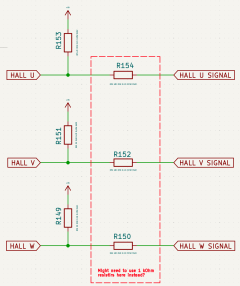
Prepared the rotary encoder. If you want to use the same rotary encoder you need to solder a 1 kOhm 0603 resistor (0402 fits too) to the R3 soldering pads.

1780459831834.png

1780460009092.png

26 AWG silicone wires can be used to connect it with the BRAIN board

1780460110731.png

Since the bottom face of the encoder will lay on the flat face the soldered wires should not stay above the surface

1780460213261.png

1780460284695.png
 
The 3D printed ABS plastic bracket for the encoder has been figured out. We are getting closer guys!


1780624627427.png

You can put a couple layers of 1" wide Kapton tape on the bottom of the encoder PCB to prevent short circuit. The PCB and the bracket parts can be glued together with B-7000 glue

1780624678026.png

You can mount it to the motor case with a couple of M3x0.5 8mm long pan head screws


1780625162532.png


1780625109644.png
 
Crimped the new phase wires (the original Bafang M620 phase wires are very stiff and the terminals on the controller side are not quite suitable).

TE 322447 terminals are for the controller side


Molex 19001-0010 terminals are for the motor side


The phase wires are 12AWG silicone wires

This 6 pieces crimping tool set with different dies should work for both terminals


1780705681482.png

1780706224713.png

1780706267506.png

The Molex terminals fit well to the original Bafang M620 motor terminals

1780706341385.png
 
Last edited:
Please note I specified quite short headers for the BRAIN (insulation 4mm tall) in the KiCAD files so you might need headers with bigger offset depending on the wires, terminals and your cable management.

1780706699922.png

I ordered a bunch of headers with different offsets to check the fitment and for my configuration I am going to use 6mm offset headers to get enough room for the cables


1780706781802.png

1780706901534.png

1780706957103.png
 
Last edited:
Trimmed and crimped the Bafang M620 CANbus motor harness battery wires. For the negative lead I used same TE 322447 terminal as for the phase wires but for the positive lead I used Panduit PM6-3R-L terminal (it suits that place better).


1780715187997.png

1780718951426.png

1780718994601.png

1780720586433.png

The controller is so dense the leads occupy the whole footprint of the controller!


1780720642702.png
 
Last edited:
The 6 mm headers have been soldered to the BRAIN board and the most power dense controller in the world is basically complete!

1780728782459.png

1780728952946.png

1780729023911.png

1780729088210.png

1780729195995.png

1780729243578.png

1780729269580.png

And you can fit it deep inside Bafang M600 with plenty space left no problem

1780730825025.png
 
Last edited:
I just realized I do not have an extra harness and a speed sensor for Bafang M620 CAN to test the controller on the bench. The one I have is already installed on the bicycle. I ordered an extra harness and a speed sensor on AliExpreess, so now we've got to wait.

But the controller did not explode when I connected a battery to it which is a good sign!

1781149239311.png
 
Guys, I know you waited it forever, but the waiting time is over! The Bafang M620 CAN harness and speed sensor have arrived and we are about to find out the truth without further ado!

1782007381932.png
 
Everything has been connected! The excitement is over the top! Do you think it is about to work so we will hit the WORD RECORD!

1782007828779.png
 
Guys, you guess what, we did it again! Unbelievable, it works, from the first try, how is it even possible! The WORLD RECORD is ours! We just built a 32.4 cubic centimeters volume motor controller (that volume includes the 2 large capacitors) with 10kW of power which is unbelievable 0.31 kW/cm^3 of power density!

Until today the world record was held by the 36 kW Silixcon controller with 0.05 kW/cm^3 .

1782011088178.png

The INNOTRACE Shrimp controller is 6 times more power dense over the previous WORLD RECORD! Guys, we just did the history and raised the bar incredibly high!

And here is the video of the first test, enjoy!

 
Last edited:
Guys, you guess what, we did it again! Unbelievable, it works, from the first try, how is it even possible! The WORLD RECORS is ours! We just built a 32.4 cubic centimeters volume motor controller (that volume includes the 2 large capacitors) with 10kW of power which is unbelievable 0.31 kW/cm^3 of power density!

Until today the world record was held by the 36 kW Silixcon controller with 0.05 kW/cm^3 .

View attachment 389752

The INNOTRACE Shrimp controller is 6 times more power dense over the previous WORLD RECORD! Guys, we just did the history and raised the bar incredibly high!

And here is the video of the first test, enjoy!

Will this be adapted to other motors like the tsdz16?
 
Will this be adapted to other motors like the tsdz16?
It can be adapted to any motor it can fit into. You just need to make a mounting bracket, connect the wires and write (or adjust) the code for the PAS sensor if necessary. The firmware for two types of Bafang PAS sensors already exists and connections are known.
 
Last edited:
The Bafang M620 UART torque sensor works with INNOTRACE Shrimp controller! It will be interesting to see how it will act with M620 motor in comparison with M620 CAN torque sensor on the bicycle.


I found a couple mistakes in the torque sensor connections specified in the KiCAD files. I am going to update those things in the next release, but it does not affect the controller Gerber files. If you already started building this controller for M620 motor with UART torque sensor using the current KiCAD files do not solder these two resistors (those are for the CANbus torque sensor configuration only)

1782094966583.png

1782095102213.png

1782095192949.png

And also swap the PAS A and PAS B wires connected to the torque sensor otherwise the PAS will work in reverse

1782095367939.png
 
Last edited:
The INNOTRACE Shrimp controller has been installed in the Bafang M620 motor and the motor has been assembled!

The bottom of the controller needs a not electrically conductive thermal pad. I used a 1mm thick ARCTIC TP-3 thermal pad


The template for thermal pad can be found here


1782198738956.png

1782198580432.png

1782198822680.png

For the Bluetooth antenna I used a 30 cm long MHF1 F to MHF1 M RG1.13 cable. The male connector can be chopped off and 30 mm of the antenna core can be exposed from the shielding on the cable end to work as a Bluetooth antenna


Here is the Bluetooth antenna routing

1782198947297.png

The antenna can be routed outside the motor case through the grommet like explained here


1782199598357.png

1782199758080.png

Be careful attaching the motor halves together and make sure the wires got not pinched


1782199870791.png
 
The rotary encoder from AliExpress works great!


Also had to lift the torque sensor rest voltage threshold from 0.75V to 0.8V and build new firmware file to prevent infinite spinning. 0.75V was too low for the Bafang M620 UART torque sensor.

1782201543790.png


Now we just need to install this bad boy on the bicycle and see what it is capable of!
 
Last edited:
Back
Top