• Hello ES! We could use some help to get us past the finish line on building the new knowledgebase for the forum.
    Can you donate? Please see our fundraising page. Thank you!

Mini Hiryuu v2 - 1.5kw lightest.bike drive on cheap hardtail

In other words, it's a stuff around to use anything other than TLR rims and tires - hard to seat, hard to seal, leak like a sieve, beads come unseated when deflated, and cannot be reseated without a compressor.

TLR rim profiles maintain a tight enough seal from the inner channel, up and over the humps, all the way to the bead channels, such that air does not as escape as you inflate them. In theory, not always in practice.

Strongly advisable to have a compressor on hand for the initial tire seating. But with a good combo, for initial installation you can inflate them with a hand pump, wait one minute, deflate them very slowly (so that the beads remain locked in the rim), remove the valve core, squirt in sealant, replace valve core, then reinflate. Done and dusted in five minutes, and unlucky if more than a few drops of sealant need to be wiped off.

I agree that fat tire tubeless setup is very forgiving. MTB and gravel tires are easy enough to get on any rim, any old tape will just about do, and sealant eventually gets the job done if you reinflate and rotate the tire every day for a week.

Fifteen years ago that was par for the course. Nowadays, with the plethora of TLR options, I don't see why anyone wouldn't avail themselves of it.

And road tubeless is a different ball game. Narrower the tire and rim, the more difficult everything gets. Any tire below 32mm I think tubeless is not worth the trouble - too high a risk that the tire and rim you choose do not mate well together. Maybe acceptable if you have enough spare time and money to keep trying new tires until you find a suitable one.
 
Some great thoughts here.

I do notice that on another rim that i have stans rim tape on ( for no good reason ), and a regular tire and tube..
When i deflate the tube, i must use some serious force to get the tire off the rim. Like it's locked on. So i ma be having an unintentional tubeless experience already.

Kenda tires typically come warped, especially if you order them around the summer. So yeah, the gradual improvement of the tire to rim lock makes sense.

I think i might want to convert the thinner tire up front to tubeless for the rolling resistance reduction.
So far, i don't like anything about sealants. But it may work OK.

TPU tubes are lightweight and pack super small but have horrible puncture resistance. I would consider them only as a backup for if/when your tubeless tyre loses seal when out. That's the main reason why i recommend going TL to everyone - the worst case scenario is just putting the tube in. And as long as you don't put absurd amounts of sealant, you can just wipe the minuscule amount left with a tissue.

Ah, in my case, the rear tire is doing an amazing job flinging off what punctures my tire very frequently. I don't even find fragments of goatheads on them, just like with my car tires. On every other tire, i am at least finding fragments stuck in.

I believe the key to this is a combination of harder rubber vs a regular tire and having an additional 1mm taller than the best "puncture proof" Schwalbe ( they must not suffer the wrath of tribulus terrestris across the pond if they think this is puncture proof ).

So i don't rely on a 0.5-1mm tube to perform any puncture protection.

That being said would there be any other downsides of TPU tubes to consider?
I know some TPU tubes have crappy stem to tube interfaces.. i would buy nicer ones so that i shouldn't have to worry about this.
 
Rolling resistance gains derive from carcass flexibility, so you're reliant on sealant, because you will suffer more punctures due to necessarily thinner sidewalls and puncture resistance belt. You only get to have cake and eat it if the sealant does it's job, so you'll have to learn to like it.

There's no guarantee it'll seal goathead punctures well. You'd want to determine that before committing to tubeless.
 
I'm okay with carrying a pair of TPU tubes for the rear, in the case that scrap metal objects penetrate it, which is ~0.5% of my punctures. The rear is most likely to get game over'd, and sealant isn't going to help me.

Last time i had a screw puncture my rear tire with sealant in it, it was both a walk of shame and visit to the bathtub to clean the mess out.. The cleanup is worse than a tube popping.

I've had fairly good luck with sealant in a tube versus goatheads with a relatively weak tire. So i imagine if the front has tubeless + sealant, it could work. Never had a metal object penetrate a front tire, so the risk of mess is low.

This being said, what TPU tubes are good these days? I already have a bottle of stans for the front. :)
 
Can't help with tube recommendations ... except to not use them? Proper mess with tube + sealant.

Carrying an emergency tube is sensible, because if the bead becomes unseated there's no guarantee you'll be able to reseat a tubeless tire on the roadside. (A CO2 inflator might make it easier. Can't say for sure, I bought one years ago but don't carry it and never tried it.)

If you carry tubeless plugs and additional sealant you shouldn't need the tube very often (assuming a setup where the tire bead remains seated while deflated.)

(A device I think ought to exist is an aluminium bidon with valve and hose. Got a puncture? Tip the water out, pressurise it with a hand pump, connect to tire valve stem, and open valve to rapidly eject its contents into tire, hopefully seating the tire bead in the process. Likely is already such a product, but would also be easy to DIY.)
 
There is a dynaplug air tool that combines a tire plug tool and CO2 injector so you can do both things at once that way. Have to remove the CO2 when you get home, though, to not harm the sealant. During initial tubeless setup you can just pour sealant in the tire bottom before putting it on the rim.

For tubes, TPUs pop way too easy compared to butyl in my experience. Even after I upgraded from the plastic stem ones to metal. There's just no point to them when we have a motor to assist us anyway. Yeah, butyl tubes are huge, but no one steals them anyway, so you can just strap spares to a frame tube somewhere.

Glad I upgraded to tubeless and an insert so I never have to deal with either anymore anyway, though. I don't think tubeless works at high pressure, though, since the sealant won't seal, though.
 
I don't think tubeless works at high pressure, though, since the sealant won't seal, though.
If the pressure is too high for the sealant, you should, in theory, only have to wait a bit until it drops, seals, and then re-pump the tyre again :)
any other downsides of TPU tubes to consider?
I've only heard bad things about them. Supposedly they are very easy to damage not just from a puncture but from any other means that can get a tubed tyre flat - rubbing, pinching etc. In the offroad motorcycle world, thicker tubes are generally considered better in that regard - but even there, where we can fit a 4mm-thick tube (which is probably a lot thicker than a lot of bicycle tyres lol), everyone is trying to get rid of them.

Unfortunately for tubeless, motorcycles having larger tyres have to run lower pressures - I run 0.5bar in the rear right now (TL with Tubliss), and 0.2-0.3 isn't uncommon. At such low values, there's barely any pressure holding the tyre to the rim, and so any high-speed side impact can deflate the tyre. There's been horror stories and other nonsense about WM vs WT type rims, but there's some truth to it. I was very confused at first when I learned that MTBs use TL tyres to get lower pressure and avoid pinch flats that way - but that makes way more sense when you realize that 1.5bar is on the lower end of spectrum there.

Again, you seem to be sitting in the goldilocks pressure zone - high enough to not cause any bead instability, low enough to not run into issues common with narrow road tyres.

(P.S. I asked about the experimental tyre I mentioned earlier in the thread - the owner reported running 1.3 right now with no issues)

I fully admit I could be wrong about all of the above and I'm not a tyre expert, but so far everything seems to confirm my theory.
 
I'll be running 40-45PSI in my front tire. I imagine sealants are still working at that pressure.
On the rear i'm running 70 PSI.

Yeah i hear that handling a TPU tube is fraught with potential error. I'm thinking if you successfully get it in, all you need to really worry about is it slipping. I think slipping might be unlikely on a 70psi rear tire.

Hope my min/maxing works out and we don't have a bad time 😂
 
So i have a couple bucks to spend.
Currently in the ring for motor consideration:

1783978592124.png
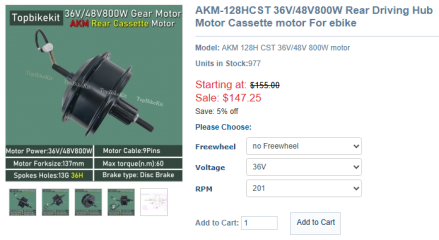
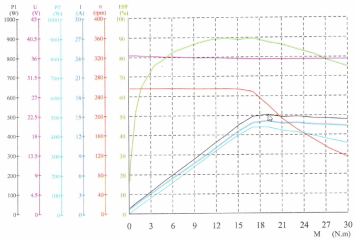
2.82kg or 6.2lbs and 800w rated... traditional gears... maybe 80% peak efficiency if the Q128H graph is to be believed

1783978702623.png

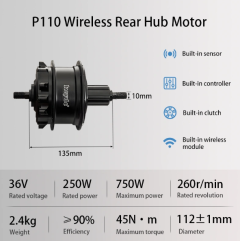
2.4kg or 5.3lbs, roller gears, very high efficiency and >500w rated if the p100 efficiency graph is to be believed.

1783979535163.png

The old Q128H graph from 2013 shows 79% efficiency peak, but it's from 2013. I imagine this was due to 0.5mm laminations being used at the time. I asked two sellers of it about lamination thickness is 0.35mm yet. this factor will break the tie.

I'm a little worried about the durability of a roller drive setup, especially since i want to run higher than 36v on either motor.

I think if i find out they're still putting 0.5mm lams in the Aikema, i'll risk it on the Keyde.
 
I've seen negative reviews for the Keyde motors here, but positive on other forums. I think they have a thru-axle variant that lures people in.

Personally, I want to try this Truckrun motor with a built-in torque sensor just to see if they can really make one less than half the cost of the Grin All Axle:

Kind of annoying it's only 250 watts, though, when the same company also makes 1500 watt motors:
 
Yeah, it's tough to swap controllers on torque sensor motors, though. Too bad Grin doesn't sell the daughter board that converts the signal they use.
 
That "≥ 90% Efficiency" assertion seems very attractive! Is that achievable?
 
Yes, with something thinner than 0.35mm lams and roller drive ( way less friction - which is usually quite bad in dual reduction hubs )

RC motors regularly achieve this and this motor easily operates in the thousands of RPMs, so it's feasible!
 
Overheating report for the Keyde:

Although if you remove the built-in controller and add Statorade like Grin used to revamp Bionx motors maybe you'd be OK.

Re bottom bracket sensors, I'd always just use a PAS wheel at that point. Less trouble, no drilling.
 
Last edited:
Overheating on a climb with a 12% grade section on stock power isn't surprising.
Even if very efficient, it will still bog down on climbs.
I'm expecting that efficiency to come into place mostly on the flats.
 
Got a sweet treat from topebikekit in my inbox today..

1784132569020.png

An extra 5% efficiency is pretty nice. These are signs of a 0.35mm lamination upgrade.
It should take added voltage well.

I believe someone's fibbing about it being a 800w rated motor though. Probably more like 500-600w.
Which is in the ballpark of my estimate for the keyde p110.
Maximum torque is impressive, but not a surprise since we're talking about a dual reduction geared hub motor.

I expect the characteristics to be similar to keyde on hills. No matter how high efficiency your motor is, the increase in load outstrips any eddy current loss reductions from using the thinnest of lams.

I'm still tempted towards the keyde for the better efficiency and -0.9lbs weight, but i think reliability is more important, so i think the Q128HCST is a win for me.
 
Besides these two motors, why don't you consider the Bafang G310?
In your opinion, what are the downsides?
Thanx.
 
Noticed a few things about the keyde.
- doesn't seem to have axle flats, so it's a bad motor to push the amps on
- probably a bad idea to crank the phase amps up with this roller drive too
- it's ~13:1 versus the h128's ~11:1, so it may make more torque... but we have the no axle flat and roller drive weakness getting in the way of actually utilizing that power.
- 260rpm on 36v means it would not like running on 52v ( too fast on a 700c wheel ), the 220rpm on 48v with the H128 is better


Besides these two motors, why don't you consider the Bafang G310?
In your opinion, what are the downsides?
Thanx.

That's a perfectly good motor. The problem is the RPM is too high ( relative to the motor's power ) for a 52v battery.
 
It's nice one of those threads had an unlock code for 250W to 750W, though. Indicates the motor/controller is overbuilt a bit and just software locked to lower power for the European market.
 
Well, that's interesting to see what their hot tune looks like.
Do you remember where you found this code?

The one thing i have a hard time getting over is the threaded interface for this motor though. Just doesn't seem right to depend on the bolt to hold the torque. I guess it's less unusual for a freewheel-having motor.

I'm strongly considering getting some NESE modules and going manual balance. With that, i could build an arbitrary voltage battery and experiment with 11-13S on that motor. No worries if i blow the controller.

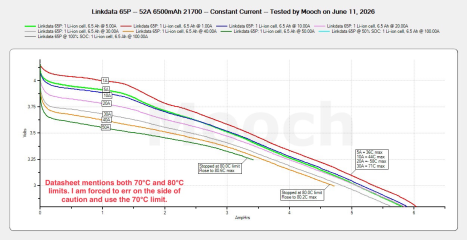
Linkdata 65P's seem like the thing to run with a 2P configuration.

1784782401684.png
 
I've been agonizing over the choice and noticed something after massively zooming in on one pic:
The P110 does actually have axle flats!

1786165249772.png

I'm concerned that the rollers will not be adequately durable on the rear wheel. Especially with this 250lbs person on it.

The front wheel is going to have at least 25% less weight on it vs the rear wheel, so that seems like a sane place to use this motor.
The front p110 is 2.3kg or 5lbs and the front p100 is 1.7kg or 3.75lbs. Once we account for the fact that we're displacing a ~200g hub, we get down to 1.5kg or 3.3lbs added. Possibly removing the controller yields a win, too.

Since i can get the Keyde with a 32h hub drilling, i can combine this with a lightweight rim and help offset the weight further.

It's possible the P100 suddenly turns into a 500w rated, 575w peak motor with the stock controller on 12S and does a bit over 20mph. Less power than i want, but improveable enough with a VESC and flux weakening to bump the max speed up to 25 periodically.

Before i buy a motor, the first order of business is to buy the NESE modules. With those and Linkdata 65's, i can build a 4lbs 12AH 13s battery that reduces my battery weight by 8lbs and is suitable for the target low power setup; this gets it to the 'carryable up 3 flights of narrow stairs' mark.

I can sweat the 4.7lbs motor weight cut later!
 
Last edited:
Even if it came with non-flattened axles I wouldn't consider that a deal breaker, because you could easily grind them yourself - no special equipment required, just nerves, patience, firm grip, and angle grinder.

The Keyde are so tempting. I'm selfishly hoping you go that route, because I've been eying them off since they hit the market. They've been around a long while, enough that I'd consider it mature tech, just that there doesn't seem to be any exploded parts diagrams or users who've stripped them down, which makes it a harder purchase decision.

Regarding 32h drilling, they mightn't be keen to do a one-off, but perhaps willing to supply undrilled. Again, an easy thing to do yourself, drilling aluminium hub flanges is a piece of cake.

Alternatively, for a front wheel, you can just use a 24h rim and skip every third hub hole. Hub motor flanges are thick and deep enough to withstand the higher spoke tension with 24 spokes. With a quality rim and good building techniques 24 spokes suffices.

Skipping every third hole has negligible effect on spoke length, you can ignore the effect in calculations. (That presumes a crossed pattern - I wouldn't recommend radial pattern for a hub motor, although crow's foot is probably ok, and much prettier than radial in any case).

In the scheme of things, little weight savings via reduced spoke count, but it does open up a range of nice rim options. That said, DT Swiss offer a couple of nice 36h rims e.g. HX 531. Alex likely has some more economical options, but unlikely with welded joins, which is a big part of what you're paying for in a quality rim.

If you're building a new wheel in 2026, a tubeless ready rim is sensible, almost mandatory I'd say. You can run a tube and use your existing tires til they're worn out, then consider tubeless for the replacement set. Or not, but at least you'll have more options and be future-proofed.
 
Back
Top